
How Poor Infrastructure Amplifies Minor Data Issues
Minor data flaws shouldn’t break outbound—but weak email infrastructure makes them fatal. Learn how poor setup magnifies small data issues into deliverability and reputation problems.
INDUSTRY INSIGHTSLEAD QUALITY & DATA ACCURACYOUTBOUND STRATEGYB2B DATA STRATEGY
CapLeads Team
2/10/20263 min read
A single bad data point shouldn’t be able to derail an entire outbound system.
But when infrastructure is weak, even small imperfections can cascade into serious deliverability and reputation problems—often faster than teams expect.
This is why many outbound teams misdiagnose failures. They look at the data, see only minor issues, and assume the impact should be limited. In reality, it’s not the data alone that determines the outcome. It’s how the infrastructure reacts to it.
Minor data issues are inevitable
No dataset is perfect. Even well-maintained lead lists can contain edge cases—slightly outdated records, role transitions not yet reflected, or domains that recently changed behavior. On their own, these issues are usually manageable.
In a healthy system, small data flaws are absorbed. Validation layers catch them, sending limits prevent sudden spikes, and infrastructure buffers reduce risk. The problem arises when these safeguards don’t exist—or aren’t properly configured.
That’s when “minor” stops being minor.
Infrastructure determines blast radius
Email infrastructure acts like a multiplier. The same data issue can produce very different outcomes depending on how the system is built.
When domains lack proper authentication, routing is brittle, or sending pools are poorly segmented, small inconsistencies become amplified. A handful of risky contacts can suddenly affect entire send volumes. Soft bounces turn into hard bounces. Temporary delivery issues start influencing long-term reputation signals.
What should have been a contained problem becomes systemic.
Weak architecture exposes hidden dependencies
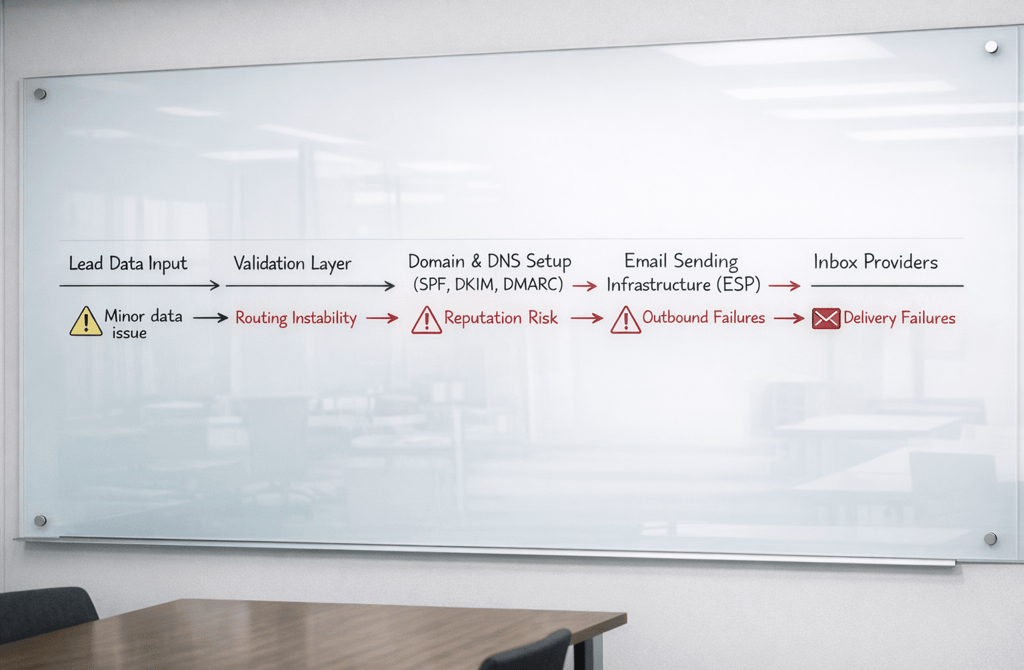
Outbound systems are not linear. Each layer—data intake, validation, DNS configuration, sending logic, and inbox provider interpretation—is interconnected.
Poor infrastructure increases dependency sensitivity. For example:
A missing or misaligned authentication record can cause inbox providers to scrutinize every message more aggressively.
Inconsistent routing can make bounce patterns appear worse than the underlying data actually is.
Shared domains or IPs allow small data errors to affect unrelated campaigns.
These dependencies are often invisible until something breaks. Teams then assume the data “suddenly went bad,” when in reality the system simply couldn’t tolerate normal variance.
Why infrastructure failures feel like data failures
One of the most dangerous aspects of poor infrastructure is misattribution. When performance drops, teams often blame lead quality because it’s the most visible input.
Infrastructure problems operate quietly. Domain reputation degrades gradually. Inbox placement shifts subtly. Sending limits tighten without clear alerts. By the time results are obvious, the root cause is buried under downstream symptoms.
This leads to reactive fixes—replacing lists, tweaking copy, changing tools—without addressing the structural issue that allowed a small data flaw to cause outsized damage.
Strong systems degrade gracefully
Well-designed infrastructure doesn’t eliminate data issues. It limits their impact.
Graceful degradation means:
Validation layers stop risky contacts before sending.
Authentication and routing consistency prevent isolated issues from spreading.
Volume controls and segmentation localize damage instead of globalizing it.
Reputation signals remain stable even when edge cases slip through.
In these systems, data quality still matters—but it’s not carrying the entire burden alone.
Why this matters as teams scale
As outbound volume increases, tolerance for fragility decreases. What worked at low send volumes often fails under scale—not because the data suddenly worsened, but because infrastructure weaknesses are exposed.
Scaling outbound without strengthening architecture is effectively increasing leverage on your weakest point. Minor data issues don’t just persist; they compound.
Teams that scale successfully treat infrastructure as a first-order system, not an afterthought. They assume data imperfections will exist and design around them.
What this means
Outbound reliability is not just about having clean data. It’s about building systems that don’t collapse when data isn’t perfect.
When infrastructure is fragile, small data issues behave like major failures. When infrastructure is sound, those same issues become manageable noise rather than existential risk.
The difference isn’t luck or list quality alone—it’s whether the system is built to absorb reality instead of amplifying it.
Related Post:
How Better Data Completeness Improves Email Relevance
The Subtle Signals Automation Fails to Interpret
Why Human Oversight Is Essential for Accurate B2B Data
How Automated Tools Miss High-Risk Email Patterns
The Quality Gap Between Algorithmic and Human Validation
Why Human Validators Still Outperform AI for Lead Safety
The Duplicate Detection Rules Every Founder Should Use
How Spam-Trap Hits Destroy Domain Reputation Instantly
Why High-Risk Emails Slip Through Cheap Validation Tools
The Real Reason Duplicate Leads Hurt Personalization Accuracy
How Risky Email Patterns Reveal Broken Data Providers
How Industry Structure Influences Email Risk Levels
Why Certain Sectors Experience Faster Data Decay Cycles
The Hidden Validation Gaps Inside Niche Industry Lists
How Industry Turnover Impacts Lead Freshness
Why Validation Complexity Increases in Specialized Markets
How Revenue Misclassification Creates Fake ICP Matches
Why Geo Inaccuracies Lower Your Reply Rate
The Size Signals That Predict Whether an Account Is Worth Targeting
How Bad Location Data Breaks Personalization Attempts
Why Company Growth Rates Matter for Accurate Targeting
Why Testing B2B Lead Data Matters Before You Buy
How Department Shifts Impact Your Cold Email Results
Why Title Ambiguity Creates Hidden Pipeline Waste
The Hidden Problems Caused by Outdated Job Roles
Connect
Get verified leads that drive real results for your business today.
www.capleads.org
© 2025. All rights reserved.
Serving clients worldwide.
CapLeads provides verified B2B datasets with accurate contacts and direct phone numbers. Our data helps startups and sales teams reach C-level executives in FinTech, SaaS, Consulting, and other industries.