
The Real Reason Duplicate Leads Hurt Personalization Accuracy
Duplicate leads quietly break personalization by repeating messages, confusing context, and training prospects to ignore you before conversations even start.
INDUSTRY INSIGHTSLEAD QUALITY & DATA ACCURACYOUTBOUND STRATEGYB2B DATA STRATEGY
CapLeads Team
2/4/20263 min read
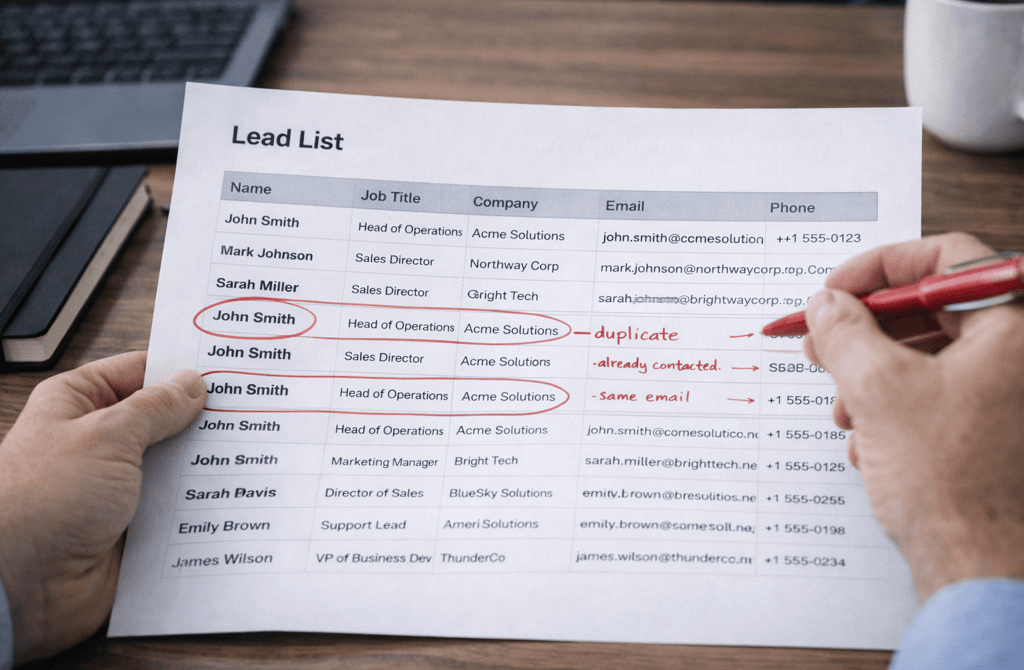
Personalization doesn’t fail loudly.
It fails quietly—through small inconsistencies that compound across a campaign until prospects stop taking your outreach seriously.
Duplicate leads are one of the fastest ways this happens, not because they inflate volume, but because they corrupt context. Once context is broken, personalization becomes noise instead of relevance.
Duplication breaks the “single conversation” illusion
Good personalization relies on a simple assumption:
each recipient experiences your outreach as a single, coherent interaction.
Duplicate leads shatter that assumption.
When the same contact appears multiple times across lists, segments, or sequences, they don’t see “personalized messaging.” They see repetition—sometimes subtle, sometimes obvious. Even when the wording changes slightly, the intent feels recycled.
From the sender’s side, each message looks unique.
From the recipient’s side, it feels careless.
That gap is where personalization accuracy collapses.
Why duplicates create conflicting personalization signals
Modern outreach systems depend on data consistency. Names, titles, companies, and behavioral history all feed into how messages are generated, sequenced, and adjusted.
Duplicate records introduce contradictions.
One record might show a prospect as a Head of Operations. Another lists them as Director of Logistics. A third has an outdated company name. Each version triggers a different personalization angle, even though the recipient is the same person.
The result isn’t tailored outreach—it’s mixed messaging. Prospects receive emails that don’t align with each other, and the personalization feels off rather than thoughtful.
Repetition trains prospects to ignore you
Personalization is supposed to signal effort.
Duplicates do the opposite.
When prospects receive multiple variations of essentially the same outreach, they learn a pattern quickly: the sender doesn’t actually know who they’re talking to. Once that conclusion forms, personalization loses credibility.
At that point, even well-written messages stop working—not because the copy is weak, but because trust has already been eroded.
This is especially damaging in early-stage outreach, where first impressions do most of the work.
Duplicates distort engagement feedback
Another hidden cost of duplicate leads is inaccurate feedback.
If the same contact opens one email but ignores the next, your analytics don’t show confusion—they show inconsistency. Teams interpret this as a copy or timing problem and start adjusting the wrong variables.
Replies get attributed to the “better” message.
Silence gets blamed on the “worse” one.
In reality, the prospect is reacting to duplication, not messaging quality.
This false feedback loop makes personalization optimization almost impossible. You end up refining tactics based on polluted data.
Why personalization tools amplify the damage
Automation makes duplicates more dangerous, not less.
Personalization engines assume each record represents a unique individual. When duplicates exist, tools confidently personalize multiple messages for the same person—often with different angles, tones, or value propositions.
Instead of one thoughtful message, the prospect receives several partially personalized ones that don’t agree with each other.
What was meant to feel human starts to feel mechanical.
The downstream impact on deliverability and reputation
While duplicate leads are often discussed as a list hygiene issue, their impact extends beyond personalization.
Repeated sends to the same inbox—especially without engagement—create negative signals. Inbox providers interpret this as low recipient interest or poor targeting. Over time, this affects placement, not just replies.
What looks like a personalization issue slowly turns into a deliverability issue.
And once inbox trust declines, even perfectly personalized emails struggle to land where they should.
Why deduplication has to happen before messaging decisions
Many teams try to “fix” duplication at the campaign level—by suppressing replies, excluding recent sends, or adjusting sequences mid-flight.
By then, the damage is already done.
Deduplication isn’t a campaign tactic. It’s a data prerequisite. If records aren’t unified before personalization logic runs, every downstream decision is compromised.
Clean personalization depends on clean identity resolution. Without that foundation, accuracy becomes guesswork.
Bottom Line
Duplicate leads don’t just waste volume—they fracture the story you’re telling each prospect.
When a single person receives conflicting messages, personalization stops feeling intentional and starts feeling automated. Context breaks, trust erodes, and engagement drops for reasons that are hard to diagnose after the fact.
Related Post:
The Difference Between Syntax Checks and Real Verification
The Bounce Threshold That Signals a System-Level Problem
How Email Infrastructure Breaks When You Use Aged Lists
The Real Reason Bounce Spikes Destroy Send Reputation
Why High-Bounce Industries Need Stricter Data Filters
How Bounce Risk Changes Based on Lead Source Quality
The Drift Timeline That Shows When Lead Lists Lose Accuracy
How Decay Turns High-Quality Leads Into Wasted Volume
Why Job-Role Drift Makes Personalization Completely Wrong
The ICP Errors Caused by Data That Aged in the Background
How Lead Aging Creates False Confidence in Your Pipeline
The Data Gaps That Cause Personalization to Miss the Mark
How Missing Titles and Departments Distort Your ICP Fit
Why Incomplete Firmographic Data Leads to Wrong-Account Targeting
The Enrichment Signals That Predict Stronger Reply Rates
How Better Data Completeness Improves Email Relevance
The Subtle Signals Automation Fails to Interpret
Why Human Oversight Is Essential for Accurate B2B Data
How Automated Tools Miss High-Risk Email Patterns
The Quality Gap Between Algorithmic and Human Validation
Why Human Validators Still Outperform AI for Lead Safety
The Duplicate Detection Rules Every Founder Should Use
How Spam-Trap Hits Destroy Domain Reputation Instantly
Why High-Risk Emails Slip Through Cheap Validation Tools
Connect
Get verified leads that drive real results for your business today.
www.capleads.org
© 2025. All rights reserved.
Serving clients worldwide.
CapLeads provides verified B2B datasets with accurate contacts and direct phone numbers. Our data helps startups and sales teams reach C-level executives in FinTech, SaaS, Consulting, and other industries.