
How Spam-Trap Hits Destroy Domain Reputation Instantly
Spam-trap hits don’t cause gradual damage—they trigger immediate trust loss. Learn how a single trap can collapse domain reputation and inbox placement.
INDUSTRY INSIGHTSLEAD QUALITY & DATA ACCURACYOUTBOUND STRATEGYB2B DATA STRATEGY
CapLeads Team
2/4/20263 min read
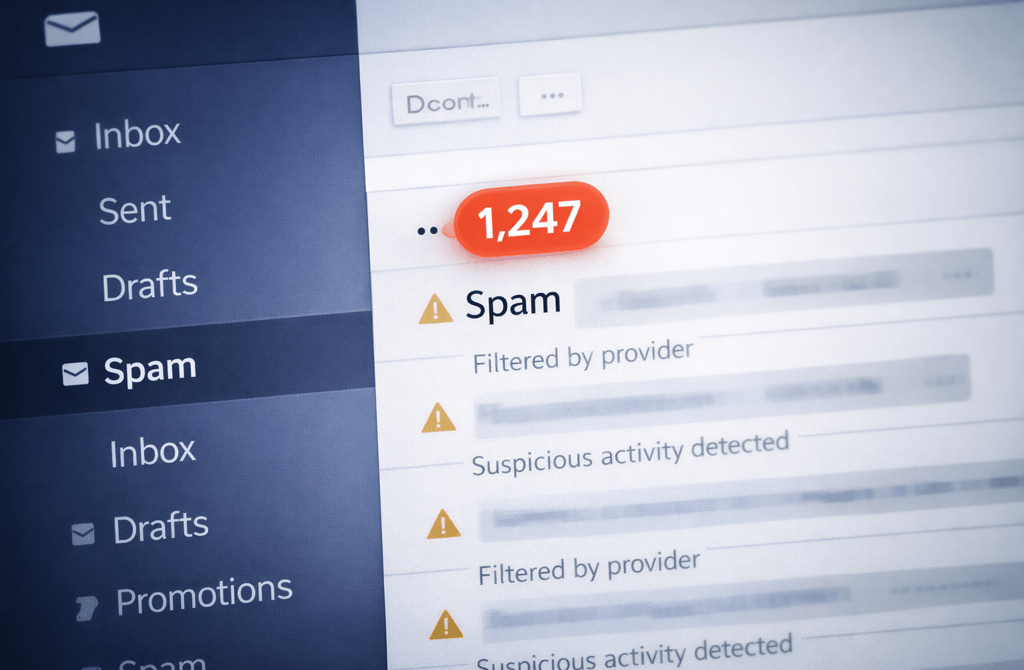
Spam-trap damage rarely shows up where founders expect to see it.
There’s no spike in hard bounces. No dramatic error message. No clear warning from your sending tool. In many cases, the campaign looks normal on the surface—emails send, dashboards update, workflows continue running.
The damage happens elsewhere, inside reputation systems you never get to see.
Spam traps don’t behave like bad leads
A spam trap isn’t just an invalid address. It’s a deliberately monitored endpoint designed to measure sender behavior, not message quality.
Inbox providers use traps to answer one question:
Does this sender know who they’re emailing?
When a spam trap is hit, the system doesn’t wait for confirmation through volume or trends. The signal is already strong enough. Careful senders don’t reach traps by accident.
That’s why the response is immediate.
Reputation systems react before metrics change
Domain reputation isn’t adjusted after campaigns fail—it’s adjusted before they do.
Once a spam trap is triggered, inbox providers quietly reclassify future messages from that domain. Delivery paths change. Filters tighten. Engagement signals are deprioritized. Messages that would have reached the primary inbox are rerouted or suppressed altogether.
From the sender’s side, it feels like interest vanished. In reality, visibility did.
Why spam-trap damage feels invisible
Spam-trap penalties don’t break delivery outright. They degrade it selectively.
Some recipients still see your emails. Others never do. This partial delivery creates misleading feedback loops. A few replies trickle in, convincing founders the campaign is “working,” while the majority of prospects never get the chance to respond.
This is why spam-trap damage is often misread as a targeting or messaging problem. The system failure is upstream, but the symptoms appear downstream.
Scale turns a single trap into a lasting problem
One spam-trap hit is bad. Repeated confirmation is worse.
When lists are reused, merged, or recycled without strict hygiene, the same trap can be triggered multiple times across campaigns. Each hit reinforces the same conclusion: the sender’s data practices are unsafe.
At that point, reputation loss compounds. Recovery becomes slow, unpredictable, and sometimes impossible without abandoning the domain entirely.
Why fixes applied after the hit rarely work
Founders often respond by adjusting infrastructure—warming new inboxes, slowing send rates, or changing tools. These actions can reduce surface-level issues, but they don’t erase the signal already logged.
Spam traps are treated as evidence, not anomalies.
Until the underlying data sourcing and preparation problems are resolved, the risk remains embedded in every send—no matter how careful the execution looks.
Bottom Line
Spam traps don’t punish aggressive sending.
They punish careless data.
Inbox providers don’t need weeks of observation to lose trust in a domain. One confirmed signal is enough to downgrade how every future email is treated.
Outbound remains stable only when the data feeding it is consistently controlled and reviewed.
Once spam traps enter the system, reputation stops being something you manage—and starts being something you recover, slowly and uncertainly.
Related Post:
The Difference Between Syntax Checks and Real Verification
The Bounce Threshold That Signals a System-Level Problem
How Email Infrastructure Breaks When You Use Aged Lists
The Real Reason Bounce Spikes Destroy Send Reputation
Why High-Bounce Industries Need Stricter Data Filters
How Bounce Risk Changes Based on Lead Source Quality
The Drift Timeline That Shows When Lead Lists Lose Accuracy
How Decay Turns High-Quality Leads Into Wasted Volume
Why Job-Role Drift Makes Personalization Completely Wrong
The ICP Errors Caused by Data That Aged in the Background
How Lead Aging Creates False Confidence in Your Pipeline
The Data Gaps That Cause Personalization to Miss the Mark
How Missing Titles and Departments Distort Your ICP Fit
Why Incomplete Firmographic Data Leads to Wrong-Account Targeting
The Enrichment Signals That Predict Stronger Reply Rates
How Better Data Completeness Improves Email Relevance
The Subtle Signals Automation Fails to Interpret
Why Human Oversight Is Essential for Accurate B2B Data
How Automated Tools Miss High-Risk Email Patterns
The Quality Gap Between Algorithmic and Human Validation
Why Human Validators Still Outperform AI for Lead Safety
The Duplicate Detection Rules Every Founder Should Use
Connect
Get verified leads that drive real results for your business today.
www.capleads.org
© 2025. All rights reserved.
Serving clients worldwide.
CapLeads provides verified B2B datasets with accurate contacts and direct phone numbers. Our data helps startups and sales teams reach C-level executives in FinTech, SaaS, Consulting, and other industries.