
Why High-Risk Emails Slip Through Cheap Validation Tools
Cheap validation tools catch obvious errors but miss risky emails that damage deliverability. Here’s why high-risk contacts pass checks and cause problems later.
INDUSTRY INSIGHTSLEAD QUALITY & DATA ACCURACYOUTBOUND STRATEGYB2B DATA STRATEGY
CapLeads Team
2/4/20263 min read
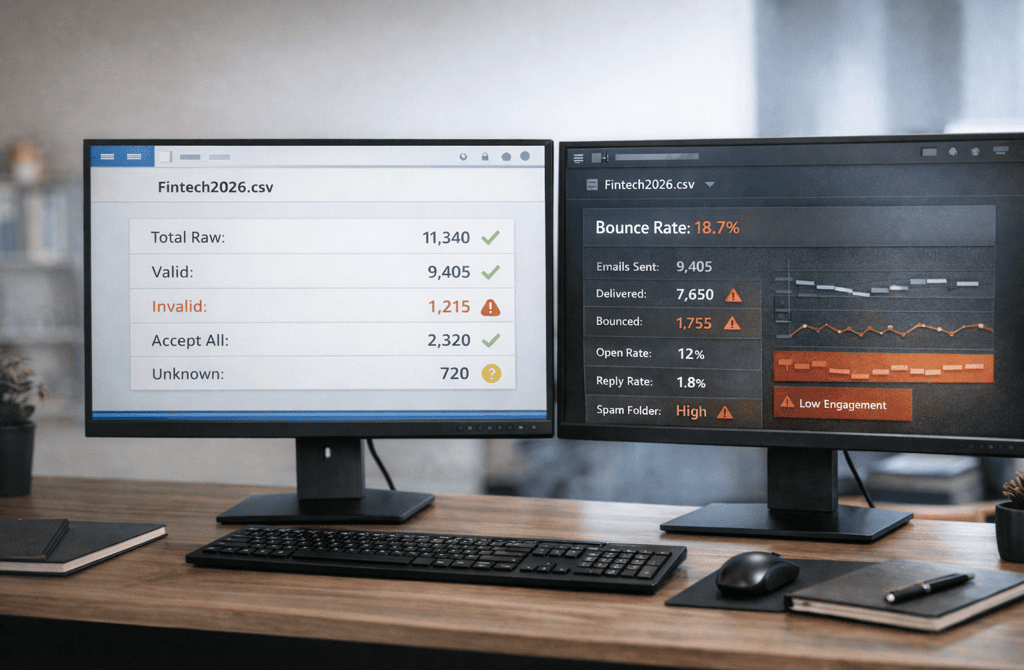
A clean validation report feels like closure.
Green numbers, low invalid counts, and a neat “ready to send” summary create the sense that a decision has already been made for you.
In reality, validation doesn’t end the risk conversation — it often hides it.
The most damaging email problems don’t show up as errors. They show up later, inside inbox algorithms, reputation models, and silent filtering systems that validation tools never see.
Validation Solves Existence, Not Exposure
Email validation answers one narrow question:
Does this address technically exist at the moment it’s checked?
Outbound exposure is a different problem entirely.
Inbox providers don’t judge emails by whether they exist.
They judge them by whether they belong.
That gap — between existence and belonging — is where high-risk emails quietly pass through.
Why “Valid” Is an Incomplete Signal
Cheap or surface-level validation tools are optimized for speed and coverage. They rely heavily on SMTP responses, domain behavior, and short-term mailbox signals.
That approach misses context.
An email can pass validation while still carrying hidden risk:
It accepts mail but routes it through aggressive filtering
It belongs to a role inbox with poor engagement history
It exists on a domain that quietly suppresses unfamiliar senders
It hasn’t bounced yet — but hasn’t engaged in months or years
None of those conditions trigger a validation failure.
All of them trigger reputation scrutiny once you send.
Where High-Risk Emails Actually Come From
High-risk emails don’t come from obvious junk sources.
They usually come from borderline-safe categories that look reasonable on paper.
Accept-All Domains Create Deferred Risk
Accept-all results feel reassuring because nothing hard-fails.
But accept-all servers don’t verify recipients upfront. They decide after delivery — which means inbox providers get to evaluate sender behavior before the mailbox does.
That delay is enough to generate negative signals without ever producing a bounce.
Role-Based Addresses Pass Technical Checks
Addresses like sales@, info@, or admin@ often validate cleanly.
Inbox systems treat them differently:
Lower tolerance for unsolicited messages
Faster escalation of negative engagement
Higher likelihood of silent filtering
Validation tools don’t downgrade them. Spam filters do.
Dormant Mailboxes Stay “Valid” for Years
An inbox can exist long after a role changes or a team dissolves.
It won’t bounce.
It won’t reply.
It will quietly record non-engagement.
From a validator’s perspective, that’s a success.
From a sender-reputation perspective, it’s cumulative damage.
Why Campaign Analytics Tell the Truth Validation Can’t
This is why validation dashboards and campaign dashboards often disagree.
Validation reports:
Clean lists
High deliverability percentages
Low apparent risk
Campaign analytics reveal:
Rising bounce clusters
Declining inbox placement
Flat reply curves despite volume
The contradiction isn’t a mystery.
Validation evaluates inputs.
Inbox systems evaluate behavior over time.
Cheap tools stop before behavior begins.
The False Safety of Re-Validation
Re-validating the same list doesn’t remove this risk.
Running another checker doesn’t surface it.
Switching tools doesn’t eliminate it.
If the underlying data selection is flawed, repeated validation only reinforces false confidence.
Risk isn’t reduced by checking harder — it’s reduced by filtering differently.
What Actually Prevents These Failures
High-performing outbound teams don’t treat validation as approval. They treat it as one gate in a longer decision chain.
That means:
Treating accept-all emails as conditional, not greenlit
Segmenting role-based inboxes intentionally
Limiting unknowns instead of batching them into sends
Evaluating lists for send-safety, not just technical validity
The goal isn’t fewer invalid emails.
It’s fewer reputation penalties.
What This Means
Outbound becomes stable when data decisions are based on downstream impact, not surface-level cleanliness.
Validation is necessary — but it’s never sufficient.
When lead data is screened for risk before it’s screened for existence, campaigns stop decaying unexpectedly.
When it isn’t, inbox providers do the screening for you — silently, and permanently.
That difference is why some outbound systems compound results over time, while others reset every few months without ever understanding why.
Related Post:
The Difference Between Syntax Checks and Real Verification
The Bounce Threshold That Signals a System-Level Problem
How Email Infrastructure Breaks When You Use Aged Lists
The Real Reason Bounce Spikes Destroy Send Reputation
Why High-Bounce Industries Need Stricter Data Filters
How Bounce Risk Changes Based on Lead Source Quality
The Drift Timeline That Shows When Lead Lists Lose Accuracy
How Decay Turns High-Quality Leads Into Wasted Volume
Why Job-Role Drift Makes Personalization Completely Wrong
The ICP Errors Caused by Data That Aged in the Background
How Lead Aging Creates False Confidence in Your Pipeline
The Data Gaps That Cause Personalization to Miss the Mark
How Missing Titles and Departments Distort Your ICP Fit
Why Incomplete Firmographic Data Leads to Wrong-Account Targeting
The Enrichment Signals That Predict Stronger Reply Rates
How Better Data Completeness Improves Email Relevance
The Subtle Signals Automation Fails to Interpret
Why Human Oversight Is Essential for Accurate B2B Data
How Automated Tools Miss High-Risk Email Patterns
The Quality Gap Between Algorithmic and Human Validation
Why Human Validators Still Outperform AI for Lead Safety
The Duplicate Detection Rules Every Founder Should Use
How Spam-Trap Hits Destroy Domain Reputation Instantly
Connect
Get verified leads that drive real results for your business today.
www.capleads.org
© 2025. All rights reserved.
Serving clients worldwide.
CapLeads provides verified B2B datasets with accurate contacts and direct phone numbers. Our data helps startups and sales teams reach C-level executives in FinTech, SaaS, Consulting, and other industries.