
The Size Signals That Predict Whether an Account Is Worth Targeting
Company size alone doesn’t predict deal success. Learn which size-related signals actually indicate buying power, readiness, and outbound viability.
INDUSTRY INSIGHTSLEAD QUALITY & DATA ACCURACYOUTBOUND STRATEGYB2B DATA STRATEGY
CapLeads Team
2/6/20263 min read
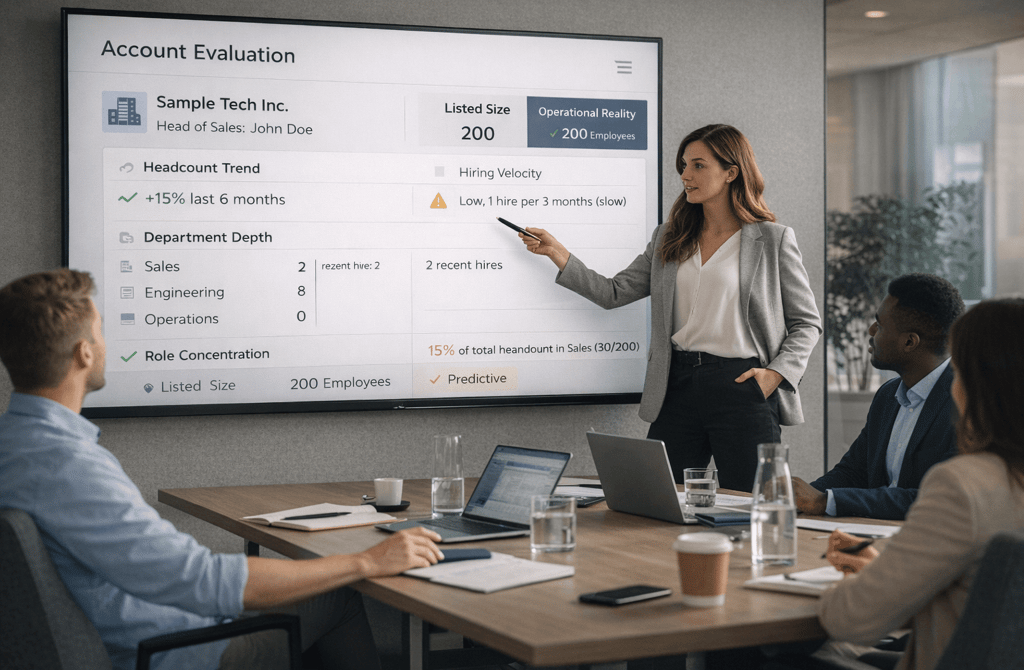
Company size feels like a safe filter.
It’s numeric, sortable, and easy to justify.
But size is also one of the most misleading signals in outbound — not because it’s useless, but because it’s often interpreted at face value. Headcount and revenue ranges create confidence without clarity, and that false clarity quietly pulls teams toward accounts that look right but behave wrong.
The accounts that respond aren’t defined by size labels. They’re defined by size signals.
Why Size Labels Create Targeting Blind Spots
When teams filter accounts by “50–200 employees” or “$10M–$50M revenue,” they assume those bands represent maturity, buying power, and internal readiness.
They don’t.
Two companies with the same size label can operate very differently:
One has layered ownership, functional depth, and budget authority
The other is founder-led, resource-thin, and decision-constrained
Outbound struggles when those differences are ignored. The problem isn’t that the ICP is wrong — it’s that the assumptions attached to size are incomplete.
Signal #1: Role Density Reveals Real Capacity
Headcount tells you how many people exist.
Role density tells you how work actually gets done.
An account with 150 employees but only:
One sales role
One ops role
No middle management
will behave like a small company in outbound. Decisions bottleneck. Evaluations stall. Replies slow down.
Accounts worth targeting usually show:
Multiple people in the same function
Clear separation between execution and oversight
Redundancy in ownership
That structure signals capacity to evaluate, not just exist.
Signal #2: Department Balance Beats Raw Growth
Balanced organizations reply differently.
When most employees sit in delivery or engineering, but sales, operations, or finance roles are thin, outbound conversations struggle to move forward. There’s no internal bandwidth to process change.
Healthy targeting signals include:
Presence of non-core support roles
Clear operational ownership
Functional balance across the org
Imbalance doesn’t mean the account is bad — it means it’s not ready.
Signal #3: Hiring Velocity Predicts Engagement Timing
Static size is less useful than movement.
Accounts actively hiring are signaling internal change. Change creates evaluation windows. Those windows produce replies.
When hiring velocity is flat:
Priorities are stable
Attention is inward
External conversations feel low-urgency
Outbound performs better when it intersects with momentum, not stagnation.
Signal #4: Decision Distance Increases with Misclassified Size
Bigger-looking accounts introduce friction.
As perceived size increases:
More stakeholders appear
Decision paths lengthen
Response speed drops
If size is inflated by inaccurate data, outreach targets roles that seem senior but lack authority. Messages don’t get rejected — they get ignored.
That’s how “perfectly sized” accounts turn into silent pipelines.
Signal #5: Operational Maturity Outperforms Revenue Estimates
Revenue data is often estimated.
Operational behavior is observable.
Accounts worth targeting tend to show:
Defined job scopes
Stable reporting lines
Clear functional accountability
These signals indicate readiness to evaluate tools, services, or change. Without them, outbound creates cognitive friction for the recipient — replying requires too much clarification.
Why Size Errors Suppress Replies Quietly
When size signals are wrong:
Messaging feels misaligned
Cadence feels inappropriate
Follow-ups lose urgency
The prospect doesn’t object. They disengage.
From their perspective, responding would require correcting assumptions. Silence is easier.
What This Means for Targeting Strategy
Effective outbound doesn’t chase bigger accounts.
It targets accounts with sufficient internal structure.
That structure shows up through signals — not labels.
Teams that adjust for these signals:
Reduce wasted sends
Improve reply consistency
What This Means
Company size is a proxy, not a truth.
When size signals reflect how an account actually operates, outreach aligns with real buying conditions.
When size is misclassified, outbound mistakes surface scale for readiness — and pays for it in silence.
Accurate size signals make outbound predictable and focused.
Misclassified size data turns targeting into guesswork that looks strategic but fails quietly.
Related Post:
How Bounce Risk Changes Based on Lead Source Quality
The Drift Timeline That Shows When Lead Lists Lose Accuracy
How Decay Turns High-Quality Leads Into Wasted Volume
Why Job-Role Drift Makes Personalization Completely Wrong
The ICP Errors Caused by Data That Aged in the Background
How Lead Aging Creates False Confidence in Your Pipeline
The Data Gaps That Cause Personalization to Miss the Mark
How Missing Titles and Departments Distort Your ICP Fit
Why Incomplete Firmographic Data Leads to Wrong-Account Targeting
The Enrichment Signals That Predict Stronger Reply Rates
How Better Data Completeness Improves Email Relevance
The Subtle Signals Automation Fails to Interpret
Why Human Oversight Is Essential for Accurate B2B Data
How Automated Tools Miss High-Risk Email Patterns
The Quality Gap Between Algorithmic and Human Validation
Why Human Validators Still Outperform AI for Lead Safety
The Duplicate Detection Rules Every Founder Should Use
How Spam-Trap Hits Destroy Domain Reputation Instantly
Why High-Risk Emails Slip Through Cheap Validation Tools
The Real Reason Duplicate Leads Hurt Personalization Accuracy
How Risky Email Patterns Reveal Broken Data Providers
How Industry Structure Influences Email Risk Levels
Why Certain Sectors Experience Faster Data Decay Cycles
The Hidden Validation Gaps Inside Niche Industry Lists
How Industry Turnover Impacts Lead Freshness
Why Validation Complexity Increases in Specialized Markets
How Revenue Misclassification Creates Fake ICP Matches
Why Geo Inaccuracies Lower Your Reply Rate
Connect
Get verified leads that drive real results for your business today.
www.capleads.org
© 2025. All rights reserved.
Serving clients worldwide.
CapLeads provides verified B2B datasets with accurate contacts and direct phone numbers. Our data helps startups and sales teams reach C-level executives in FinTech, SaaS, Consulting, and other industries.