
How Better Data Completeness Improves Email Relevance
Better data completeness improves email relevance by aligning messages with real roles, context, and intent. Here’s how missing fields quietly break alignment.
INDUSTRY INSIGHTSLEAD QUALITY & DATA ACCURACYOUTBOUND STRATEGYB2B DATA STRATEGY
CapLeads Team
2/2/20263 min read
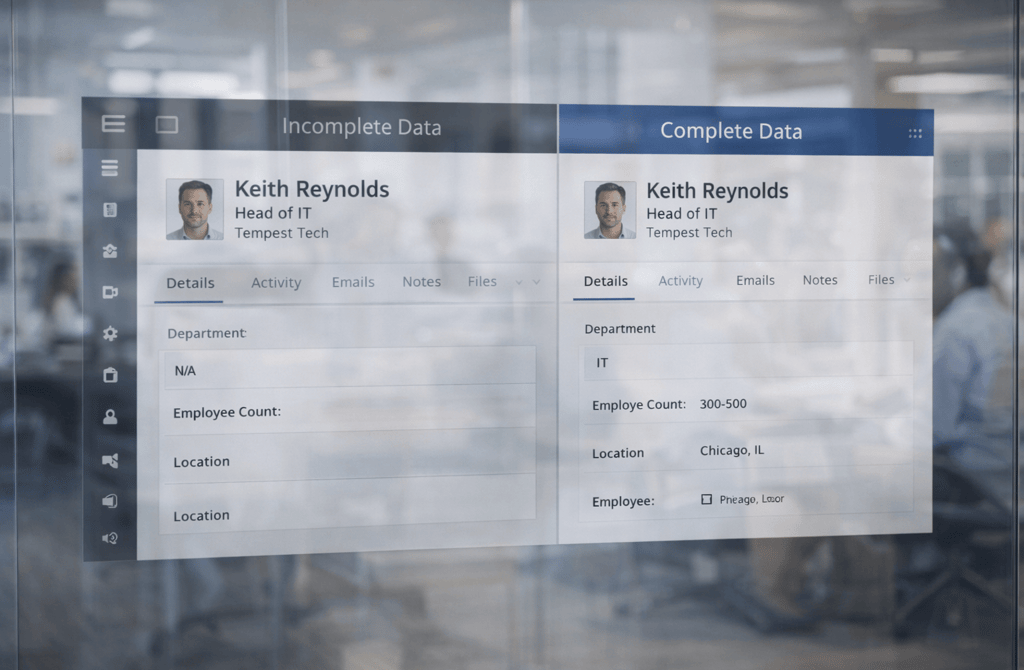
Email relevance isn’t decided when you hit send.
It’s decided in the few seconds someone scans your message and subconsciously answers one question:
“Is this meant for me?”
Most outreach fails that test not because the copy is bad, but because the data behind it doesn’t give the message enough context to land naturally.
Relevance Is a Context Problem, Not a Copy Problem
When people think about relevance, they usually think about wording:
Personalization tokens
Custom openers
But relevance actually comes from context alignment — whether the message matches the recipient’s role, responsibilities, and operating reality.
That context doesn’t live in the copy.
It lives in the data.
When your data is incomplete, your message may be well-written but still feel off. And recipients are extremely good at detecting that mismatch.
What Incomplete Data Does to a “Good” Email
Incomplete data doesn’t always create obvious errors. More often, it creates subtle misalignment, which is harder to diagnose.
Here’s how it shows up:
The problem you reference is real, but not their problem
The angle makes sense, but not for someone in their function
The value proposition is valid, but framed at the wrong level
Nothing is technically wrong — yet the email doesn’t feel relevant enough to respond to.
From the recipient’s perspective, the email feels generic.
From your perspective, it feels confusing because the copy “should” work.
Completeness Changes the Frame of the Message
Data completeness doesn’t just fill fields.
It changes how you frame the message before a single word is written.
When role, department, company context, and structure are clear, the sender naturally makes better decisions:
What level of detail to include
Whether to speak operationally, strategically, or tactically
This is why complete data often produces better emails even with average copy. The framing is correct, so the message lands more naturally.
Why Relevance Feels Obvious When Data Is Complete
When an email is truly relevant, it doesn’t feel impressive.
It feels obvious.
Recipients don’t think:
“This is personalized.”
They think:
“Yes, this is my world.”
That reaction happens when the message aligns cleanly with:
The role they actually perform
The scope they actually own
The problems they actually recognize
Those signals don’t come from clever writing.
They come from having enough accurate data to aim the message correctly.
Incomplete Data Forces Guesswork
When key fields are missing or vague, outreach becomes a guessing game.
Senders compensate by:
Broadening the message
Softening the language
Avoiding specificity
Ironically, this makes emails less relevant, not safer.
The message becomes polite but hollow — easy to ignore without feeling rude.
Complete data removes that hesitation. It gives the sender confidence to be specific without being presumptive.
Relevance Is a Gate, Not a Multiplier
A common mistake is treating relevance as something that amplifies performance.
In reality, relevance is a gate.
If relevance isn’t established, nothing else matters:
Not follow-ups
Not volume
Better data completeness doesn’t guarantee replies.
But it ensures your message gets past the first mental filter: “Is this meant for me?”
Without that, the conversation never starts.
What This Means in Practice
Improving data completeness doesn’t make outreach flashy.
It makes it quieter, cleaner, and more accurate.
Emails stop trying to convince and start sounding like they belong.
And when that happens, relevance isn’t something you have to force — it’s something the recipient recognizes immediately.
Bottom Line
Email relevance is not created in the inbox.
It’s decided long before the message is written.
When contact and company data are complete, messages align naturally with real roles and real contexts.
When key fields are missing, even strong copy struggles to feel like it belongs.
Relevance isn’t about saying more.
It’s about knowing who you’re actually talking to before you say anything at all.
Related Post:
Why Some Sectors Offer Better Lead Value Than Others
Why Outbound Falls Apart When Lead Lists Age Faster Than Your Campaigns
The Real Reason Fresh Data Makes Your Outreach Feel Easier
How a 90-Day Recency Window Changes Your Entire Cold Email Strategy
The Hidden Costs of Emailing Contacts Who Haven’t Been Validated Recently
Why Aged Leads Attract More Spam Filter Scrutiny
The Silent Errors That Occur When Providers Skip Manual Review
How Deep Validation Reveals Problems Basic Checkers Can’t Detect
The Multi-Step Verification Process Behind Reliable Lead Lists
Why Cheap Tools Miss the Most Dangerous Email Types
The Difference Between Syntax Checks and Real Verification
The Bounce Threshold That Signals a System-Level Problem
How Email Infrastructure Breaks When You Use Aged Lists
The Real Reason Bounce Spikes Destroy Send Reputation
Why High-Bounce Industries Need Stricter Data Filters
How Bounce Risk Changes Based on Lead Source Quality
The Drift Timeline That Shows When Lead Lists Lose Accuracy
How Decay Turns High-Quality Leads Into Wasted Volume
Why Job-Role Drift Makes Personalization Completely Wrong
The ICP Errors Caused by Data That Aged in the Background
How Lead Aging Creates False Confidence in Your Pipeline
The Data Gaps That Cause Personalization to Miss the Mark
How Missing Titles and Departments Distort Your ICP Fit
Why Incomplete Firmographic Data Leads to Wrong-Account Targeting
The Enrichment Signals That Predict Stronger Reply Rates
Connect
Get verified leads that drive real results for your business today.
www.capleads.org
© 2025. All rights reserved.
Serving clients worldwide.
CapLeads provides verified B2B datasets with accurate contacts and direct phone numbers. Our data helps startups and sales teams reach C-level executives in FinTech, SaaS, Consulting, and other industries.