
How Bad Location Data Breaks Personalization Attempts
Personalization fails when location data is wrong. Learn how bad geo assumptions quietly undermine relevance, timing, and reply rates.
INDUSTRY INSIGHTSLEAD QUALITY & DATA ACCURACYOUTBOUND STRATEGYB2B DATA STRATEGY
CapLeads Team
2/6/20263 min read
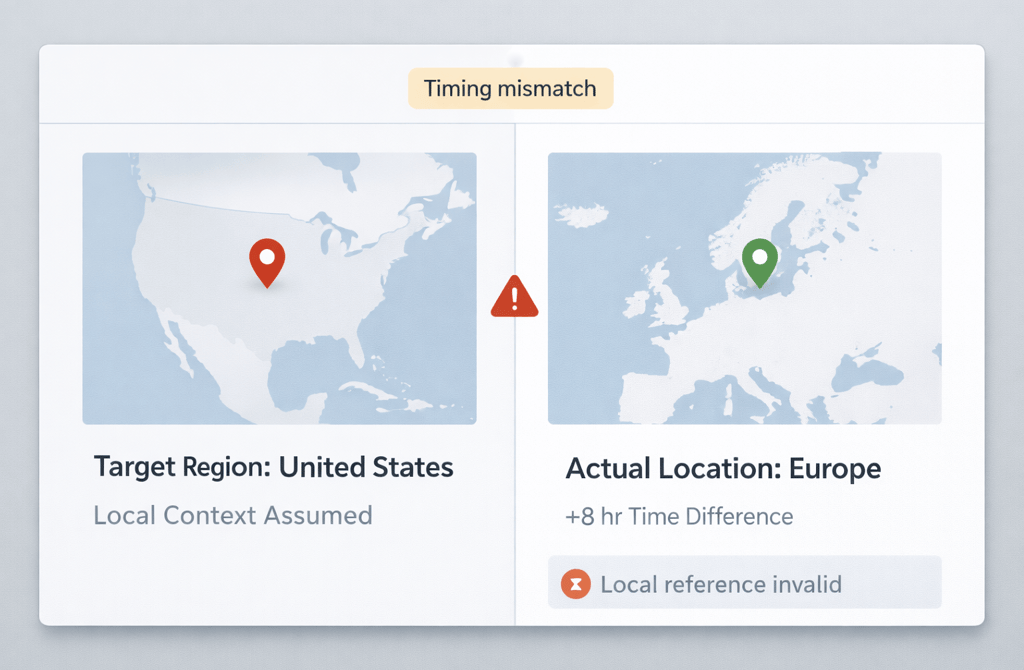
Personalization doesn’t fail loudly.
It fails subtly — the moment a reader senses something is off.
A city name that doesn’t apply. A regional reference that doesn’t land. A local assumption that doesn’t match reality. None of these trigger complaints or spam reports. They trigger doubt. And doubt is enough to stop a reply.
Bad location data doesn’t just make personalization inaccurate. It makes it untrustworthy.
Personalization Is a Trust Exercise, Not a Tactic
Personalization works when it signals care and correctness at the same time.
When a prospect reads a message that references their location, they instinctively check one thing:
“Does this person actually know where I am?”
If the answer is no, the personalization backfires. The message no longer feels thoughtful. It feels automated, careless, or misinformed.
At that point, the content of the email barely matters. Trust has already been downgraded.
Why Location Errors Are More Damaging Than Missing Personalization
A missing personalization attempt is neutral.
A wrong one is negative.
Bad location data introduces cognitive friction. The reader must pause to reconcile the mismatch:
“I’m not based there.”
“That doesn’t apply to my market.”
“This wasn’t written with me in mind.”
That pause interrupts the reading flow. Instead of evaluating the message, the prospect evaluates the sender. Most don’t bother correcting the assumption. They disengage.
Silence follows.
How Location Errors Break the Illusion of Intent
Good personalization creates the illusion of intent — the feeling that this message was crafted deliberately.
Bad location data destroys that illusion instantly.
Once the prospect spots a geographic mistake:
Other personalization tokens become suspect
The sender’s research credibility drops
The message feels batch-generated, even if it wasn’t
From the reader’s perspective, replying would require effort to fix context before a conversation can even begin. Ignoring the message is easier.
Why This Happens Even With “Mostly Correct” Data
Location data often fails at the edges.
A country may be correct, but:
The city is wrong
The region is outdated
The role moved locations
These aren’t dramatic errors. They’re small mismatches that quietly erode confidence.
And because the email still technically makes sense, teams rarely realize personalization is the problem. They assume messaging or offer fit needs adjustment — while the real issue is contextual accuracy.
The Hidden Cost: Personalization Fatigue
When prospects repeatedly receive messages that almost get their location right, they develop personalization fatigue.
They stop reading location-based references altogether. Even accurate ones lose impact because prior mistakes trained skepticism.
This is how bad data doesn’t just hurt individual campaigns — it lowers the ceiling for personalization across future outreach.
Why Tools Don’t Catch This Problem
Most outbound tools treat location as a static field.
They don’t:
Check assumption accuracy
Flag partial mismatches
As long as a value exists, the system proceeds. The error only appears in the prospect’s mind — where analytics can’t see it.
By the time reply rates drop, the damage is already done.
What Actually Breaks When Location Is Wrong
Bad location data doesn’t just affect copy. It breaks alignment.
It misaligns:
Tone (too formal or too casual for the region)
Urgency (wrong working hours or business norms)
Framing (references that don’t resonate locally)
The email becomes internally consistent but externally incorrect — the worst possible combination for personalization.
How High-Performing Teams Treat Location Data
Teams that succeed with personalization treat location as context, not decoration.
They understand that:
A wrong reference is worse than no reference
Accuracy matters more than cleverness
Personalization should reduce friction, not create it
They would rather say less — correctly — than say more with assumptions.
Bottom Line
Personalization fails the moment accuracy is questioned.
When location data is wrong, even thoughtful messages feel careless. Trust drops before value is considered, and replies disappear without explanation.
Accurate location data makes personalization feel natural and intentional.
Bad location data turns personalization into a credibility liability — one mismatch at a time.
Related Post:
How Bounce Risk Changes Based on Lead Source Quality
The Drift Timeline That Shows When Lead Lists Lose Accuracy
How Decay Turns High-Quality Leads Into Wasted Volume
Why Job-Role Drift Makes Personalization Completely Wrong
The ICP Errors Caused by Data That Aged in the Background
How Lead Aging Creates False Confidence in Your Pipeline
The Data Gaps That Cause Personalization to Miss the Mark
How Missing Titles and Departments Distort Your ICP Fit
Why Incomplete Firmographic Data Leads to Wrong-Account Targeting
The Enrichment Signals That Predict Stronger Reply Rates
How Better Data Completeness Improves Email Relevance
The Subtle Signals Automation Fails to Interpret
Why Human Oversight Is Essential for Accurate B2B Data
How Automated Tools Miss High-Risk Email Patterns
The Quality Gap Between Algorithmic and Human Validation
Why Human Validators Still Outperform AI for Lead Safety
The Duplicate Detection Rules Every Founder Should Use
How Spam-Trap Hits Destroy Domain Reputation Instantly
Why High-Risk Emails Slip Through Cheap Validation Tools
The Real Reason Duplicate Leads Hurt Personalization Accuracy
How Risky Email Patterns Reveal Broken Data Providers
How Industry Structure Influences Email Risk Levels
Why Certain Sectors Experience Faster Data Decay Cycles
The Hidden Validation Gaps Inside Niche Industry Lists
How Industry Turnover Impacts Lead Freshness
Why Validation Complexity Increases in Specialized Markets
How Revenue Misclassification Creates Fake ICP Matches
Why Geo Inaccuracies Lower Your Reply Rate
The Size Signals That Predict Whether an Account Is Worth Targeting
Connect
Get verified leads that drive real results for your business today.
www.capleads.org
© 2025. All rights reserved.
Serving clients worldwide.
CapLeads provides verified B2B datasets with accurate contacts and direct phone numbers. Our data helps startups and sales teams reach C-level executives in FinTech, SaaS, Consulting, and other industries.