
How Department Shifts Impact Your Cold Email Results
Internal department changes quietly break cold email relevance. Learn how org shifts affect role accuracy, targeting alignment, and reply outcomes.
INDUSTRY INSIGHTSLEAD QUALITY & DATA ACCURACYOUTBOUND STRATEGYB2B DATA STRATEGY
CapLeads Team
2/9/20264 min read
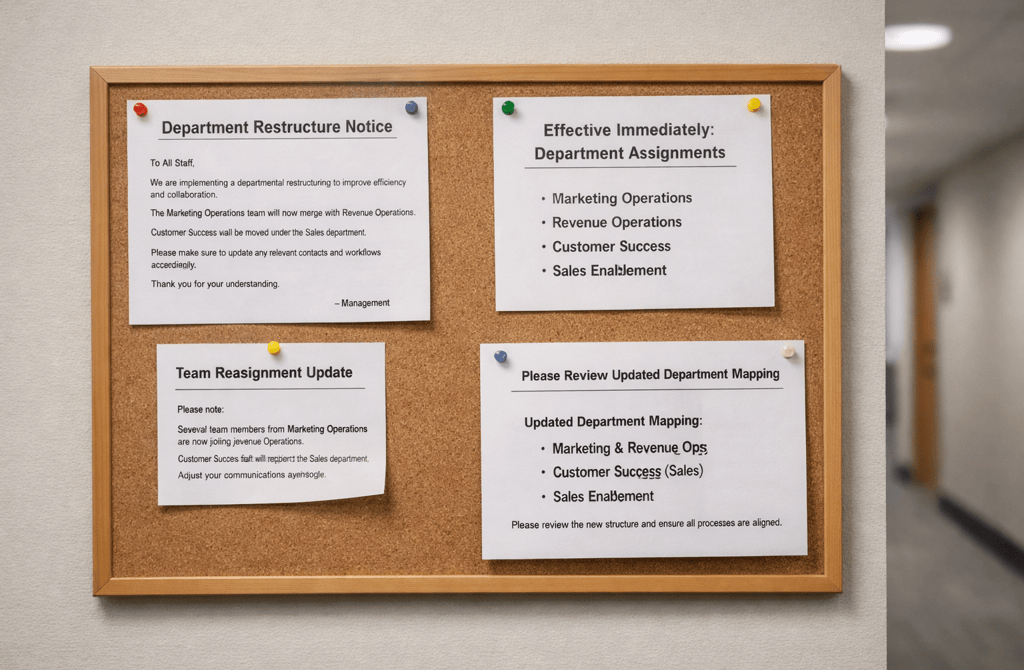
Cold email failures are often blamed on copy, subject lines, or timing. But many campaigns break for a quieter reason that never shows up in dashboards: the internal structure of companies changes faster than your data updates.
Department shifts don’t look dramatic from the outside. A role still exists. The company still fits your ICP. The email address may even still be valid. Yet replies slow, relevance drops, and messages start missing the mark. The reason is simple—your outreach is targeting a version of the organization that no longer exists.
Department shifts change who “owns” the problem you’re emailing about
Most cold emails are framed around responsibility. You’re not just emailing a person—you’re emailing a function. Marketing operations, revenue operations, customer success, enablement, growth, partnerships. These departments define context.
When a company restructures, responsibilities often move before titles do. Marketing ops merges into RevOps. Customer success moves under sales. Enablement gets absorbed into revenue. The work stays the same, but the reporting line—and the internal language—changes.
Cold emails written for the old structure land flat because they reference problems the recipient no longer owns. Even if the person is still involved, they are no longer the decision point. That subtle mismatch is enough to stop replies.
Titles stay stable longer than departments do
One of the biggest traps in outbound is trusting titles too much. Job titles often lag behind internal change. Someone may still be labeled “Marketing Operations Manager,” but their day-to-day priorities now sit squarely inside revenue or sales enablement.
Cold email logic usually assumes title equals department equals responsibility. Department shifts break that assumption. Emails remain technically accurate but contextually wrong. The result isn’t an angry response—it’s silence.
This is why campaigns can show healthy deliverability but declining engagement. The inbox is reached. The message is read. It just doesn’t feel relevant anymore.
Department drift weakens personalization without obvious errors
Department shifts don’t create hard failures like bounces. They create soft failures—emails that feel slightly off.
Personalization tokens still populate correctly. Company data looks fine. But the message references workflows, KPIs, or problems that no longer align with how the company is organized. The reader doesn’t think, “This is wrong.” They think, “This isn’t for me.”
That reaction is deadly for cold email because it trains inbox providers on low engagement. Over time, even accurate messages suffer because the system has learned that your emails don’t resonate with recipients in that role group.
Department changes distort targeting at scale
At small volumes, department misalignment is easy to miss. At scale, it compounds.
If your list assumes customer success sits outside sales, but half your targets now operate under a revenue org, your entire segment becomes noisy. Replies drop unevenly. A/B tests give confusing results. Teams start tweaking copy instead of fixing targeting.
This is how outbound teams end up chasing messaging improvements when the real issue is structural misalignment. The system is targeting the right companies but the wrong internal ownership model.
Why department shifts matter more in modern outbound
Organizations restructure more frequently than they used to. RevOps consolidation, lean teams, and cross-functional roles are now normal. Departments are fluid. Responsibility moves faster than data providers update records.
Cold email performance depends on alignment with how buyers currently operate, not how they were organized six or twelve months ago. Department shifts are one of the fastest ways for data to become misleading without becoming obviously wrong.
Ignoring this leads to campaigns that technically “work” but never scale. Replies become unpredictable because relevance depends on whether your data happens to match that company’s latest internal structure.
What this means for outbound teams
Cold email relevance isn’t just about saying the right thing—it’s about saying it to the function that actually owns the problem today.
Teams that account for department shifts build more resilient targeting. They adjust framing. They validate role context, not just titles. They understand that organizational structure is a moving part, not a fixed field.
Those that don’t end up with lists that look clean but behave inconsistently.
Bottom line
Cold email breaks quietly when department ownership changes but targeting logic stays the same. Messages don’t fail because they’re bad—they fail because they’re aimed at an outdated version of the org.
When your data reflects current department realities, outreach becomes easier to align and more consistent to scale.
When department shifts go unnoticed, even valid emails slowly lose their ability to generate replies.
Related Post:
How Lead Aging Creates False Confidence in Your Pipeline
The Data Gaps That Cause Personalization to Miss the Mark
How Missing Titles and Departments Distort Your ICP Fit
Why Incomplete Firmographic Data Leads to Wrong-Account Targeting
The Enrichment Signals That Predict Stronger Reply Rates
How Better Data Completeness Improves Email Relevance
The Subtle Signals Automation Fails to Interpret
Why Human Oversight Is Essential for Accurate B2B Data
How Automated Tools Miss High-Risk Email Patterns
The Quality Gap Between Algorithmic and Human Validation
Why Human Validators Still Outperform AI for Lead Safety
The Duplicate Detection Rules Every Founder Should Use
How Spam-Trap Hits Destroy Domain Reputation Instantly
Why High-Risk Emails Slip Through Cheap Validation Tools
The Real Reason Duplicate Leads Hurt Personalization Accuracy
How Risky Email Patterns Reveal Broken Data Providers
How Industry Structure Influences Email Risk Levels
Why Certain Sectors Experience Faster Data Decay Cycles
The Hidden Validation Gaps Inside Niche Industry Lists
How Industry Turnover Impacts Lead Freshness
Why Validation Complexity Increases in Specialized Markets
How Revenue Misclassification Creates Fake ICP Matches
Why Geo Inaccuracies Lower Your Reply Rate
The Size Signals That Predict Whether an Account Is Worth Targeting
How Bad Location Data Breaks Personalization Attempts
Why Company Growth Rates Matter for Accurate Targeting
Why Testing B2B Lead Data Matters Before You Buy
Connect
Get verified leads that drive real results for your business today.
www.capleads.org
© 2025. All rights reserved.
Serving clients worldwide.
CapLeads provides verified B2B datasets with accurate contacts and direct phone numbers. Our data helps startups and sales teams reach C-level executives in FinTech, SaaS, Consulting, and other industries.