
The Duplicate Detection Rules Every Founder Should Use
Duplicate leads quietly inflate metrics, hurt deliverability, and waste outbound volume. Learn the practical duplicate-detection rules founders should apply before sending a single email.
INDUSTRY INSIGHTSLEAD QUALITY & DATA ACCURACYOUTBOUND STRATEGYB2B DATA STRATEGY
CapLeads Team
2/4/20264 min read

Most founders don’t realize they have a duplicate problem until their outbound numbers stop making sense.
Reply rates flatten. Bounce rates creep up. Metrics look busy, but pipeline doesn’t move. The instinctive reaction is to tweak copy, adjust subject lines, or blame inbox placement. In reality, many of these symptoms trace back to something far more basic: duplicated contacts quietly poisoning the list.
Duplicates don’t just waste volume. They distort signals, mislead decision-making, and introduce deliverability risk long before a campaign ever “fails.”
Why duplicates are more dangerous than they look
At a glance, duplicates seem harmless. One extra record here, another there. But outbound systems don’t treat them lightly.
When the same contact appears multiple times—especially across merged lists or reused datasets—several things happen at once. The recipient receives multiple variations of the same message. Engagement signals become inconsistent. Inbox providers see repeated targeting of the same address or domain. Over time, this pattern trains filters to view the sender as careless or low-quality.
Even worse, duplicates inflate performance metrics. Open rates appear higher. Reply counts feel “active.” In reality, you’re measuring repeated exposure, not genuine market interest. Founders end up optimizing based on false positives.
That’s why duplicate detection isn’t a hygiene task—it’s a system safeguard.
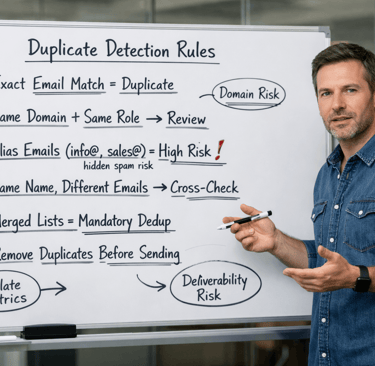
Rule 1: Exact email matches are always duplicates
This one is non-negotiable. If two records share the same email address, only one should survive.
Keeping both doesn’t add reach. It only adds repetition. Even if names, titles, or metadata differ slightly, the inbox provider sees a single recipient receiving multiple sends. That repetition is logged, remembered, and used as a trust signal.
One clean record beats five noisy ones every time.
Rule 2: Same domain plus same role requires review
Duplicates don’t always show up as exact matches. A more subtle pattern is the same role at the same company appearing multiple times with different emails.
This often happens when lists are scraped from multiple sources or stitched together over time. While not every case is a true duplicate, this pattern is risky enough to require manual review. At minimum, founders should confirm recency, role accuracy, and whether both contacts genuinely represent different people.
Ignoring this step is how recycled data sneaks into otherwise “clean” lists.
Rule 3: Alias emails should be treated as high risk
Addresses like info@, sales@, admin@, and support@ are common duplicate magnets. They often appear across multiple datasets, industries, and vendors.
These emails inflate list size without increasing decision-maker access. Worse, they carry a higher likelihood of spam filtering, shared inbox complaints, and silent suppression.
Alias emails aren’t always invalid—but they should never be treated as unique value.
Rule 4: Same name, different email doesn’t mean safe
Seeing “John Smith” twice with different emails creates a dangerous assumption: two people, two opportunities.
In practice, this pattern frequently represents email changes, aliases, or recycled records. Founders should cross-check company, department, seniority, and recency before keeping both entries. When in doubt, favor the most recent, role-accurate record and remove the rest.
Duplicates thrive in ambiguity.
Rule 5: Merged lists must always be deduplicated
Source-level deduplication is unreliable. Every provider defines “duplicate” differently. Some only remove exact matches. Others ignore role or domain overlaps entirely.
Whenever lists are merged—whether across time, tools, or vendors—deduplication must happen again. Skipping this step is how quiet list corruption starts.
Rule 6: Deduplication must happen before outreach
Removing duplicates after emails are sent doesn’t undo the damage. The inbox provider has already logged the behavior. Engagement data is already polluted.
Deduplication is a pre-send rule, not a cleanup task.
Rule 7: Duplicates hide real performance problems
One of the most dangerous effects of duplicates is psychological. They make founders think their system is working when it isn’t. Replies come from repeated exposure. Opens spike without intent. Decisions get made on numbers that don’t reflect reality.
Clean lists produce fewer illusions and more truth.
What This Means
Duplicate detection isn’t about perfection—it’s about trust. Trust in your metrics. Trust from inbox providers. Trust that when someone replies, it’s because your message reached the right person at the right time.
When duplicates are allowed to accumulate, outbound stops being a system and starts being noise.
Lists that are deduplicated before sending behave more predictably, age more slowly, and expose real demand instead of artificial engagement. Lists that aren’t eventually collapse under their own signal distortion.
Outbound becomes reliable when your data only speaks once per person.
When the same contact shows up multiple times, the system listens less every time.
Related Post:
The Difference Between Syntax Checks and Real Verification
The Bounce Threshold That Signals a System-Level Problem
How Email Infrastructure Breaks When You Use Aged Lists
The Real Reason Bounce Spikes Destroy Send Reputation
Why High-Bounce Industries Need Stricter Data Filters
How Bounce Risk Changes Based on Lead Source Quality
The Drift Timeline That Shows When Lead Lists Lose Accuracy
How Decay Turns High-Quality Leads Into Wasted Volume
Why Job-Role Drift Makes Personalization Completely Wrong
The ICP Errors Caused by Data That Aged in the Background
How Lead Aging Creates False Confidence in Your Pipeline
The Data Gaps That Cause Personalization to Miss the Mark
How Missing Titles and Departments Distort Your ICP Fit
Why Incomplete Firmographic Data Leads to Wrong-Account Targeting
The Enrichment Signals That Predict Stronger Reply Rates
How Better Data Completeness Improves Email Relevance
The Subtle Signals Automation Fails to Interpret
Why Human Oversight Is Essential for Accurate B2B Data
How Automated Tools Miss High-Risk Email Patterns
The Quality Gap Between Algorithmic and Human Validation
Why Human Validators Still Outperform AI for Lead Safety
Connect
Get verified leads that drive real results for your business today.
www.capleads.org
© 2025. All rights reserved.
Serving clients worldwide.
CapLeads provides verified B2B datasets with accurate contacts and direct phone numbers. Our data helps startups and sales teams reach C-level executives in FinTech, SaaS, Consulting, and other industries.