
How Bounce Risk Changes Based on Lead Source Quality
Not all bounce risk comes from sending behavior. Learn how lead source quality directly changes bounce patterns, deliverability stability, and send reputation outcomes.
INDUSTRY INSIGHTSLEAD QUALITY & DATA ACCURACYOUTBOUND STRATEGYB2B DATA STRATEGY
CapLeads Team
1/31/20263 min read
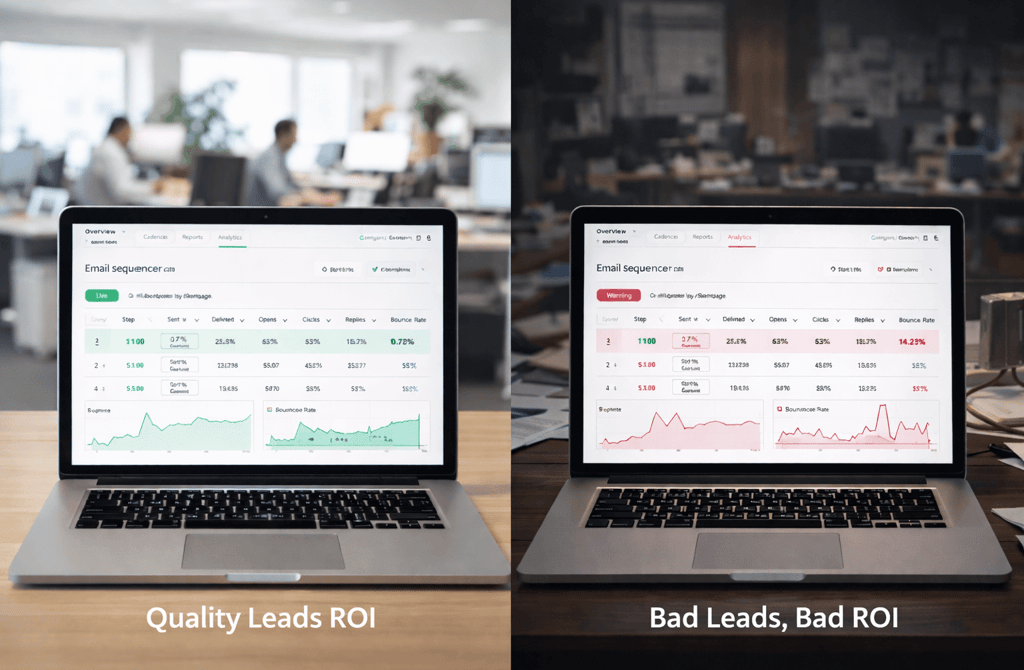
Bounce risk doesn’t increase because you send more emails.
It increases because the system learns what kind of inputs you rely on.
Two teams can run the same sequencer, same domains, same copy, and same cadence—yet one sees stable delivery while the other spirals into bounce issues. The difference usually isn’t execution. It’s the quality of the lead source feeding the system.
Lead sources teach inbox systems how to judge you
Inbox providers don’t evaluate emails in isolation. They evaluate patterns over time.
Every lead source introduces a distinct pattern of:
Address validity
Domain reliability
Role relevance
Engagement likelihood
High-quality sources produce predictable patterns. Lower-quality sources introduce noise. Over time, inbox systems associate those patterns with the sender—not the source.
Once that association forms, bounce risk stops being episodic and starts becoming systemic.
Why bounce risk compounds faster with weak sources
Low-quality lead sources rarely fail cleanly.
Instead of one obvious error, they produce:
Small clusters of invalid emails
Inconsistent domain behavior
Each issue alone might look manageable. Together, they create volatility. Inbox systems interpret volatility as loss of sender control, which raises bounce sensitivity across future sends.
That’s why teams often say, “Even our good lists started bouncing.”
The hidden difference between “cheap” and “risky”
Cheap leads aren’t automatically risky.
Risky leads are the ones that behave inconsistently under volume.
Some sources look fine in small tests but break down when scaled. Others degrade unevenly, meaning revalidation only fixes part of the problem. The result is a lead pool that passes surface checks but fails structural ones.
Inbox systems don’t care how much the data cost. They care whether your sending behavior stays stable.
Why the same bounce rate means different things depending on source
A 2% bounce rate from a clean, stable source is very different from a 2% bounce rate from a volatile one.
In the first case, bounces are distributed and predictable.
In the second, they tend to cluster and spike.
Inbox providers respond more aggressively to clustering because it suggests the sender isn’t filtering or controlling inputs tightly enough. That’s why bounce risk is tied to source behavior, not just headline numbers.
How lead source quality affects recovery time
When bounce issues appear, teams usually pause, clean lists, and resume.
Recovery speed depends heavily on what comes next.
If you resume sending with:
Consistent, high-quality sources → trust stabilizes faster
Mixed or questionable sources → penalties linger
Inbox systems need repeated evidence that the sender has regained control. One bad source can delay that recovery far longer than expected.
The mistake teams make when “diversifying” sources
Many teams respond to bounce problems by spreading volume across more sources.
That often makes things worse.
Without strict source-level separation, diversification introduces more variability, not less. Inbox systems don’t see diversification—they see unpredictability.
High-performing teams don’t diversify blindly. They segment by source quality and apply different tolerance levels to each.
What high-quality sources really buy you
Good lead sources don’t just reduce bounce rates.
They:
Smooth error distribution
Reduce volatility between sends
Make validation more effective
Shorten recovery windows when issues happen
In other words, they make your entire outbound system easier to trust.
What This Means
Bounce risk isn’t just about how you send—it’s about what you feed into the system.
Lead source quality shapes the patterns inbox providers learn from you over time. Stable sources build tolerance. Volatile ones erode it quietly.
If bounce issues feel unpredictable, the problem is rarely effort or tooling.
It’s usually that the system has learned something unfavorable about the sources you rely on.
Related Post:
Why LinkedIn Titles Matter More Than Email Metadata
How Regulatory Environments Influence Data Quality
Why Global Lead Lists Require Region-Specific Handling
The International Data Signals That Predict Reliability
How Country-Level Mobility Impacts Role Accuracy
Why Global Data Drifts Faster in Emerging Markets
How Market Competition Influences Lead Pricing
Why Industry Complexity Drives Lead Cost Variation
The Cross-Industry Factors That Predict Lead Price
How Data Difficulty Impacts Lead Cost Across Verticals
Why Some Sectors Offer Better Lead Value Than Others
Why Outbound Falls Apart When Lead Lists Age Faster Than Your Campaigns
The Real Reason Fresh Data Makes Your Outreach Feel Easier
How a 90-Day Recency Window Changes Your Entire Cold Email Strategy
The Hidden Costs of Emailing Contacts Who Haven’t Been Validated Recently
Why Aged Leads Attract More Spam Filter Scrutiny
The Silent Errors That Occur When Providers Skip Manual Review
How Deep Validation Reveals Problems Basic Checkers Can’t Detect
The Multi-Step Verification Process Behind Reliable Lead Lists
Why Cheap Tools Miss the Most Dangerous Email Types
The Difference Between Syntax Checks and Real Verification
The Bounce Threshold That Signals a System-Level Problem
How Email Infrastructure Breaks When You Use Aged Lists
The Real Reason Bounce Spikes Destroy Send Reputation
Why High-Bounce Industries Need Stricter Data Filters
Connect
Get verified leads that drive real results for your business today.
www.capleads.org
© 2025. All rights reserved.
Serving clients worldwide.
CapLeads provides verified B2B datasets with accurate contacts and direct phone numbers. Our data helps startups and sales teams reach C-level executives in FinTech, SaaS, Consulting, and other industries.