
The Deliverability Risks Hidden in “Instant Validation” Tools
Instant email validation tools promise fast verification, but speed often hides deeper deliverability risks. Learn how shallow validation methods can still allow outdated or risky contacts into your cold email campaigns.
INDUSTRY INSIGHTSLEAD QUALITY & DATA ACCURACYOUTBOUND STRATEGYB2B DATA STRATEGY
CapLeads Team
3/12/20264 min read
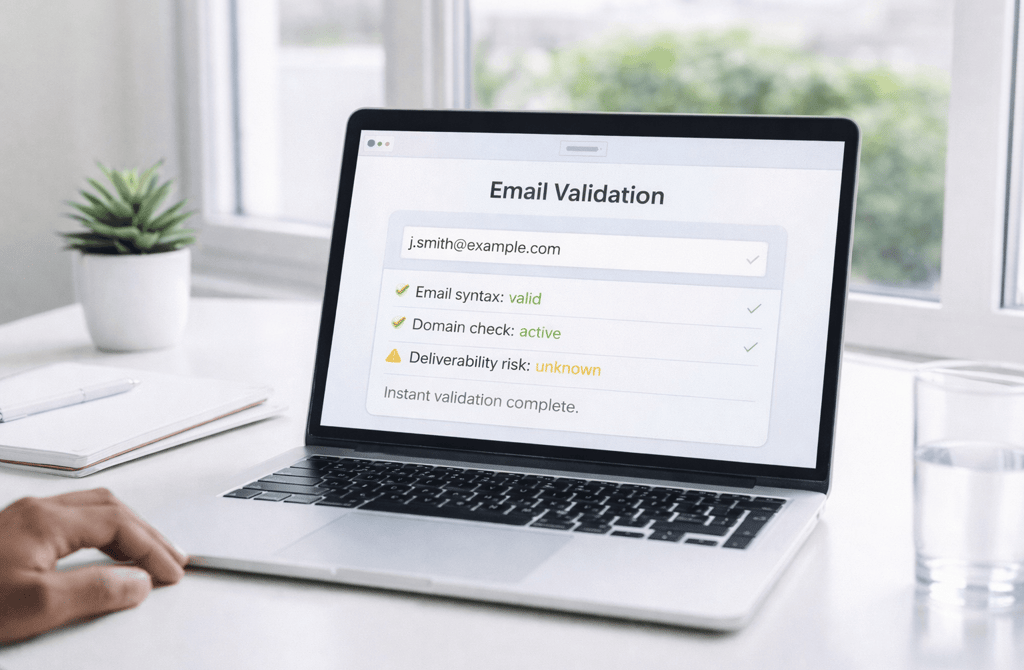
Speed has become one of the biggest selling points in modern email validation tools.
Enter a list, press a button, and within seconds the system returns a report: valid, invalid, safe to send. For busy outbound teams, this kind of instant verification sounds ideal. Campaigns can launch faster, lead lists can be cleaned quickly, and the technical step of validation appears to be handled.
But speed often hides a deeper issue.
Many “instant validation” tools only perform a narrow set of checks, and those checks do not always reveal the risks that actually impact deliverability. When outbound teams rely entirely on these rapid validation systems, they may unknowingly introduce unstable contacts into their campaigns.
Over time, those hidden risks begin to affect inbox placement, bounce ratios, and overall sender reputation.
What Instant Validation Tools Actually Check
Most instant verification tools focus on a small group of technical indicators.
Typical checks include:
email syntax verification
domain existence confirmation
server response testing
mailbox availability signals
These tests determine whether an email address might accept a message at a technical level. If the domain exists and the server responds correctly, the tool may mark the address as valid.
From a technical standpoint, the result appears reassuring.
However, these checks rarely examine the broader context that determines whether the contact is still relevant or safe for outreach.
Why Fast Validation Often Misses Deliverability Risk
The biggest weakness of instant validation systems is that they evaluate only a single moment in time.
Email infrastructure can appear healthy even when the underlying contact data is outdated or unreliable.
For example, instant validation tools often cannot detect situations such as:
employees who have already left the company
catch-all domains that accept messages but rarely reach a real inbox
role accounts that trigger spam complaints
departments that no longer exist within the organization
In these cases, the email address technically passes validation, but the contact still introduces risk into the campaign.
This is where deliverability problems begin to surface.
How Catch-All Domains Create Hidden Problems
Catch-all domains are a common example of why instant validation can be misleading.
A catch-all system allows a mail server to accept messages for any address within the domain, even if the specific mailbox does not exist. To a fast validation tool, this behavior often appears as a successful server response.
The tool therefore marks the address as valid.
But when outreach campaigns send messages to these contacts, several outcomes are possible:
messages silently disappear into inactive inboxes
mail servers begin to filter repeated attempts
engagement signals drop sharply
None of these outcomes appear in the instant validation report.
Yet they directly influence sender reputation and inbox placement.
Deliverability Systems Evaluate Engagement Signals
Modern mailbox providers evaluate far more than simple bounce rates.
They also analyze how recipients interact with incoming messages. When campaigns repeatedly send emails to contacts who never engage, the sending domain begins to lose credibility.
Over time, the consequences may include:
emails landing in spam folders
inconsistent inbox placement
lower open rates across campaigns
These effects can occur even when bounce rates appear relatively normal.
Because instant validation tools do not evaluate recipient relevance, they cannot prevent these engagement-based deliverability issues.
Why Deeper Validation Requires Multiple Layers
More reliable validation processes typically examine contact data across several layers rather than relying on a single automated check.
These additional layers may include:
cross-referencing contacts across multiple datasets
evaluating role and department alignment
filtering high-risk domains or role accounts
Each layer removes a different category of potential error.
The goal is not simply to confirm that an email address exists, but to determine whether the contact still represents a real and reachable decision-maker.
When these deeper checks are included, outreach campaigns operate with far fewer hidden variables.
Why Instant Tools Remain Popular
Despite their limitations, instant validation tools remain widely used.
Their appeal is understandable. They are easy to run, produce fast results, and integrate smoothly into outbound workflows.
For teams launching campaigns under time pressure, these tools offer a convenient way to clean a list quickly.
The problem arises when teams assume that speed equals completeness.
Instant validation can be a useful early filter, but it rarely provides the depth required to protect long-term deliverability.
What This Means for Cold Email Campaigns
Cold email performance depends on a chain of systems working together: infrastructure, targeting, messaging, and data quality.
When the contact dataset contains hidden risks, even well-designed campaigns can begin to struggle.
Bounce spikes, low engagement, and unstable inbox placement are often symptoms of validation processes that did not examine the data deeply enough.
For organizations targeting companies in software markets, working with SaaS B2B leads that have passed deeper verification layers helps reduce the hidden deliverability risks that fast validation tools often overlook.
The Bottom Line
Instant validation tools can provide useful technical signals, but they rarely capture the full picture of contact quality.
By focusing only on immediate server responses, these tools overlook many of the factors that influence real campaign performance. Catch-all domains, outdated roles, and inactive recipients can still pass fast validation checks while quietly weakening deliverability.
Successful outbound programs treat instant validation as only the first step in a broader verification process.
Because the stability of cold email campaigns ultimately depends on how thoroughly the contact data has been examined before the first message is ever sent.
Related Post:
Why SDR Judgment Beats Automation in High-Stakes Accounts
The Blind Spots Inside Automation-First Outbound Systems
How System-Level Data Drift Derails Reliable Email Sending
Why Modern Outbound Systems Rely on Data Interconnectivity
The Data Dependencies Most Founders Never See
How Industry Turnover Drives Bounce Rate Differences
Why High-Churn Markets Produce Unstable Email Data
The Bounce Risk Patterns Hidden Inside Each Industry
How Industry-Specific Roles Influence Email Behavior
Why Certain Verticals Prefer Multi-Step Messaging
The Outbound Timing Patterns Hidden Inside Each Industry
How Sector Stability Predicts Long-Term Data Freshness
Why Fast-Decay Verticals Require More Frequent Validation
The Industry-Level Signals That Reveal Accelerated Data Aging
Why AI Becomes Unreliable With Aged Lead Lists
The AI Pipeline Behind Modern B2B Data Processing
Why LLM-Assisted Validation Requires Clean Metadata
The Vertical Variances That Predict ICP Fit Accuracy
How Industry Complexity Impacts Lead Quality Signals
Why Some Verticals Have Stronger Multi-Contact Data
The Channel-Specific Validation Gaps Most Teams Never Notice
How Contact Recency Impacts Phone Outreach More Than Email
Why LinkedIn Signals Reveal Intent Email Can’t Detect
The Geographic Accuracy Patterns Hidden in Lead Lists
How Cultural Factors Influence B2B Data Consistency
Why Contact Fields Behave Differently Across Regions
The Pricing Logic Behind High-Demand Industries
How Industry Growth Trends Impact Lead Cost
Why Validation Depth Changes Lead Prices by Industry
How Lead Recency Influences Inbox Placement More Than Subject Lines
The Recency-Driven Framework High-Performing Outbound Teams Use
Why Lead Lists Decay Faster in Certain Industries
Why Providers Overclaim Their Validation Accuracy
How Verification Depth Determines Your Cold Email Success
Connect
Get verified leads that drive real results for your business today.
www.capleads.org
© 2025. All rights reserved.
Serving clients worldwide.
CapLeads provides verified B2B datasets with accurate contacts and direct phone numbers. Our data helps startups and sales teams reach C-level executives in FinTech, SaaS, Consulting, and other industries.