
The Industry-Level Signals That Reveal Accelerated Data Aging
Certain industries generate warning signs when contact data begins aging rapidly. Learn the industry-level signals that reveal accelerated data decay—and how recognizing them helps outbound teams protect targeting accuracy.
INDUSTRY INSIGHTSLEAD QUALITY & DATA ACCURACYOUTBOUND STRATEGYB2B DATA STRATEGY
CapLeads Team
3/5/20264 min read
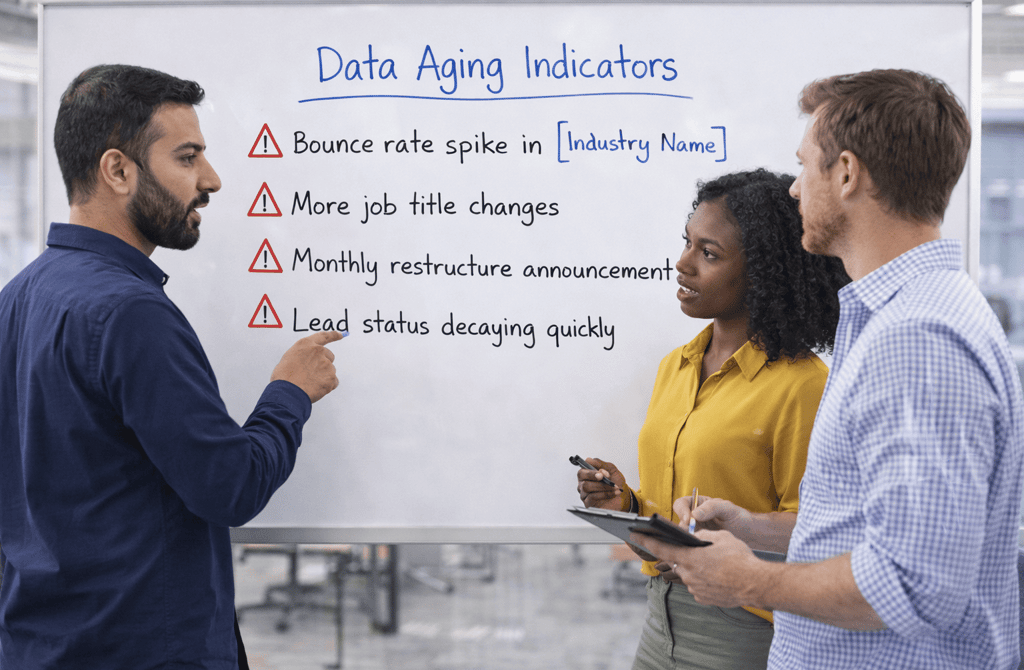
When outbound campaigns begin losing efficiency, most teams immediately examine their messaging. Subject lines get rewritten, sequences are adjusted, and personalization tactics are expanded. Yet many of these changes address symptoms rather than the root problem.
In many cases, the real issue is much quieter: the data itself is aging faster than expected.
Data decay rarely happens randomly. Certain industries generate early warning signs that indicate when contact records are beginning to lose accuracy. Recognizing these signals allows outbound teams to refresh datasets before campaigns begin suffering from bounce spikes, misaligned targeting, or declining engagement.
Understanding these patterns transforms data management from a reactive process into a proactive one.
Early Signals Often Appear Before Campaigns Fail
One of the biggest misconceptions in outbound is that data becomes outdated suddenly. In reality, data aging typically leaves small traces before it causes noticeable performance drops.
Teams that monitor industry-level behavior often notice subtle changes first. These may include small increases in bounce rates within a specific sector or a growing number of prospects whose roles no longer match the responsibilities previously associated with their titles.
At first glance, these issues may seem isolated. But when they appear consistently within the same vertical, they usually signal a broader shift in how that industry is evolving.
Markets that move quickly tend to generate these signals more frequently.
Structural Industry Changes Accelerate Data Decay
Industries rarely remain static. New technologies, regulatory shifts, and funding cycles can all trigger waves of internal change across companies operating within the same sector.
When these shifts occur, organizations often restructure teams, redefine leadership roles, and adjust departmental responsibilities. As a result, contact data that was recently accurate may no longer reflect the current decision-making structure inside those companies.
From an outbound perspective, these structural changes are one of the clearest indicators that data aging is accelerating.
Teams that observe frequent organizational adjustments across an industry should expect the accuracy of their contact records to decline more quickly.
Role Mobility Creates Invisible Targeting Gaps
Another powerful signal of rapid data aging is increasing role mobility.
In some industries, executives and senior decision-makers remain in their positions for extended periods. In others, professionals frequently move between companies, shift into new departments, or adopt evolving job titles as organizations grow.
When role mobility increases across an entire vertical, the impact on outbound targeting can be significant.
Contact records that once mapped clearly to buying authority may gradually drift away from the individuals who now control purchasing decisions. Messages that previously reached the right stakeholders begin landing with contacts who no longer influence the relevant business outcomes.
These shifts rarely appear overnight. Instead, they slowly widen the gap between the original dataset and the current market reality.
Deliverability Patterns Often Reveal Industry Instability
One of the most practical ways to identify accelerated data aging is through deliverability patterns.
When a particular industry begins producing a disproportionate share of bounced emails or unreachable contacts, it often indicates that the underlying company structures within that vertical are evolving rapidly.
Outbound teams sometimes assume that deliverability issues stem from sender reputation or email infrastructure. While those factors certainly matter, sector-specific patterns often reveal something deeper.
If deliverability problems consistently appear within one industry but not others, the most likely explanation is that the data within that segment has aged faster than expected.
Recognizing these patterns early helps teams avoid prolonged campaign inefficiencies.
Monitoring Sector Signals Improves Data Strategy
Outbound systems work best when data maintenance aligns with how industries actually behave. Some sectors allow datasets to remain accurate for long periods, while others require constant monitoring and refresh cycles.
Teams that observe industry-level signals gain an important advantage: they can anticipate when datasets are approaching the edge of reliability.
Instead of waiting for campaigns to fail, they can schedule validation cycles, refresh targeting lists, and update contact records before performance declines become visible.
This approach turns data management into a strategic process rather than an emergency response.
Organizations working with BPO company decision maker contacts, for example, often monitor industry hiring patterns and organizational expansion trends because those signals can quickly influence which roles control vendor selection.
By watching these indicators closely, outbound teams maintain alignment with the real structure of their target markets.
Conclusion
Data decay rarely happens without warning. Industries often generate signals that reveal when contact information is beginning to age faster than expected.
Structural shifts, rising role mobility, and sector-specific deliverability changes can all indicate that an industry is moving through a period of rapid internal change. When these signals appear, datasets tied to that vertical typically require faster validation cycles.
Outbound teams that monitor industry behavior closely gain a clear operational advantage.
When data refresh cycles reflect the real pace of market change, campaigns remain aligned with current decision-makers.
But when industry signals are ignored, datasets gradually drift away from reality—and outreach begins targeting a version of the market that no longer exists.
Related Post:
Why CRM Metadata Conflicts Corrupt Segmentation
The Lifecycle Management Mistakes That Block Deals
How Scoring Drift Creates False High-Priority Leads
Why Strong Scoring Depends on Field Completeness
The Multi-Signal Scoring Framework That Actually Works
How Inconsistent Metadata Breaks Your Segmentation Logic
Why Metadata Drift Happens Inside Large Lead Lists
The Contact-Level Clues Buried Inside Metadata Fields
How Company Expansion Alters Contact Accuracy
Why Lifecycle Drift Skews Segmentation Over Time
The Stage-Based Patterns That Predict Reply Probability
How Source Diversity Boosts Lead Accuracy at Scale
Why Multi-Source Data Requires Stricter Deduplication
The Blending Rules That Prevent Data Integrity Loss
How Bad Data Bloats Sending Volume With No Returns
Why SDR Teams Burn Out When Lead Data Is Faulty
The Compounding Waste Caused by Outdated Lead Lists
How Data Drift Disrupts Revenue Decision-Making
Why Revenue Systems Require Continuous Data Validation
The Data Signals That Reveal Structural Revenue Weakness
How Over-Automation Creates Pipeline Noise
Why SDR Judgment Beats Automation in High-Stakes Accounts
The Blind Spots Inside Automation-First Outbound Systems
How System-Level Data Drift Derails Reliable Email Sending
Why Modern Outbound Systems Rely on Data Interconnectivity
The Data Dependencies Most Founders Never See
How Industry Turnover Drives Bounce Rate Differences
Why High-Churn Markets Produce Unstable Email Data
The Bounce Risk Patterns Hidden Inside Each Industry
How Industry-Specific Roles Influence Email Behavior
Why Certain Verticals Prefer Multi-Step Messaging
The Outbound Timing Patterns Hidden Inside Each Industry
How Sector Stability Predicts Long-Term Data Freshness
Why Fast-Decay Verticals Require More Frequent Validation
Connect
Get verified leads that drive real results for your business today.
www.capleads.org
© 2025. All rights reserved.
Serving clients worldwide.
CapLeads provides verified B2B datasets with accurate contacts and direct phone numbers. Our data helps startups and sales teams reach C-level executives in FinTech, SaaS, Consulting, and other industries.