
The Recency-Driven Framework High-Performing Outbound Teams Use
High-performing outbound teams don’t rely on copy tricks. Discover the recency-driven framework they use to keep lead data fresh, maintain deliverability, and generate consistent replies.
INDUSTRY INSIGHTSLEAD QUALITY & DATA ACCURACYOUTBOUND STRATEGYB2B DATA STRATEGY
CapLeads Team
3/11/20264 min read
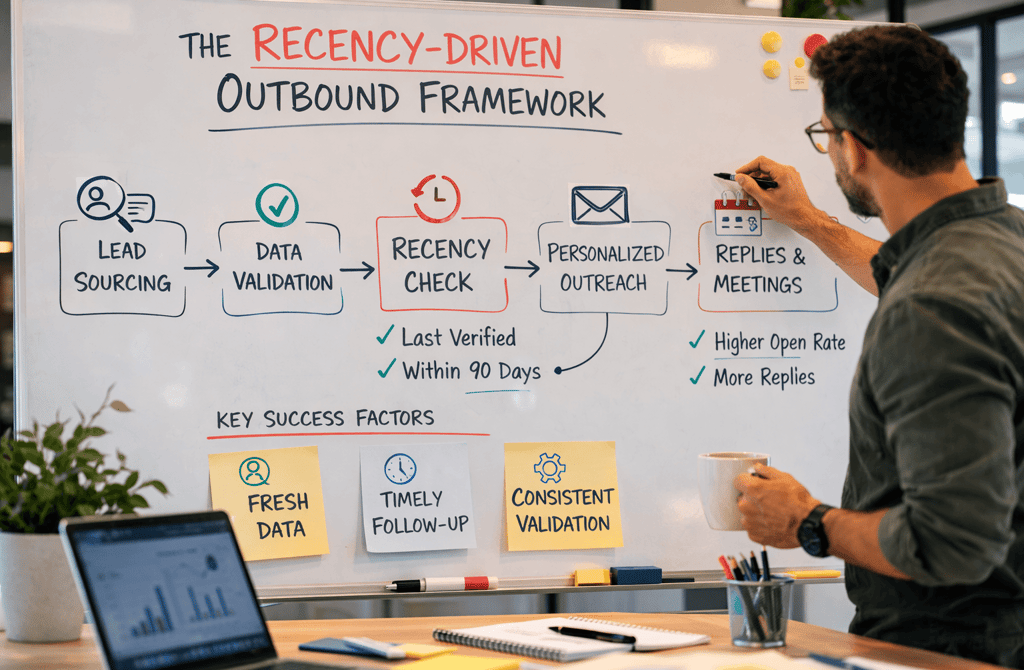
Many outbound teams treat lead lists as static assets.
They build a database once, upload it to their outreach platform, and begin testing subject lines, messaging angles, and follow-up timing. When results decline, the instinct is to rewrite the campaign or adjust copy.
But the highest-performing outbound teams operate very differently.
They treat lead data as something that constantly ages, and they structure their entire outreach system around controlling that aging process. Instead of focusing first on messaging, they focus on recency.
This operational mindset forms what many teams informally call a recency-driven framework.
The First Principle: Data Has a Shelf Life
In B2B markets, roles and responsibilities change continuously.
People get promoted.
Teams restructure.
Companies merge or expand into new markets.
Every one of those changes slowly erodes the accuracy of a contact database.
A lead list that was perfectly targeted six months ago may now contain:
Contacts who changed companies
Decision-makers who moved to different departments
Email addresses that no longer receive messages
Prospects whose priorities shifted
Outbound teams that ignore this decay unknowingly weaken their campaigns over time.
High-performing teams design systems that detect and manage this decay before it affects deliverability and engagement.
Step One: Recency Filters Before Campaign Launch
The first layer of the framework happens before a campaign ever begins.
Instead of sending outreach to the entire database, teams apply recency filters to determine which contacts are still safe to target.
Typical recency checks include:
Last validation date
Job role confirmation
Email deliverability checks
These filters remove aging contacts from the active outreach pool. The result is a smaller but far more accurate campaign list.
That accuracy directly improves engagement signals once emails begin sending.
Step Two: Segment Leads by Data Age
Top outbound teams rarely treat all contacts equally.
Instead, they segment leads by how recently the data was verified.
For example, a typical structure might include:
Fresh leads (validated within the last 90 days)
Recently verified leads (3–6 months old)
Aging contacts (6–12 months old)
Each segment receives different outreach treatment.
Fresh leads often receive primary campaigns because they produce the strongest engagement signals. Older segments might be used cautiously or sent through re-verification before entering outreach again.
This segmentation prevents older data from contaminating campaign performance.
Step Three: Continuous Data Re-Validation
Another core component of the recency-driven framework is continuous validation.
Instead of cleaning data once a year, strong outbound teams maintain rolling validation cycles.
Contacts are rechecked regularly to confirm:
Email deliverability
Current job role
Company affiliation
Domain activity
This process prevents silent decay inside the database. Even small validation cycles dramatically improve list accuracy over time.
Teams that rely on verified B2B cybersecurity companies leads often prioritize frequent recency checks because security roles evolve quickly across organizations and responsibilities change often.
Without validation cycles, outreach systems slowly drift away from the real structure of the market.
Step Four: Monitoring Engagement Signals
Recency-driven systems also monitor the signals that inbox providers observe.
Outbound teams track metrics such as:
Reply rates
Open rates
Bounce levels
Spam complaints
When engagement begins to decline, high-performing teams investigate the data age distribution of the campaign rather than assuming messaging problems.
In many cases, declining performance traces back to aging contact records rather than poor copywriting.
Monitoring these signals allows teams to pause campaigns before deliverability issues spread across domains.
Step Five: Refreshing Data Before Scaling Campaigns
Scaling outreach too quickly with aging data is one of the fastest ways to damage sender reputation.
The recency-driven framework prevents this by refreshing the contact pool before expansion.
When teams want to increase sending volume, they first ensure the database contains enough recently validated contacts to support the larger campaign.
This approach maintains stable engagement signals even as outbound volume grows.
Without that safeguard, scaling campaigns can amplify the negative signals caused by outdated contacts.
What Makes the Framework Effective
The reason this framework works is simple: it aligns outreach with how inbox providers evaluate senders.
Email filtering systems analyze patterns of engagement across campaigns. If emails consistently reach relevant recipients, sender reputation improves.
Recency-driven outreach naturally produces those positive signals.
Fresh contacts are more likely to:
Recognize the company sending the message
Respond to relevant offers
Engage with the email rather than ignoring it
Over time, these signals strengthen domain reputation and stabilize inbox placement.
Bottom Line
The strongest outbound systems do not start with subject lines or messaging experiments.
They start with data recency.
When teams build their outreach process around controlling how quickly their lead database ages, campaign performance becomes far more predictable. Deliverability improves, engagement stabilizes, and scaling outreach becomes much safer.
The most reliable outbound growth often comes from improving the structure behind the campaigns, not the emails themselves.
Clean outreach systems depend on contact data that reflects the current structure of companies and decision-makers.
When the database drifts away from that reality, even the best campaigns struggle to reach the inbox.
Related Post:
The Compounding Waste Caused by Outdated Lead Lists
How Data Drift Disrupts Revenue Decision-Making
Why Revenue Systems Require Continuous Data Validation
The Data Signals That Reveal Structural Revenue Weakness
How Over-Automation Creates Pipeline Noise
Why SDR Judgment Beats Automation in High-Stakes Accounts
The Blind Spots Inside Automation-First Outbound Systems
How System-Level Data Drift Derails Reliable Email Sending
Why Modern Outbound Systems Rely on Data Interconnectivity
The Data Dependencies Most Founders Never See
How Industry Turnover Drives Bounce Rate Differences
Why High-Churn Markets Produce Unstable Email Data
The Bounce Risk Patterns Hidden Inside Each Industry
How Industry-Specific Roles Influence Email Behavior
Why Certain Verticals Prefer Multi-Step Messaging
The Outbound Timing Patterns Hidden Inside Each Industry
How Sector Stability Predicts Long-Term Data Freshness
Why Fast-Decay Verticals Require More Frequent Validation
The Industry-Level Signals That Reveal Accelerated Data Aging
Why AI Becomes Unreliable With Aged Lead Lists
The AI Pipeline Behind Modern B2B Data Processing
Why LLM-Assisted Validation Requires Clean Metadata
The Vertical Variances That Predict ICP Fit Accuracy
How Industry Complexity Impacts Lead Quality Signals
Why Some Verticals Have Stronger Multi-Contact Data
The Channel-Specific Validation Gaps Most Teams Never Notice
How Contact Recency Impacts Phone Outreach More Than Email
Why LinkedIn Signals Reveal Intent Email Can’t Detect
The Geographic Accuracy Patterns Hidden in Lead Lists
How Cultural Factors Influence B2B Data Consistency
Why Contact Fields Behave Differently Across Regions
The Pricing Logic Behind High-Demand Industries
How Industry Growth Trends Impact Lead Cost
Why Validation Depth Changes Lead Prices by Industry
How Lead Recency Influences Inbox Placement More Than Subject Lines
Connect
Get verified leads that drive real results for your business today.
www.capleads.org
© 2025. All rights reserved.
Serving clients worldwide.
CapLeads provides verified B2B datasets with accurate contacts and direct phone numbers. Our data helps startups and sales teams reach C-level executives in FinTech, SaaS, Consulting, and other industries.