
Why Providers Overclaim Their Validation Accuracy
Many B2B data providers claim extremely high validation accuracy, but the reality is often different. Learn why verification claims are frequently overstated and how buyers can evaluate real data quality before purchasing lead lists.
INDUSTRY INSIGHTSLEAD QUALITY & DATA ACCURACYOUTBOUND STRATEGYB2B DATA STRATEGY
CapLeads Team
3/12/20264 min read
At some point, every company buying B2B leads hears the same promise.
“99% verified.”
“Fully validated.”
“Guaranteed accuracy.”
On paper, these claims sound reassuring. If a provider is advertising extremely high validation accuracy, it should mean the data is reliable enough to launch campaigns with confidence.
But experienced outbound teams eventually notice something strange.
Even when lists are marketed as “fully verified,” bounce rates appear higher than expected. Job titles don’t always match the real decision-maker. Some contacts have clearly changed roles months earlier.
The gap between the claimed accuracy and the actual performance of the data begins to reveal an uncomfortable truth.
Many providers dramatically overstate how accurate their validation really is.
Understanding why this happens helps buyers evaluate data more realistically before they rely on it for outreach.
The Problem With “Single-Step Validation”
One major reason providers exaggerate accuracy is that many validation processes are far simpler than buyers assume.
In many cases, “validation” means only one automated check, such as:
Syntax verification
Domain existence checks
SMTP handshake detection
These checks are useful, but they only answer one narrow question: Does the email server accept messages?
They do not confirm whether:
The person still works at the company
The role matches the target buyer
The email is tied to an active employee
The contact is safe to include in outreach
A list can technically pass these automated tests and still contain outdated or misaligned contacts.
When providers advertise “verified data,” they often refer only to these surface-level checks.
Marketing Incentives Push Accuracy Claims Higher
Another reason validation accuracy gets inflated is simple competitive pressure.
The lead generation market is crowded. Providers compete heavily on a few visible metrics:
price per lead
bounce rate claims
validation percentages
If one provider claims 98% accuracy, others feel pressure to match or exceed that number.
But real validation accuracy is difficult to measure precisely. Data moves constantly. Roles change. Companies restructure.
Because of this complexity, providers often round their numbers upward to remain competitive in marketing comparisons.
Over time, these inflated figures become the industry norm.
Validation Accuracy Is Harder Than It Looks
A realistic validation process usually involves multiple layers.
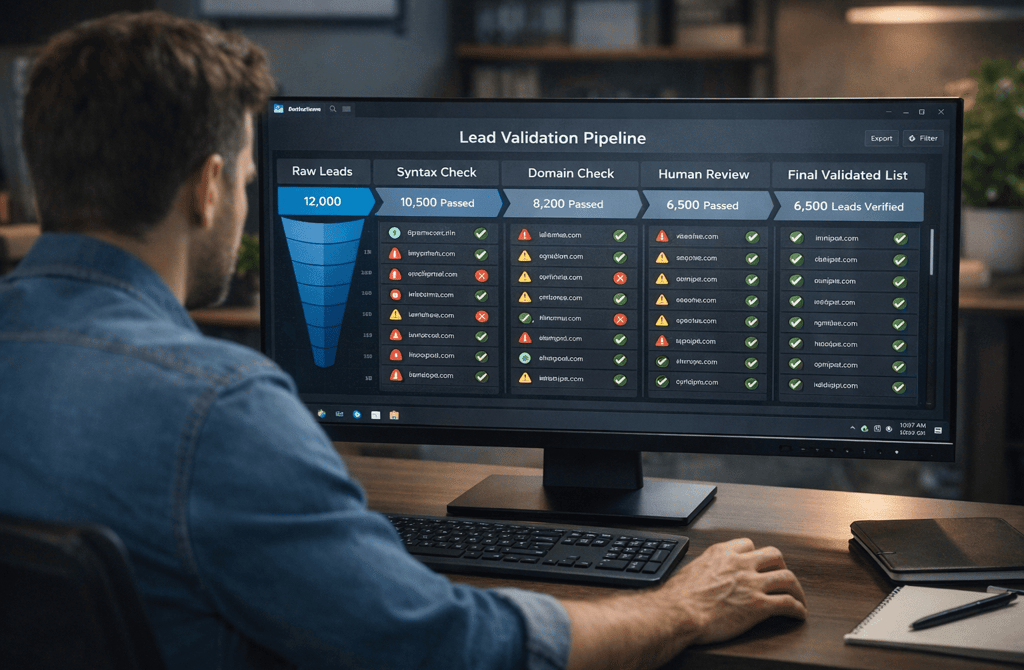
A typical high-quality pipeline includes stages such as:
Raw data ingestion
syntax and domain verification
cross-source enrichment
role and title normalization
manual or AI-assisted review
final list preparation
Each step introduces new opportunities to detect errors.
But every additional step also costs time and resources.
Some providers shorten this process to move faster. Others skip deeper validation entirely, relying almost entirely on automation.
The result is a dataset that technically passes basic verification checks but still contains hidden inaccuracies.
Data Changes Faster Than Providers Can Maintain
Another overlooked factor is how quickly B2B data decays.
Employees change roles frequently. Startups grow and restructure. Departments merge or split.
Even a perfectly validated record can become outdated within months.
This means a provider claiming extremely high accuracy must also maintain continuous data refresh cycles.
Without constant updates, accuracy numbers decline over time—even if the initial validation process was solid.
This is why buyers sometimes receive lists that look correct on paper but perform inconsistently during outreach.
Buyers Rarely Audit Validation Claims
Most buyers never verify a provider’s validation claims themselves.
Once a dataset is delivered, teams typically move straight into campaign execution.
Only after running outreach do they notice problems such as:
unexpected bounce clusters
incorrect job titles
inactive employees
mismatched departments
By then, the accuracy claim has already served its purpose: convincing the buyer to trust the dataset.
Without deeper audits or verification transparency, inflated claims can remain unchallenged.
What Buyers Should Look For Instead
Instead of focusing on marketing percentages, experienced teams look for signals that reveal how validation actually works.
These signals include:
whether the provider explains their validation layers
how frequently the dataset is refreshed
whether multiple data sources are used
whether human review is included in the process
whether validation happens continuously or only once
These operational details usually matter far more than a single advertised accuracy number.
When validation is treated as an ongoing system rather than a one-time process, data quality tends to remain far more stable.
Why Validation Transparency Matters
For outbound teams, the quality of contact data determines whether campaigns succeed or fail.
When validation is overstated, teams unknowingly take on additional risk.
Bounce rates rise. targeting becomes inconsistent. outreach results fluctuate.
Accurate validation isn’t just a technical process—it directly affects campaign predictability.
That’s why more experienced buyers now evaluate providers based on how validation works, not just the percentage claims used in marketing.
For companies targeting consulting firms and advisory organizations, using consulting B2B leads built from structured validation pipelines helps reduce the uncertainty that inflated accuracy claims often introduce.
What This Means
The B2B lead industry has developed a habit of advertising impressive validation numbers, but those figures rarely tell the full story.
Real validation accuracy depends on process depth, data refresh cycles, and how carefully providers handle inconsistencies across sources.
When those systems are weak, accuracy claims quickly become marketing slogans rather than operational reality.
Reliable outreach begins with data that has been examined carefully, updated frequently, and validated across multiple layers.
Because in outbound, the stability of your results always reflects the integrity of the data behind them.
Related Post:
Why SDR Judgment Beats Automation in High-Stakes Accounts
The Blind Spots Inside Automation-First Outbound Systems
How System-Level Data Drift Derails Reliable Email Sending
Why Modern Outbound Systems Rely on Data Interconnectivity
The Data Dependencies Most Founders Never See
How Industry Turnover Drives Bounce Rate Differences
Why High-Churn Markets Produce Unstable Email Data
The Bounce Risk Patterns Hidden Inside Each Industry
How Industry-Specific Roles Influence Email Behavior
Why Certain Verticals Prefer Multi-Step Messaging
The Outbound Timing Patterns Hidden Inside Each Industry
How Sector Stability Predicts Long-Term Data Freshness
Why Fast-Decay Verticals Require More Frequent Validation
The Industry-Level Signals That Reveal Accelerated Data Aging
Why AI Becomes Unreliable With Aged Lead Lists
The AI Pipeline Behind Modern B2B Data Processing
Why LLM-Assisted Validation Requires Clean Metadata
The Vertical Variances That Predict ICP Fit Accuracy
How Industry Complexity Impacts Lead Quality Signals
Why Some Verticals Have Stronger Multi-Contact Data
The Channel-Specific Validation Gaps Most Teams Never Notice
How Contact Recency Impacts Phone Outreach More Than Email
Why LinkedIn Signals Reveal Intent Email Can’t Detect
The Geographic Accuracy Patterns Hidden in Lead Lists
How Cultural Factors Influence B2B Data Consistency
Why Contact Fields Behave Differently Across Regions
The Pricing Logic Behind High-Demand Industries
How Industry Growth Trends Impact Lead Cost
Why Validation Depth Changes Lead Prices by Industry
How Lead Recency Influences Inbox Placement More Than Subject Lines
The Recency-Driven Framework High-Performing Outbound Teams Use
Why Lead Lists Decay Faster in Certain Industries
Connect
Get verified leads that drive real results for your business today.
www.capleads.org
© 2025. All rights reserved.
Serving clients worldwide.
CapLeads provides verified B2B datasets with accurate contacts and direct phone numbers. Our data helps startups and sales teams reach C-level executives in FinTech, SaaS, Consulting, and other industries.