
How System-Level Data Drift Derails Reliable Email Sending
When system-level data fields drift out of alignment, email performance breaks long before bounce rates spike. Learn how hidden data dependencies quietly undermine reliable outbound sending.
INDUSTRY INSIGHTSLEAD QUALITY & DATA ACCURACYOUTBOUND STRATEGYB2B DATA STRATEGY
CapLeads Team
3/2/20264 min read
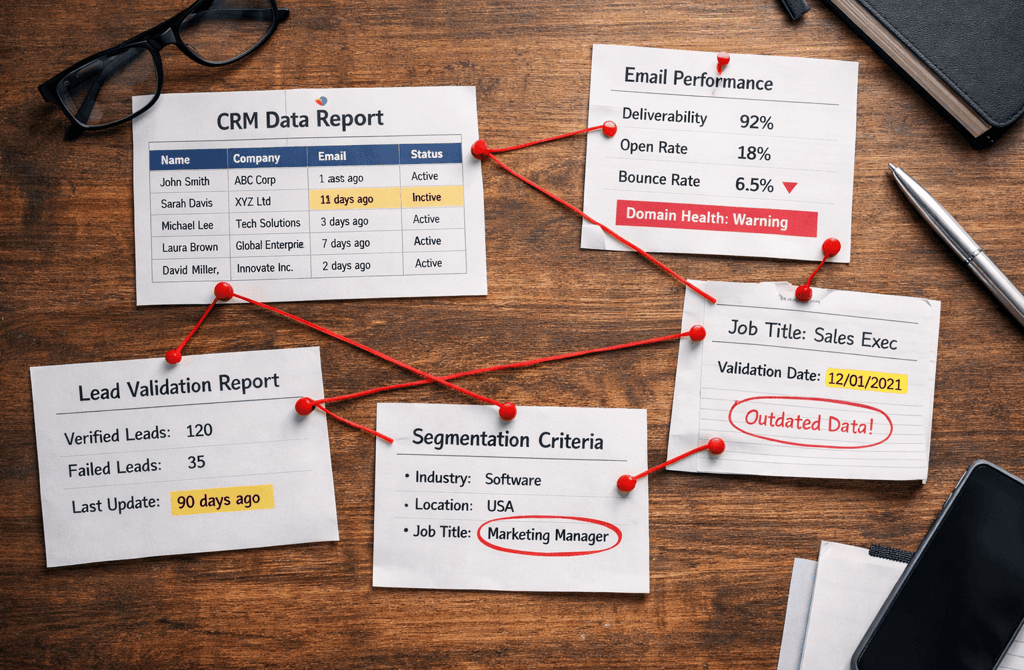

Email systems don’t collapse in dramatic fashion. They degrade quietly.
A campaign that once delivered stable open rates starts showing subtle inconsistencies. Bounce rates remain “acceptable,” but reply quality drops. Domain health indicators fluctuate. Segments that previously converted begin to stall. Nothing looks catastrophic — yet reliability disappears.
This is what system-level data drift looks like.
Most teams think of drift as a contact problem. An outdated title. A stale validation date. A job change that wasn’t captured. But drift at the system level is different. It’s not about one bad record — it’s about how small inaccuracies ripple through interconnected layers of your outbound architecture.
Reliable email sending depends on stable data dependencies. When those dependencies drift out of alignment, performance becomes unpredictable.
Drift Doesn’t Break a Field — It Breaks Relationships
In isolation, a single outdated job title seems harmless.
But that title feeds segmentation logic. Segmentation feeds targeting. Targeting influences engagement signals. Engagement influences inbox placement. Inbox placement shapes domain reputation.
Now multiply that by thousands of records.
System-level drift occurs when interdependent fields fall out of sync:
Recency data no longer reflects validation timing.
Company size data misaligns with ICP filters.
Role metadata conflicts with department categorization.
CRM lifecycle stages don’t match actual buyer movement.
Individually, these errors look minor. Collectively, they destabilize the system.
Email sending is not a linear process. It’s a chain of dependent calculations. When upstream accuracy weakens, downstream reliability erodes.
The Illusion of Stability
One of the most dangerous traits of system-level drift is that it hides behind “acceptable metrics.”
You might see:
Deliverability above 90%
No immediate domain warnings
Yet something feels off.
Reply rates flatten.
Engagement timing shifts.
Certain segments stop responding entirely.
This is where teams misdiagnose the problem. They rewrite copy. They adjust subject lines. They modify cadence.
But the issue isn’t messaging.
It’s structural misalignment.
When CRM fields, validation timestamps, and segmentation filters are no longer synchronized, the system begins sending to contacts that technically exist but no longer align behaviorally. That mismatch trains inbox providers to view your traffic as less relevant.
Over time, inbox placement becomes inconsistent.
Reliable sending becomes guesswork.
Data Dependencies Amplify Drift
Modern outbound stacks rely on layered logic:
Validation tools determine send eligibility.
Segmentation rules determine audience grouping.
Scoring models determine priority.
Sending infrastructure interprets engagement patterns.
Spam filters evaluate historical consistency.
Each layer depends on the integrity of the previous one.
If recency metadata drifts by 60–90 days, segmentation accuracy declines.
If company growth data lags behind reality, ICP filters misfire.
If role precision degrades, buying committee targeting collapses.
This is why accurate B2B data for consulting firms or any industry-specific segment isn’t just about contact correctness — it’s about preserving alignment across the entire system.
When alignment holds, performance feels stable.
When it slips, performance becomes erratic.
Why System-Level Drift Is Hard to Detect
Drift rarely announces itself.
There’s no flashing red dashboard that says:
“Your metadata relationships are misaligned.”
Instead, you see secondary symptoms:
Increased follow-ups required per reply
Higher soft-bounce clusters
Slower engagement velocity
Inconsistent inbox placement across domains
Segment-specific underperformance
These aren’t infrastructure failures. They’re dependency failures.
And because the breakdown is gradual, teams adapt to lower performance without realizing that reliability has degraded.
The system keeps sending — but predictability disappears.
Preventing Drift at the System Level
Fixing system-level drift isn’t about one-time cleaning.
It requires discipline across:
Recency controls
Cross-field consistency checks
Role and department synchronization
Company data revalidation cycles
CRM lifecycle auditing
More importantly, it requires understanding that outbound reliability is not an email problem.
It’s a dependency stability problem.
The moment one layer ages faster than the others, the system begins compensating with weaker signals. Inbox providers detect that instability long before your bounce rate spikes.
And once domain reputation begins absorbing those inconsistencies, recovery becomes slow.
Why This Matters
Reliable email sending is not created by better copy or higher volume.
It’s created by stable data relationships.
When system-level data remains synchronized — recency, role accuracy, segmentation logic, lifecycle stage — email performance feels consistent. Metrics stabilize. Reply behavior becomes easier to forecast.
But when drift accumulates across interconnected fields, reliability disappears long before obvious warning signs appear.
Outbound systems don’t fail because of one bad contact.
They fail because silent data misalignment weakens every downstream signal.
When your data dependencies remain aligned, outbound feels controlled and measurable.
When those dependencies drift apart, performance turns volatile and infrastructure begins to erode.
Related Post:
How Engagement Timing Predicts Buying Motivation
Why Intent Data Works Only When the Inputs Are Clean
The Multi-Signal Indicators Behind Strong Reply Rates
How ICP Precision Improves Reply Rate Fast
Why Bad Data Creates False Low-Reply Signals
The Underestimated Variables Behind Reply Probability
How Data Drift Creates False Confidence in Pipeline Health
Why Incorrect ICP Fit Leads to Dead Pipeline Stages
The Drop-Off Patterns That Reveal Data Quality Problems
How Duplicate CRM Entries Kill Data Reliability
Why CRM Metadata Conflicts Corrupt Segmentation
The Lifecycle Management Mistakes That Block Deals
How Scoring Drift Creates False High-Priority Leads
Why Strong Scoring Depends on Field Completeness
The Multi-Signal Scoring Framework That Actually Works
How Inconsistent Metadata Breaks Your Segmentation Logic
Why Metadata Drift Happens Inside Large Lead Lists
The Contact-Level Clues Buried Inside Metadata Fields
How Company Expansion Alters Contact Accuracy
Why Lifecycle Drift Skews Segmentation Over Time
The Stage-Based Patterns That Predict Reply Probability
How Source Diversity Boosts Lead Accuracy at Scale
Why Multi-Source Data Requires Stricter Deduplication
The Blending Rules That Prevent Data Integrity Loss
How Bad Data Bloats Sending Volume With No Returns
Why SDR Teams Burn Out When Lead Data Is Faulty
The Compounding Waste Caused by Outdated Lead Lists
How Data Drift Disrupts Revenue Decision-Making
Why Revenue Systems Require Continuous Data Validation
The Data Signals That Reveal Structural Revenue Weakness
How Over-Automation Creates Pipeline Noise
Why SDR Judgment Beats Automation in High-Stakes Accounts
The Blind Spots Inside Automation-First Outbound Systems
Connect
Get verified leads that drive real results for your business today.
www.capleads.org
© 2025. All rights reserved.
Serving clients worldwide.
CapLeads provides verified B2B datasets with accurate contacts and direct phone numbers. Our data helps startups and sales teams reach C-level executives in FinTech, SaaS, Consulting, and other industries.