
How Sector Stability Predicts Long-Term Data Freshness
Some industries maintain stable company structures for years, while others change weekly. Learn how sector stability influences data freshness—and why it determines how long B2B lead lists stay reliable for outbound.
INDUSTRY INSIGHTSLEAD QUALITY & DATA ACCURACYOUTBOUND STRATEGYB2B DATA STRATEGY
CapLeads Team
3/5/20264 min read

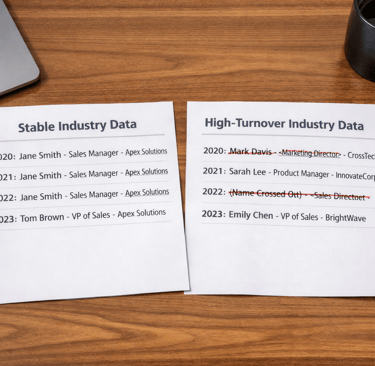
Markets don’t move at the same speed.
Some industries change leadership structures every quarter. Others keep the same executives and organizational structures for years. From an outbound perspective, that difference matters more than most teams realize. Sector stability directly affects how long contact data remains accurate—and ultimately how predictable outreach performance becomes.
Many outbound teams treat lead lists as static assets. Once a dataset is acquired, it’s assumed that the contacts inside it will remain usable for months. In reality, the longevity of that data depends heavily on the industry the companies belong to.
Some sectors naturally preserve data accuracy longer. Others continuously erode it.
Understanding the difference can determine whether your campaigns operate on stable foundations or constantly fight invisible decay.
Why Sector Stability Shapes Data Freshness
Every industry has its own rhythm of hiring, restructuring, and organizational change. When that rhythm is slow and predictable, data remains usable longer. When it’s fast and chaotic, contact accuracy degrades quickly.
Stable sectors often share several characteristics:
Longer executive tenure
Slower company restructuring cycles
More traditional operational structures
Lower workforce turnover at senior levels
These factors allow contact records to remain accurate for extended periods.
By contrast, fast-moving sectors experience rapid hiring cycles, aggressive growth phases, and constant internal changes. In those environments, titles shift frequently, departments reorganize, and decision-makers move between companies.
The result is faster data decay.
Outbound teams who ignore these structural differences often misinterpret campaign results. When replies drop or bounce rates increase, the problem is frequently blamed on copy or messaging—even though the underlying issue is that the contact data has quietly become outdated.
Stable Industries Preserve Data Integrity Longer
Certain industries maintain remarkably consistent organizational structures.
Manufacturing companies, for example, often operate with stable leadership teams and clearly defined departmental hierarchies. Senior roles change less frequently, and the buying committees responsible for vendor decisions remain intact for longer periods.
Similarly, many healthcare organizations maintain relatively stable administrative structures due to regulatory complexity and operational continuity requirements. Decision-makers tend to stay in their roles longer, and departmental responsibilities evolve more gradually.
This structural stability allows contact data to remain accurate for extended periods.
For outbound teams, this means that validated datasets from these sectors often maintain higher deliverability rates and more consistent reply behavior over time.
That is one reason companies seeking verified healthcare company leads often prioritize deeper validation and careful data management—because the sector rewards accuracy and long-term reliability.
Stable industries reward disciplined data practices.
When the underlying organizational structures move slowly, clean data can continue producing results long after it is first validated.
Fast-Moving Sectors Age Data Rapidly
Other industries operate in a completely different environment.
High-growth markets frequently experience leadership reshuffles, rapid scaling, and constant internal restructuring. Startups expand departments quickly, titles evolve as companies grow, and key decision-makers move between firms.
From a data perspective, this creates extremely short accuracy windows.
A contact record that is correct today may become outdated within a few months. Job titles change, responsibilities shift, and buying committees reorganize.
Outbound teams operating in these sectors must refresh their data far more frequently.
Without continuous validation, datasets quickly lose reliability.
This is why campaigns targeting fast-moving industries often experience sudden spikes in bounce rates or declining engagement. The underlying market dynamics are simply eroding the data faster than the outreach systems can adapt.
Sector Stability Influences Deliverability Signals
Data freshness doesn’t just affect reply rates. It also shapes how inbox providers interpret your campaigns.
When lead data remains accurate, outreach naturally produces stronger engagement signals:
Fewer hard bounces
Higher positive reply rates
Better engagement consistency
These signals strengthen domain reputation and improve long-term deliverability.
But when data ages rapidly, the opposite occurs.
Outdated contacts lead to bounced emails, ignored messages, and declining engagement. Inbox providers interpret those signals as signs of poor targeting, which can gradually reduce inbox placement.
Over time, the campaign appears to “stop working,” even though the real issue is that the data foundation has eroded.
Sector stability determines how quickly this erosion occurs.
Aligning Data Strategy With Industry Behavior
Outbound teams often apply the same data strategy across every campaign. But sectors behave differently, and the lifespan of lead data varies accordingly.
Industries with stable leadership structures allow longer refresh cycles and more predictable targeting. Campaigns can run longer before datasets require full revalidation.
In contrast, volatile industries demand constant updates. Data must be refreshed frequently, and campaigns must adapt quickly to organizational changes.
Recognizing these differences allows teams to design outreach systems that remain effective longer.
Instead of fighting invisible data decay, the campaign infrastructure aligns with how each sector actually behaves.
Conclusion
Outbound success often appears to hinge on messaging, sequencing, or personalization. But beneath every successful campaign is something far more fundamental: the stability of the data itself.
Industries that move slowly preserve contact accuracy for longer periods. Markets that evolve rapidly erode data reliability much faster.
Understanding sector stability allows outbound teams to predict how long their data will remain trustworthy—and when it needs to be refreshed.
Campaigns built on stable, well-maintained data foundations perform consistently because the underlying contacts remain accurate.
But when sector dynamics accelerate data decay, even the best outreach systems struggle to produce reliable results.
Reliable outbound starts with understanding how long your data stays true to reality.
When contact data remains stable, outreach stays efficient; when it decays faster than expected, even strong campaigns lose their footing.
Related Post:
Why CRM Metadata Conflicts Corrupt Segmentation
The Lifecycle Management Mistakes That Block Deals
How Scoring Drift Creates False High-Priority Leads
Why Strong Scoring Depends on Field Completeness
The Multi-Signal Scoring Framework That Actually Works
How Inconsistent Metadata Breaks Your Segmentation Logic
Why Metadata Drift Happens Inside Large Lead Lists
The Contact-Level Clues Buried Inside Metadata Fields
How Company Expansion Alters Contact Accuracy
Why Lifecycle Drift Skews Segmentation Over Time
The Stage-Based Patterns That Predict Reply Probability
How Source Diversity Boosts Lead Accuracy at Scale
Why Multi-Source Data Requires Stricter Deduplication
The Blending Rules That Prevent Data Integrity Loss
How Bad Data Bloats Sending Volume With No Returns
Why SDR Teams Burn Out When Lead Data Is Faulty
The Compounding Waste Caused by Outdated Lead Lists
How Data Drift Disrupts Revenue Decision-Making
Why Revenue Systems Require Continuous Data Validation
The Data Signals That Reveal Structural Revenue Weakness
How Over-Automation Creates Pipeline Noise
Why SDR Judgment Beats Automation in High-Stakes Accounts
The Blind Spots Inside Automation-First Outbound Systems
How System-Level Data Drift Derails Reliable Email Sending
Why Modern Outbound Systems Rely on Data Interconnectivity
The Data Dependencies Most Founders Never See
How Industry Turnover Drives Bounce Rate Differences
Why High-Churn Markets Produce Unstable Email Data
The Bounce Risk Patterns Hidden Inside Each Industry
How Industry-Specific Roles Influence Email Behavior
Why Certain Verticals Prefer Multi-Step Messaging
The Outbound Timing Patterns Hidden Inside Each Industry
Connect
Get verified leads that drive real results for your business today.
www.capleads.org
© 2025. All rights reserved.
Serving clients worldwide.
CapLeads provides verified B2B datasets with accurate contacts and direct phone numbers. Our data helps startups and sales teams reach C-level executives in FinTech, SaaS, Consulting, and other industries.