
How Bad Data Bloats Sending Volume With No Returns
When your lead data is weak, sending volume spikes while replies flatline. Learn how bad data inflates outreach metrics, increases bounce rates, and quietly wastes your entire outbound capacity.
INDUSTRY INSIGHTSLEAD QUALITY & DATA ACCURACYOUTBOUND STRATEGYB2B DATA STRATEGY
CapLeads Team
2/27/20263 min read
There’s a point in outbound where activity starts to look like progress.
Dashboards glow. Email counts climb. Sequences scale. The team feels busy.
But underneath that rising volume, nothing meaningful moves.
Sending volume is one of the most misleading metrics in cold email. It’s easy to increase. It’s easy to celebrate. And it’s completely useless if the data underneath it is weak.
Bad data doesn’t just lower reply rates. It distorts your entire outbound system by inflating activity without producing outcomes.
The Illusion of Momentum
When lead quality drops, one of two things usually happens:
Reply rates fall.
Teams compensate by sending more.
Instead of diagnosing the root cause — poor targeting, stale contacts, incomplete fields — volume becomes the solution.
If 2,000 emails don’t work, send 5,000.
If 5,000 don’t work, send 10,000.
But weak data doesn’t scale. It compounds waste.
As bounce rates creep upward and reply rates flatten, the system quietly burns:
Sending capacity
Domain reputation
Warmup stability
Follow-up cycles
You feel active. You feel aggressive. But the returns stay flat.
Why Weak Data Forces Volume Inflation
Bad data creates three structural problems that push teams toward higher volume:
1. Low Intent Density
When segmentation is loose and ICP precision is weak, the percentage of truly relevant contacts shrinks.
If only 2–3% of a list actually matches your real buyer profile, volume becomes a brute-force attempt to find them.
You’re not targeting.
You’re fishing.
2. Bounce Suppression Through Volume
Ironically, high bounce rates often trigger more sending.
Instead of tightening validation rules, teams try to “average out” the damage by increasing overall sends. The math feels comforting:
“If we just send enough, replies will come.”
But inbox providers don’t average behavior — they evaluate patterns. Rising bounce clusters signal low data integrity immediately.
3. Metadata Gaps That Kill Relevance
Incomplete role, department, or company-size fields force generic messaging. Generic messaging lowers engagement. Lower engagement reduces reply rates.
And when reply rates drop, volume increases again.
It becomes a loop:
Bad data → Low engagement → More volume → Higher risk → Worse performance.
The Hidden Cost of Inflated Volume
On the surface, higher sending looks like scale.
Underneath, it creates structural damage.
More follow-ups to dead contacts
More bounce clean-up cycles
More suppression lists
More revalidation
More warmup instability
Outbound becomes heavier. Slower. Less predictable.
The team works harder, but the system gets weaker.
This is especially visible in technology and telecom B2B lead data, where role changes, reorgs, and rapid company shifts can quietly shrink the number of valid, high-fit contacts inside a list. Volume rises to compensate — but returns don’t.
The Signal Inside the Dashboard
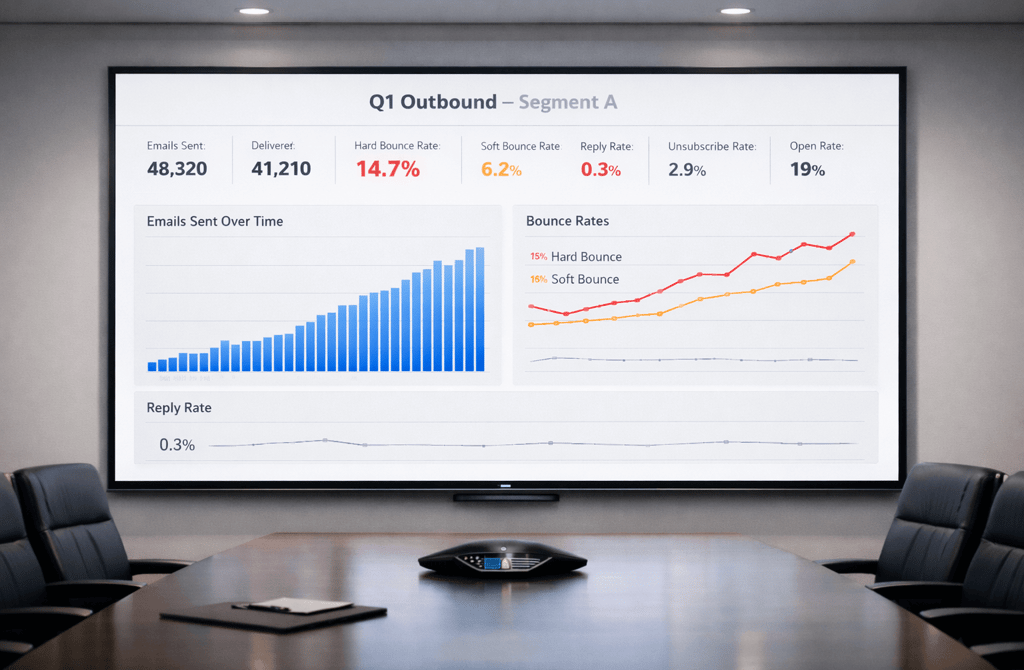
If you look closely at bloated campaigns, the pattern is obvious:
Emails sent trending sharply upward
Bounce rate slowly climbing
Reply rate flat near zero
Unsubscribes creeping higher
Open rates inconsistent
The system is expanding activity, not effectiveness.
That’s what bad data does. It converts precision work into mechanical repetition.
Clean Data Compresses Volume
When lead quality improves, something interesting happens:
You send less.
Not because you can’t send more — but because you don’t need to.
High-integrity data increases intent density.
Intent density increases reply probability.
Reply probability reduces required volume.
Outbound becomes lighter.
You stop chasing numbers and start focusing on fit.
Instead of 50,000 sends to generate noise, you might need 8,000 well-targeted contacts to create meaningful conversations.
Volume becomes a byproduct of quality — not a substitute for it.
Operational Discipline vs Volume Addiction
Scaling outbound is not about pushing the send button harder.
It’s about tightening:
ICP filters
Validation thresholds
Recency windows
Role precision
Field completeness
Every one of those reduces waste.
The moment sending volume becomes the primary lever, it’s usually a sign that data discipline has slipped.
What This Means
If your dashboard shows rising volume and flat replies, don’t rewrite the copy first.
Don’t extend the sequence.
Don’t add another domain.
Audit the list.
Because inflated sending is rarely a messaging problem. It’s almost always a data integrity problem disguised as ambition.
Outbound doesn’t break because teams send too little.
It breaks because they send too much to the wrong people.
When targeting is precise and validation is strict, volume becomes efficient.
When data is weak and segmentation is loose, scale turns into waste.
Related Post:
Why Buyer Fit Accuracy Matters More Than Industry Fit
The Hidden ICP Mistakes That Make Outreach Unpredictable
How Poor Data Creates Blind Spots in Committee Mapping
Why Buying Committees Prefer Consistent Messaging Across Roles
The Contact Layering Strategy Behind Multi-Threaded Sequences
How Engagement Timing Predicts Buying Motivation
Why Intent Data Works Only When the Inputs Are Clean
The Multi-Signal Indicators Behind Strong Reply Rates
How ICP Precision Improves Reply Rate Fast
Why Bad Data Creates False Low-Reply Signals
The Underestimated Variables Behind Reply Probability
How Data Drift Creates False Confidence in Pipeline Health
Why Incorrect ICP Fit Leads to Dead Pipeline Stages
The Drop-Off Patterns That Reveal Data Quality Problems
How Duplicate CRM Entries Kill Data Reliability
Why CRM Metadata Conflicts Corrupt Segmentation
The Lifecycle Management Mistakes That Block Deals
How Scoring Drift Creates False High-Priority Leads
Why Strong Scoring Depends on Field Completeness
The Multi-Signal Scoring Framework That Actually Works
How Inconsistent Metadata Breaks Your Segmentation Logic
Why Metadata Drift Happens Inside Large Lead Lists
The Contact-Level Clues Buried Inside Metadata Fields
How Company Expansion Alters Contact Accuracy
Why Lifecycle Drift Skews Segmentation Over Time
The Stage-Based Patterns That Predict Reply Probability
How Source Diversity Boosts Lead Accuracy at Scale
Why Multi-Source Data Requires Stricter Deduplication
The Blending Rules That Prevent Data Integrity Loss
Connect
Get verified leads that drive real results for your business today.
www.capleads.org
© 2025. All rights reserved.
Serving clients worldwide.
CapLeads provides verified B2B datasets with accurate contacts and direct phone numbers. Our data helps startups and sales teams reach C-level executives in FinTech, SaaS, Consulting, and other industries.