
Why Incorrect ICP Fit Leads to Dead Pipeline Stages
Incorrect ICP targeting doesn’t just lower reply rates — it creates stalled deals and dead pipeline stages. Learn how ICP misalignment silently kills conversion momentum and what to fix.
INDUSTRY INSIGHTSLEAD QUALITY & DATA ACCURACYOUTBOUND STRATEGYB2B DATA STRATEGY
CapLeads Team
2/20/20263 min read
A pipeline doesn’t die at the top.
It dies in the middle.
When deals consistently stall in “Qualified,” “Proposal Sent,” or “Negotiation,” the instinct is to push harder. Add more follow-ups. Tighten objections. Improve demos. Increase urgency.
But when multiple opportunities freeze in the same stage, that’s not a sales execution problem.
That’s an ICP misalignment problem.
Dead stages are rarely caused by lack of effort. They are created when your targeting logic allows structurally incompatible accounts into the funnel.
The Illusion of Progress
Incorrect ICP fit creates what looks like movement.
The prospect replies.
A discovery call happens.
A proposal gets requested.
The CRM shows activity. The deal advances.
But the foundation is unstable.
The account may:
Have budget, but not at the right level.
Have interest, but not operational readiness.
Have the right title, but not actual authority.
Fit your industry filter, but not your lifecycle sweet spot.
The deal moves forward on surface signals — not structural compatibility.
That’s how it ends up parked mid-pipeline.
Dead Stages Are a Probability Problem
An ICP is not a description. It’s a probability filter.
When it’s accurate, it increases the likelihood that early engagement converts into later-stage momentum.
When it’s wrong, early-stage engagement becomes noise.
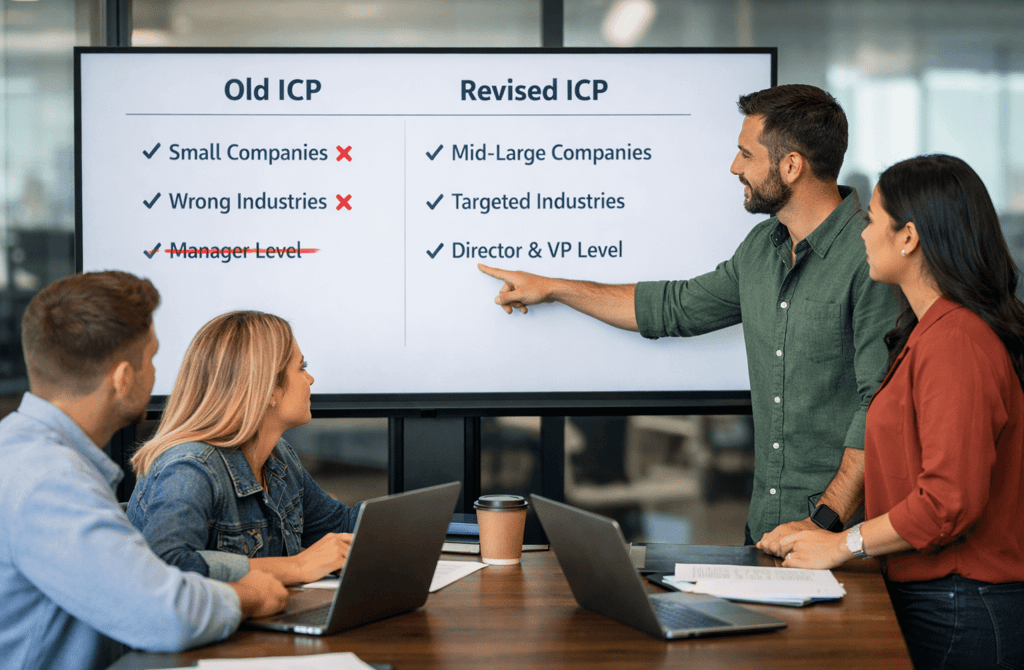
For example, in FinTech B2B leads, regulatory layers, procurement controls, and risk oversight structures often mean that mid-level interest does not translate into executive approval. If your ICP assumes manager-level buying authority, your pipeline fills with “engaged” accounts that never gain internal traction.
That’s not a messaging failure.
That’s a structural assumption failure.
Why These Deals Rarely Die Cleanly
Incorrect-fit deals don’t always close-lost quickly.
Instead, they:
Go silent after internal review.
Ask for extended timelines.
Introduce new stakeholders late.
Request additional documentation without committing.
They linger.
Lingering deals inflate stage counts and distort forecast models.
Because they’re technically open, they give a false sense of depth.
But depth without velocity is not strength — it’s drag.
The Stage Clustering Warning
One of the clearest signals of ICP misalignment is stage clustering.
If a disproportionate number of deals accumulate in one column for longer than historical norms, something upstream is wrong.
It could be:
Role misclassification.
Incorrect company size assumptions.
Wrong lifecycle targeting.
Outdated buyer mapping.
Dead stages aren’t random.
They are statistical signals.
When fit declines, stage velocity declines.
The Hidden Cost of Misfit Accounts
Carrying incorrect-fit opportunities has cascading effects:
Forecast inflation
SDR rework cycles
AE time wasted on low-probability deals
Longer average sales cycles
Lower close-rate benchmarks
Misleading performance analytics
Worse, teams start adjusting strategy around flawed data.
They change pricing.
They rewrite messaging.
They alter cadence.
All while the real issue sits untouched: the ICP model is letting in accounts that were never designed to close.
Why ICP Drift Makes It Harder to Notice
Even strong ICPs decay.
Market conditions shift.
Funding cycles tighten.
Org charts restructure.
Buying committees expand.
If your ICP remains static while your target market evolves, misalignment grows quietly.
You don’t notice immediately because early engagement still exists.
But deeper conversion stalls.
And stalled conversion is what creates dead stages.
Structural Correction Instead of Surface Optimization
Fixing dead pipeline stages requires moving upstream.
Not better objection handling.
Not more automation.
Not more follow-ups.
It requires:
Revalidating buyer authority assumptions.
Reviewing company lifecycle compatibility.
Auditing historical wins for structural commonalities.
Comparing stalled deals against closed-won deals.
Tightening segmentation logic.
When ICP precision improves, stage velocity improves.
Because the accounts entering your pipeline are built to move — not just respond.
What This Means
Dead pipeline stages are not usually a sales effort problem.
They are an ICP accuracy problem disguised as sales friction.
When targeting assumptions are wrong, deals enter your funnel but never reach gravity.
When targeting is precise, progression becomes natural.
Clean targeting builds forward motion.
Misaligned ICPs build traffic — not traction.
Related Post:
The Hidden Problems Caused by Outdated Job Roles
How Poor Infrastructure Amplifies Minor Data Issues
Why Weak Architecture Triggers Spam Filters Faster
The Domain Reputation Mechanics Founders Should Understand
How Spam Algorithms Interpret Sudden Send Volume Changes
Why Inconsistent Targeting Raises Spam Filter Suspicion
The Inbox Sorting Logic ESPs Never Explain Publicly
How Risky Sending Patterns Trigger Domain-Level Penalties
Why Domain Reputation Is Built on Consistency, Not Volume
The Hidden Domain Factors That Influence Inbox Placement
Why Copy Tweaks Don’t Fix Underlying Data Problems
The Hidden Data Requirements Behind High-Performing Frameworks
Why Framework Experiments Fail When Lists Aren’t Fresh
How Overly Broad Segments Lower Reply Probability
Why Weak Targeting Logic Confuses Inbox Providers
The Real Cost of Using “Catch-All” Segments in Outbound
How Weak ICP Definitions Inflate Your Pipeline With Noise
Why Buyer Fit Accuracy Matters More Than Industry Fit
The Hidden ICP Mistakes That Make Outreach Unpredictable
How Poor Data Creates Blind Spots in Committee Mapping
Why Buying Committees Prefer Consistent Messaging Across Roles
The Contact Layering Strategy Behind Multi-Threaded Sequences
How Engagement Timing Predicts Buying Motivation
Why Intent Data Works Only When the Inputs Are Clean
The Multi-Signal Indicators Behind Strong Reply Rates
How ICP Precision Improves Reply Rate Fast
Why Bad Data Creates False Low-Reply Signals
The Underestimated Variables Behind Reply Probability
How Data Drift Creates False Confidence in Pipeline Health
Connect
Get verified leads that drive real results for your business today.
www.capleads.org
© 2025. All rights reserved.
Serving clients worldwide.
CapLeads provides verified B2B datasets with accurate contacts and direct phone numbers. Our data helps startups and sales teams reach C-level executives in FinTech, SaaS, Consulting, and other industries.