
The Blending Rules That Prevent Data Integrity Loss
When multiple datasets are combined without structure, integrity erodes fast. Here are the blending rules that protect field accuracy, resolve conflicts, and prevent silent data corruption.
INDUSTRY INSIGHTSLEAD QUALITY & DATA ACCURACYOUTBOUND STRATEGYB2B DATA STRATEGY
CapLeads Team
2/26/20263 min read
Most data integrity failures don’t start with corruption.
They start with merging.
When teams combine datasets, the intention is enrichment — better coverage, stronger fields, deeper segmentation. But without strict blending rules, integration quietly introduces contradictions that erode structural trust.
Blending is not stacking records together.
It is deciding which truth survives.
If that decision logic isn’t defined upfront, integrity loss becomes gradual and invisible.
Blending Without Hierarchy Creates Silent Overwrites
When two sources disagree, one must win.
If Source A lists a contact as “Director of Operations”
and Source B lists them as “VP Operations,”
a merge process must determine:
Which title is more recent?
Which source has higher authority?
Should both be preserved with timestamps?
Without hierarchy rules, merges often default to:
Last imported value wins
Or first value preserved
Or random overwrite based on system logic
Each of these approaches risks degrading accuracy.
Data blending requires source weighting — not blind merging.
Standardization Must Precede Consolidation
Blending raw fields before normalization multiplies inconsistencies.
Company names, for example, vary widely:
“Acme Ltd.”
“Acme Limited”
“Acme Ltd”
“ACME LTD”
If consolidation occurs before standardization, duplicate entities remain hidden under formatting differences.
Title variation behaves similarly:
“Chief Revenue Officer”
“CRO”
“Head of Revenue”
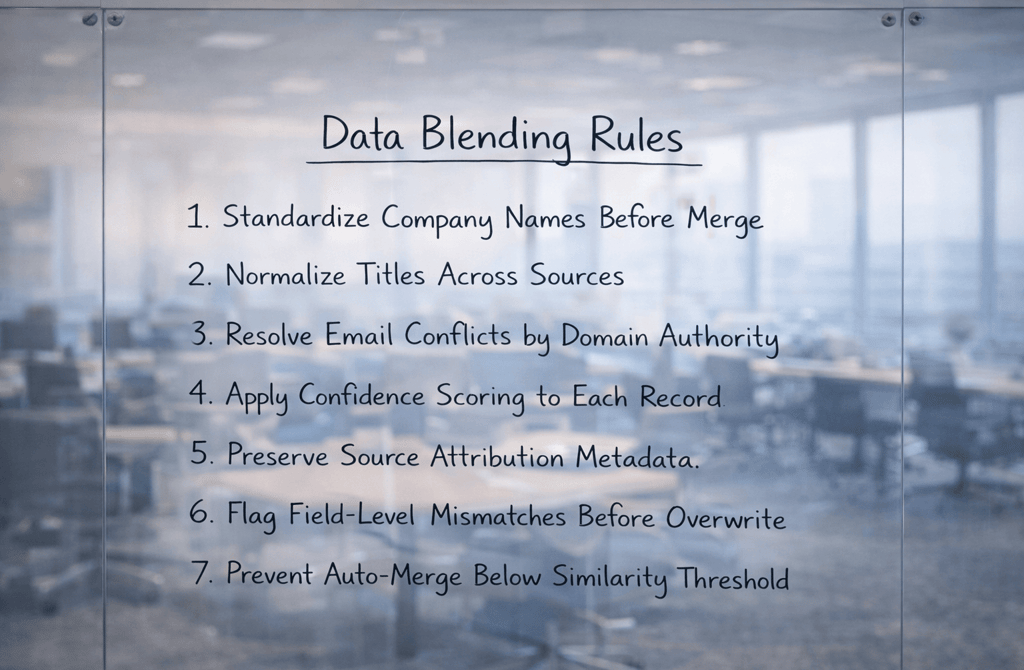
Blending rules must define:
Canonical company naming structure
Approved title normalization dictionary
Formatting standards across fields
Integrity protection begins before records touch each other.
Field-Level Validation Prevents Cascade Errors
Not all fields should be treated equally during blending.
Some fields tolerate variation:
Phone formatting
Middle initials
Others require strict validation:
Email domain alignment
Company-to-domain mapping
Seniority tier classification
If a blend overwrites a validated corporate email with a lower-confidence alternative, deliverability risk increases immediately.
In industries like Industrials B2B lead targeting, where procurement structures can be rigid and authority lines clearly defined, incorrect seniority blending can shift targeting toward non-decision roles without anyone noticing.
Blending rules must classify fields by sensitivity.
Not every mismatch is equal.
Preserve Source Attribution — Always
One of the most common integrity mistakes is losing source metadata during merge.
When records are blended without preserving origin tags, conflict resolution becomes impossible later.
If a title appears incorrect, you must know:
Which source supplied it
When it was imported
What its original format was
Without attribution, auditing becomes guesswork.
Blending rules should require:
Persistent source tagging
Timestamp preservation
Conflict logs for overwritten fields
Integrity isn’t just about correctness.
It’s about traceability.
Confidence Scoring Should Guide Merge Decisions
Binary merging is outdated logic.
Modern blending should operate on probabilistic confidence:
High-confidence match → merge automatically
Medium-confidence → flag for review
Low-confidence → maintain separation
Confidence scoring should consider:
Name similarity
Email-to-domain validation
Title alignment strength
Blending without scoring increases the chance of false merges — combining two distinct individuals into one record — which is often harder to detect than duplicates.
Integrity loss from over-merging can distort segmentation more severely than leaving duplicates unresolved.
Protect the Core Identity Graph
Every database should maintain a stable identity backbone:
Person ID
Company ID
Verified domain
Blending rules should prioritize protecting this core graph above enrichment fields.
When identity anchors shift due to careless merging, downstream segmentation inherits instability:
Accounts appear merged incorrectly
Contacts shift companies unexpectedly
ICP filters return inconsistent results
The blending layer must respect identity anchors as immutable unless strong evidence supports change.
Blending Is Ongoing, Not One-Time
Data integrity protection is not a single import event.
As new datasets enter the system, blending rules must re-evaluate:
Existing identities
Prior merge decisions
Confidence thresholds
Without continuous enforcement, drift reintroduces conflict.
Every new source increases blending complexity.
Without defined rules, scale magnifies corruption.
What This Means
Blending is the most underestimated integrity risk in multi-source pipelines.
Without structured rules for normalization, hierarchy, conflict resolution, and confidence scoring, merging datasets gradually distorts segmentation accuracy.
When blending logic is defined before integration, datasets strengthen each other.
When merging happens without governance, integrity erodes quietly beneath expanding volume.
Related Post:
Why Weak Targeting Logic Confuses Inbox Providers
The Real Cost of Using “Catch-All” Segments in Outbound
How Weak ICP Definitions Inflate Your Pipeline With Noise
Why Buyer Fit Accuracy Matters More Than Industry Fit
The Hidden ICP Mistakes That Make Outreach Unpredictable
How Poor Data Creates Blind Spots in Committee Mapping
Why Buying Committees Prefer Consistent Messaging Across Roles
The Contact Layering Strategy Behind Multi-Threaded Sequences
How Engagement Timing Predicts Buying Motivation
Why Intent Data Works Only When the Inputs Are Clean
The Multi-Signal Indicators Behind Strong Reply Rates
How ICP Precision Improves Reply Rate Fast
Why Bad Data Creates False Low-Reply Signals
The Underestimated Variables Behind Reply Probability
How Data Drift Creates False Confidence in Pipeline Health
Why Incorrect ICP Fit Leads to Dead Pipeline Stages
The Drop-Off Patterns That Reveal Data Quality Problems
How Duplicate CRM Entries Kill Data Reliability
Why CRM Metadata Conflicts Corrupt Segmentation
The Lifecycle Management Mistakes That Block Deals
How Scoring Drift Creates False High-Priority Leads
Why Strong Scoring Depends on Field Completeness
The Multi-Signal Scoring Framework That Actually Works
How Inconsistent Metadata Breaks Your Segmentation Logic
Why Metadata Drift Happens Inside Large Lead Lists
The Contact-Level Clues Buried Inside Metadata Fields
How Company Expansion Alters Contact Accuracy
Why Lifecycle Drift Skews Segmentation Over Time
The Stage-Based Patterns That Predict Reply Probability
How Source Diversity Boosts Lead Accuracy at Scale
Why Multi-Source Data Requires Stricter Deduplication
Connect
Get verified leads that drive real results for your business today.
www.capleads.org
© 2025. All rights reserved.
Serving clients worldwide.
CapLeads provides verified B2B datasets with accurate contacts and direct phone numbers. Our data helps startups and sales teams reach C-level executives in FinTech, SaaS, Consulting, and other industries.