
Why Industry Structure Shapes Lead Accuracy Patterns
Industry structure directly affects lead accuracy. Learn how org design, role clarity, and hierarchy patterns shape how reliable B2B data really is.
INDUSTRY INSIGHTSLEAD QUALITY & DATA ACCURACYOUTBOUND STRATEGYB2B DATA STRATEGY
CapLeads Team
12/16/20253 min read
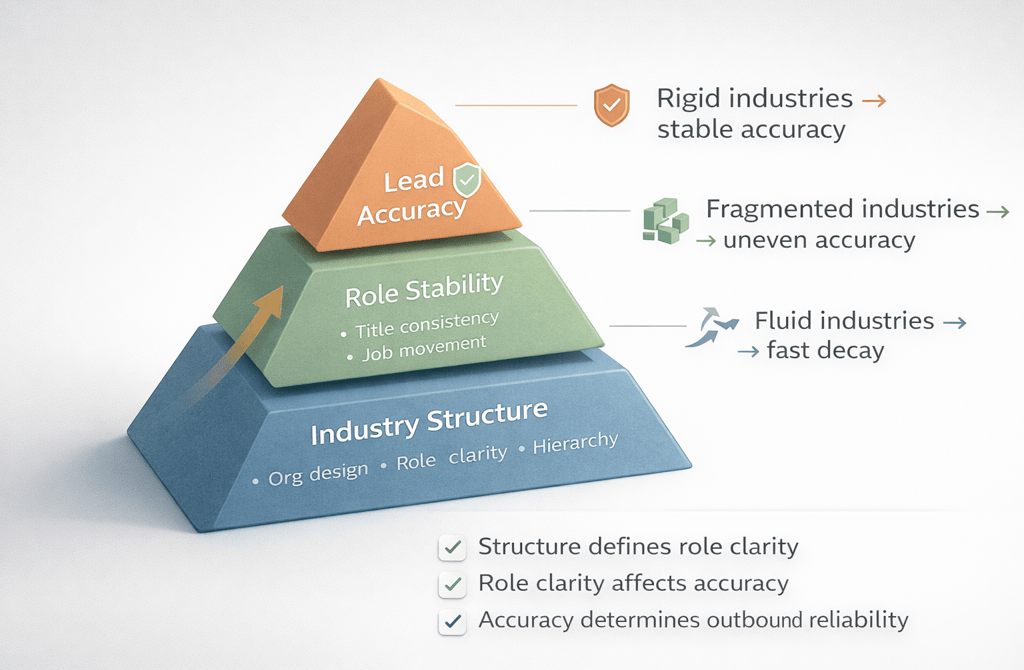
Most outbound teams think lead accuracy is a tooling problem. If data goes bad, the assumption is that validation failed or the source was weak. What’s often missed is that industry structure itself determines how accurate lead data can realistically be.
Two datasets collected the same way can behave completely differently once they’re used in outreach — not because one is “better,” but because the industries behind them are built differently.
Understanding this structural layer is what separates predictable outbound from constant troubleshooting.
1. Industry Structure Comes Before Data Quality
Every industry has an underlying structure: how companies are organized, how authority flows, and how roles are defined.
Some industries operate with clear hierarchies and rigid role boundaries. Others rely on overlapping responsibilities, flexible titles, or constantly shifting teams. These structural traits directly influence how accurate lead data remains after collection.
When structure is stable, data holds its shape. When structure is fluid or fragmented, accuracy erodes faster — even if validation checks pass.
2. Rigid Structures Produce More Stable Lead Accuracy
Industries with rigid organizational design tend to produce more reliable lead data.
In regulated or traditional sectors, roles are clearly defined and slow to change. Job titles carry consistent meaning. Decision-making authority is easier to map. When someone holds a role, they usually keep it for a reasonable length of time.
This stability means that lead data stays accurate longer. Email addresses, titles, and departments remain aligned, reducing the risk of sending relevant messages to the wrong person.
Outbound teams working in these industries often experience fewer surprises, even with modest refresh cycles.
3. Fragmented Structures Create Uneven Accuracy Patterns
Some industries don’t follow clean hierarchies.
Construction, logistics, and field-based sectors often have overlapping roles, inconsistent titles, and decentralized authority. Decision-making may shift between projects, locations, or timeframes. Digital records lag behind reality.
In these environments, lead accuracy becomes uneven rather than uniformly bad. Some contacts remain correct for months. Others become outdated almost immediately. This inconsistency is what makes outreach feel unpredictable.
Teams that expect uniform accuracy across a list struggle here because the structure itself doesn’t support consistency.
4. Fluid Structures Accelerate Accuracy Decay
Modern tech and fast-moving service industries introduce another pattern: structural fluidity.
Teams reorganize frequently. Titles evolve. Responsibilities expand laterally. Someone can remain at the same company while their relevance to a buying decision changes completely.
This creates fast accuracy decay. The contact may still exist, but the role no longer matches the intent or authority implied by the data. Validation tools won’t always catch this because the email still works.
Outbound teams often mistake this for messaging failure when it’s actually structural drift.
5. Why Accuracy Problems Are Often Misdiagnosed
Most teams look at accuracy through a technical lens: bounce rates, syntax checks, or validation scores.
What they miss is that accuracy patterns are structural before they are technical. A dataset can be technically valid and strategically wrong at the same time.
When industry structure isn’t considered, teams:
over-trust unstable data
under-refresh volatile segments
misread performance signals
This leads to endless tweaking instead of systemic fixes.
6. Adjusting Accuracy Expectations by Industry
High-performing outbound teams don’t chase perfect accuracy everywhere. They adjust expectations based on structure.
They expect slower decay and cleaner mapping in rigid industries. They plan for uneven reliability in fragmented sectors. They refresh aggressively in fluid environments where roles shift quickly.
This approach doesn’t require more tools — it requires structural awareness.
Final Thought
Lead accuracy isn’t random, and it isn’t purely a data problem. It reflects how industries are built.
When outbound strategy respects industry structure, accuracy patterns become easier to predict, refresh cycles make sense, and outreach stops feeling like guesswork.
Related Posts
Why Titles & Departments Matter More Than Personalization
The Hidden Patterns in Leads That Always Reply
Why Some Industries Email Back Faster Than Others
How Buying Behavior Data Influences Outbound Results
The Real Meaning of Verified in B2B Lead Data
Why Multi-Signal Data Outperforms Basic Email Lists
The Micro-Data Points That Predict Reply Probability
Why Data Completeness Makes Outbound Easier to Scale
How Company Lifecycle Stage Impacts Deliverability
The Common Data Gaps That Break Founder-Led Outreach
The Hidden Indicators That Tell You a Lead Is Worth Emailing
Why Mapping the Buying Committee Boosts Reply Rates
Why AI Needs Clean Inputs to Improve Lead Accuracy
The Hidden AI Errors Caused by Dirty Data
How AI Enhances Lead Processing Without Replacing Humans
Why AI Models Break When Metadata Is Incomplete
Why Each Industry Produces Completely Different Lead Data
The Vertical Data Behaviors Most Outbound Teams Miss
How B2B Data Signals Change Depending on the Industry
Connect
Get verified leads that drive real results for your business today.
www.capleads.org
© 2025. All rights reserved.
Serving clients worldwide.
CapLeads provides verified B2B datasets with accurate contacts and direct phone numbers. Our data helps startups and sales teams reach C-level executives in FinTech, SaaS, Consulting, and other industries.