
Why Multi-Signal Data Outperforms Basic Email Lists
Multi-signal data explains why some outbound campaigns outperform simple email lists. This post breaks down the real differences and results.
INDUSTRY INSIGHTSLEAD QUALITY & DATA ACCURACYOUTBOUND STRATEGYB2B DATA STRATEGY
CapLeads Team
12/13/20252 min read
For a long time, outbound was built on one assumption:
if you have an email address, you have a lead.
That assumption no longer holds.
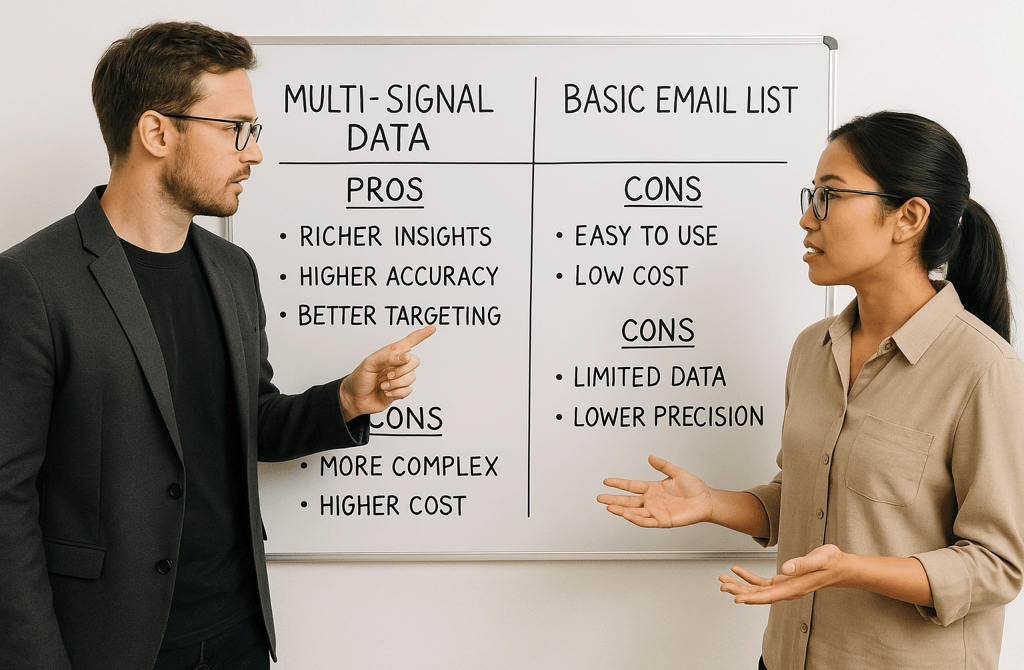
Basic email lists may still deliver messages, but delivery alone doesn’t create replies, meetings, or revenue. What separates high-performing outbound from stalled campaigns is context — and that context comes from multi-signal data.
1. Basic Email Lists Only Answer “Can I Send?”
A basic email list usually provides:
An email address
Sometimes a name
Occasionally a job title
That’s it.
This type of data answers a single question: Can this message be delivered?
It does not answer:
Is this person still in the role?
Does this company buy tools like mine?
Is there any reason they’d care right now?
Outbound built on basic lists often relies on volume to compensate for missing context.
2. Multi-Signal Data Explains “Should I Send?”
Multi-signal data goes beyond deliverability.
It layers additional signals such as:
Role and department accuracy
Company size and industry fit
Technology usage or tool adoption
Buying behavior or recent company changes
Verification status across multiple fields
Instead of guessing, outbound becomes selective. Messages are sent because conditions align — not because a list exists.
3. Context Changes How Messages Are Interpreted
The same outbound message can perform very differently depending on the data behind it.
With basic email lists:
Messages feel generic
Timing is accidental
Relevance is assumed, not confirmed
With multi-signal data:
Messaging aligns with real responsibilities
Offers match company maturity
Outreach lands when change is already happening
Performance improves not because the copy is clever, but because the message makes sense when it arrives.
4. Multi-Signal Data Reduces Wasted Volume
Basic lists push teams toward scale:
More emails
More follow-ups
More inbox noise
Multi-signal data shifts outbound toward efficiency:
Fewer contacts
Higher relevance
Better response density
This reduces deliverability risk and improves consistency across campaigns.
5. Verification Alone Isn’t Enough
Many lists advertise “verified emails” as their primary value.
Verification matters — but it’s only one signal.
A verified email tied to:
The wrong role
The wrong company size
A stagnant organization
Is still a poor outbound target.
Multi-signal data ensures verification supports relevance instead of masking deeper mismatches.
6. Why Results Diverge Over Time
Early outbound campaigns using basic lists may show temporary success. Over time, results usually decay as:
Roles change
Companies evolve
Timing drifts
Multi-signal data adapts better because it’s tied to movement, not static snapshots. This is why long-term outbound systems increasingly outperform list-based tactics.
Final Thought
Multi-signal data doesn’t replace outbound fundamentals — it sharpens them.
When outreach is supported by role accuracy, company context, and real behavioral signals, results stop depending on volume and start depending on alignment.
Clean data makes outbound predictable by stacking the right signals before a message is sent.
Basic email lists ignore those signals — and force teams to guess instead.
Related Pos
Why Email Volume Doesn't Fix Data Problems
How Data Scoring Boosts Deliverability
Why Domain Reputation Depends on Your Lead Data Quality
The Data-Driven Way to Increase Cold Email ROI
Why Your Inbox Placement Is Linked to Lead Validation
How Data Recency Improves Reply Intent
Why Clean Lists Outperform Personalization Tricks
Why Lead Segmentation Matters More Than List Size
The Real Science Behind Targeting the Right Decision-Maker
Why Role-Based Targeting Beats Mass Prospecting
How Company Health Signals Predict Your Cold Email Success
The Data Behind High-Intent Prospects Most People Miss
Why Industry Fit Decides Whether Your Cold Email Works
What Pipeline-Ready Lead Data Actually Looks Like
The Silent Impact of Company Size Accuracy in Outreach
Why Titles & Departments Matter More Than Personalization
The Hidden Patterns in Leads That Always Reply
Why Some Industries Email Back Faster Than Others
How Buying Behavior Data Influences Outbound Results
The Real Meaning of Verified in B2B Lead Data
Connect
Get verified leads that drive real results for your business today.
www.capleads.org
© 2025. All rights reserved.
Serving clients worldwide.
CapLeads provides verified B2B datasets with accurate contacts and direct phone numbers. Our data helps startups and sales teams reach C-level executives in FinTech, SaaS, Consulting, and other industries.