
How Company Lifecycle Stage Impacts Deliverability
Deliverability changes as companies grow. Learn how company lifecycle stage impacts inbox placement, sender trust, and outbound performance.
INDUSTRY INSIGHTSLEAD QUALITY & DATA ACCURACYOUTBOUND STRATEGYB2B DATA STRATEGY
CapLeads Team
12/14/20252 min read
Deliverability problems don’t appear randomly.
They usually show up when outbound volume increases faster than the systems supporting it. One of the most overlooked factors behind this is company lifecycle stage.
The same outbound behavior that works for a startup can quietly break deliverability at scale.
1. Deliverability Changes as Companies Grow
Email providers don’t judge senders in isolation.
They evaluate patterns over time—volume consistency, engagement signals, complaint rates, and domain behavior. As companies move through different lifecycle stages, these patterns change.
What feels like a technical issue is often a maturity issue.
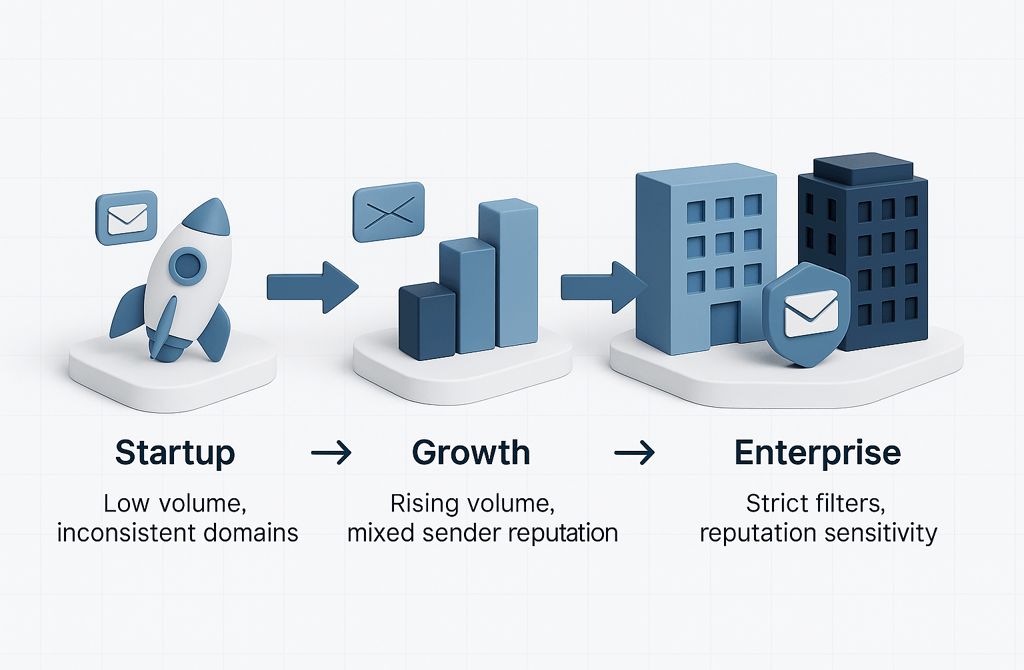
2. Startup Stage: Low Volume, Inconsistent Domains
Early-stage companies typically send low outbound volume.
They often:
Experiment with multiple domains
Pause and restart campaigns
Lack consistent engagement signals
At this stage, deliverability issues are usually masked by low volume. Emails land not because reputation is strong, but because there isn’t enough activity to trigger filtering.
The risk appears later, when habits formed early start scaling.
3. Growth Stage: Rising Volume, Mixed Sender Reputation
Growth introduces pressure.
Outbound volume increases, more inboxes are contacted, and reputation starts to matter. If domain practices, list quality, or warming processes weren’t disciplined early, cracks start to show.
Common issues here include:
Uneven inbox placement
Sudden spam filtering
Domain-level reputation volatility
Deliverability becomes inconsistent because sender signals are still stabilizing.
4. Scale Stage: Volume Amplifies Weak Signals
At scale, small mistakes compound.
Higher send volume amplifies every weak signal—poor engagement, outdated data, misaligned targeting. Email providers become less forgiving as volume increases.
This is where many outbound programs plateau. Messages aren’t blocked outright, but inbox placement degrades quietly, reducing replies without obvious errors.
Deliverability becomes an operational constraint, not a technical one.
5. Enterprise Stage: Reputation Sensitivity and Strict Filters
Enterprise environments operate under tighter scrutiny.
Email providers expect:
Stable sending patterns
Clean data sources
Strong engagement consistency
Minor deviations—sudden spikes, list changes, or targeting shifts—can trigger filtering faster than at earlier stages.
At this level, deliverability isn’t about warming or tools. It’s about predictability.
6. Why Lifecycle Awareness Prevents Deliverability Loss
Most deliverability issues aren’t caused by a single mistake.
They come from applying early-stage outbound behavior at later stages. What works when volume is low becomes risky when scale increases.
Aligning outbound strategy with company lifecycle stage prevents silent deliverability decay.
Final Thought
Deliverability doesn’t break overnight.
It erodes as outbound grows without structure.
Clean data makes outbound predictable.
Ignoring lifecycle-stage realities makes deliverability fail long before inboxes fully block you.
Related Pos
How Data Recency Improves Reply Intent
Why Clean Lists Outperform Personalization Tricks
Why Lead Segmentation Matters More Than List Size
The Real Science Behind Targeting the Right Decision-Maker
Why Role-Based Targeting Beats Mass Prospecting
How Company Health Signals Predict Your Cold Email Success
The Data Behind High-Intent Prospects Most People Miss
Why Industry Fit Decides Whether Your Cold Email Works
What Pipeline-Ready Lead Data Actually Looks Like
The Silent Impact of Company Size Accuracy in Outreach
Why Titles & Departments Matter More Than Personalization
The Hidden Patterns in Leads That Always Reply
Why Some Industries Email Back Faster Than Others
How Buying Behavior Data Influences Outbound Results
The Real Meaning of Verified in B2B Lead Data
Why Multi-Signal Data Outperforms Basic Email Lists
The Micro-Data Points That Predict Reply Probability
Why Data Completeness Makes Outbound Easier to Scale
Connect
Get verified leads that drive real results for your business today.
www.capleads.org
© 2025. All rights reserved.
Serving clients worldwide.
CapLeads provides verified B2B datasets with accurate contacts and direct phone numbers. Our data helps startups and sales teams reach C-level executives in FinTech, SaaS, Consulting, and other industries.