
Why High-Bounce Industries Need Stricter Data Filters
Some industries naturally produce higher bounce risk than others. Learn why high-bounce sectors require stricter data filters to protect deliverability and send reputation.
INDUSTRY INSIGHTSLEAD QUALITY & DATA ACCURACYOUTBOUND STRATEGYB2B DATA STRATEGY
CapLeads Team
1/31/20263 min read

Some industries don’t “break” email campaigns.
They stress-test them.
You can run the same outbound system, the same validation logic, and the same sending infrastructure—and see wildly different results depending on the industry you target. That’s not bad luck. It’s structural reality. Certain industries naturally generate more bounce risk, even when you do everything “right.”
Ignoring that difference is how teams damage send reputation without realizing why.
Bounce risk isn’t evenly distributed across industries
Not all industries produce contact data the same way. Some have:
High employee turnover
Decentralized company structures
Field-based or rotating roles
Frequent domain changes or subdomains
These characteristics increase the probability that contact data goes stale faster, even when sourced from reputable providers.
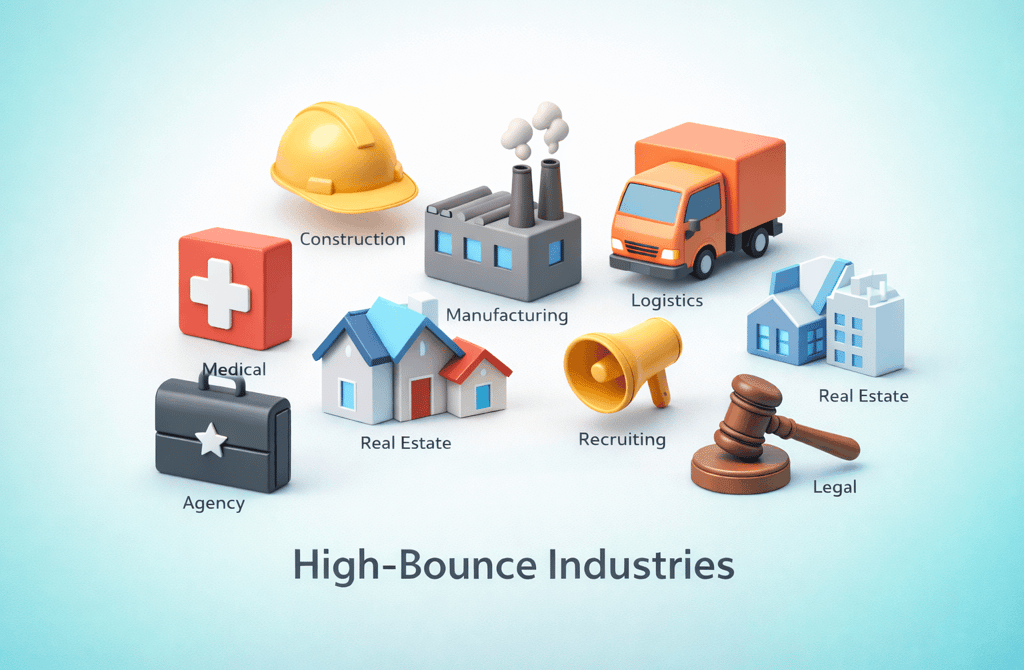
Industries like construction, logistics, recruiting, agencies, and some professional services simply move faster at the contact level. Email addresses don’t just expire—they become unpredictable.
Why standard filtering fails in high-bounce sectors
Most outbound systems use uniform data filters:
One recency rule
One validation depth
One send threshold
One retry logic
That works fine in stable industries. It breaks in volatile ones.
High-bounce industries require tighter gates because the margin for error is smaller. A filter that’s “good enough” elsewhere becomes a liability when role churn and domain volatility are high.
The result isn’t gradual underperformance. It’s sudden bounce spikes.
Bounce spikes are an industry signal, not a campaign mistake
When bounce rates surge in these sectors, teams often assume:
The list was bad
Validation failed
The provider messed up
Sometimes that’s true. Often, it’s not.
What actually happened is that industry behavior exceeded the tolerance of your filters. The system didn’t adapt to higher volatility, so invalid contacts slipped through in clusters instead of individually.
Inbox providers don’t contextualize that by industry. They just see risk.
Why stricter filters protect infrastructure, not just metrics
Stricter filtering in high-bounce industries isn’t about chasing lower bounce percentages for reporting.
It’s about:
Preventing bounce clustering
Reducing volatility between sends
Preserving domain trust under stress
Keeping error patterns predictable
Inbox systems reward consistency more than optimization. Strong filters make volatile industries behave predictably enough to stay trusted.
The mistake teams keep repeating
Teams often loosen filters to “increase volume” in hard-to-reach industries.
That tradeoff looks harmless in the short term:
More contacts
More sends
More apparent reach
But it quietly increases infrastructure risk. One bad batch can undo months of careful sending, especially when industry volatility is already high.
Volume doesn’t offset volatility. It amplifies it.
What experienced teams do differently
Teams that succeed in high-bounce industries don’t fight volatility—they design for it.
They:
Apply stricter recency cutoffs
Revalidate closer to send time
Exclude borderline domains entirely
Separate high-risk industries at the system level
They accept lower theoretical volume in exchange for higher structural stability. That’s what keeps their infrastructure alive.
Why this matters before you ever send
By the time bounce rates spike, the damage is already in motion.
The real decision happens earlier:
How strict your filters are
How you treat industry volatility
Whether you design one system or multiple tolerance levels
High-bounce industries don’t forgive lazy filtering. They expose it.
What This Means
Some industries naturally push email systems closer to failure.
When that’s the case, stricter data filters aren’t optional—they’re protective. Treating volatile industries the same as stable ones isn’t neutral. It’s risky.
If send reputation feels fragile in certain verticals, the issue usually isn’t effort.
It’s that the system wasn’t built to handle the industry you’re targeting.
Related Post:
Why LinkedIn Titles Matter More Than Email Metadata
How Regulatory Environments Influence Data Quality
Why Global Lead Lists Require Region-Specific Handling
The International Data Signals That Predict Reliability
How Country-Level Mobility Impacts Role Accuracy
Why Global Data Drifts Faster in Emerging Markets
How Market Competition Influences Lead Pricing
Why Industry Complexity Drives Lead Cost Variation
The Cross-Industry Factors That Predict Lead Price
How Data Difficulty Impacts Lead Cost Across Verticals
Why Some Sectors Offer Better Lead Value Than Others
Why Outbound Falls Apart When Lead Lists Age Faster Than Your Campaigns
The Real Reason Fresh Data Makes Your Outreach Feel Easier
How a 90-Day Recency Window Changes Your Entire Cold Email Strategy
The Hidden Costs of Emailing Contacts Who Haven’t Been Validated Recently
Why Aged Leads Attract More Spam Filter Scrutiny
The Silent Errors That Occur When Providers Skip Manual Review
How Deep Validation Reveals Problems Basic Checkers Can’t Detect
The Multi-Step Verification Process Behind Reliable Lead Lists
Why Cheap Tools Miss the Most Dangerous Email Types
The Difference Between Syntax Checks and Real Verification
The Bounce Threshold That Signals a System-Level Problem
How Email Infrastructure Breaks When You Use Aged Lists
The Real Reason Bounce Spikes Destroy Send Reputation
Connect
Get verified leads that drive real results for your business today.
www.capleads.org
© 2025. All rights reserved.
Serving clients worldwide.
CapLeads provides verified B2B datasets with accurate contacts and direct phone numbers. Our data helps startups and sales teams reach C-level executives in FinTech, SaaS, Consulting, and other industries.