
How Contact Aging Creates Metadata Conflicts in Your CRM
Contact aging doesn’t just make records outdated—it creates conflicting metadata inside your CRM. Learn how aging contacts distort segmentation, automation rules, and sales routing.
INDUSTRY INSIGHTSLEAD QUALITY & DATA ACCURACYOUTBOUND STRATEGYB2B DATA STRATEGY
CapLeads Team
3/14/20264 min read

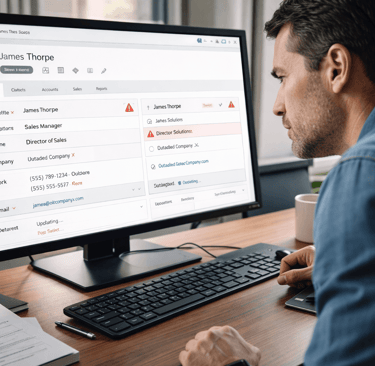
A contact enters the database at a specific moment in time. Their title reflects their role at that company. Their department signals where decisions are made. Their company profile matches the organization’s structure at that point.
Everything in the record makes sense.
But time keeps moving.
Contacts change roles. Departments reorganize. Companies expand, merge, or restructure leadership teams. The original record remains in the CRM, but the reality behind it evolves.
When this happens across thousands of records, a new problem begins to appear inside the CRM itself: metadata conflicts.
The Hidden Layer Behind CRM Records
Every contact record contains more than just a name and an email address.
Behind the visible fields sits a layer of metadata that powers how the CRM behaves. This includes job titles, departments, seniority levels, company size, industry classification, and ownership rules.
That metadata determines how contacts are segmented, routed, and prioritized.
For example, a CRM might automatically assign contacts with “Head of Operations” in their title to a specific sales team. Marketing automation might trigger campaigns based on department or company size. Lead scoring models may depend on seniority or role categories.
These systems assume the metadata inside the record remains accurate.
But contact aging slowly breaks that assumption.
How Aging Records Start Creating Conflicts
Aging contacts rarely produce obvious errors at first.
The CRM still recognizes the email address. The company name still exists. The record technically functions inside the system.
But the metadata inside the profile slowly stops matching reality.
A “Director of Procurement” becomes a “VP of Supply Chain.”
A “Head of IT” moves into an advisory role.
A “Marketing Manager” transitions into product leadership.
When these changes occur, the CRM continues to treat the contact according to the old metadata.
The result is conflicting information inside the system.
The visible job title may suggest one thing, while the routing logic still follows rules based on older metadata categories. Automation workflows trigger campaigns that no longer match the contact’s responsibilities.
The system hasn’t broken.
But it has become internally inconsistent.
When Metadata Conflicts Spread Across the CRM
One outdated record is manageable.
Thousands of aging records are not.
As contact aging spreads through a database, metadata conflicts begin to appear across multiple layers of the CRM:
Segmentation becomes unreliable because the same contact might belong to multiple categories at once. Lead scoring models begin prioritizing contacts based on outdated roles. Sales routing rules assign conversations to teams that are no longer relevant to the contact’s current responsibilities.
At first these issues look like minor operational inefficiencies.
Over time they start distorting the entire outreach system.
Why CRM Conflicts Are Hard to Detect
The most frustrating part of metadata conflicts is that they rarely trigger clear warnings.
CRMs typically flag obvious errors like missing emails or duplicate records. Metadata conflicts, however, are more subtle. The system still sees a valid contact record, so nothing appears broken.
Campaigns run normally.
Automation continues triggering workflows.
Sales pipelines remain active.
But the logic behind those systems becomes weaker because the metadata guiding them is no longer trustworthy.
Without regular data review, teams may not notice the drift until outreach performance begins to decline.
The Downstream Effects on Targeting
Once metadata conflicts appear, targeting precision starts to weaken.
Automation rules depend on consistent field values. When those values no longer match the contact’s real role, segmentation logic produces misleading results.
Marketing campaigns may target the wrong departments. Sales outreach may reach stakeholders who have already moved away from decision-making responsibilities. Lead scoring systems may prioritize contacts who no longer control budgets.
This creates a subtle but important shift.
The CRM still appears organized, but the signals guiding outreach become less reliable.
Organizations working with technology media and telecom decision-maker data often encounter this challenge because titles and departmental responsibilities evolve quickly across technology and media companies. A role that represented purchasing authority a year ago may no longer map to the same responsibility today.
If the metadata behind those records is not refreshed, the CRM begins operating on outdated assumptions.
The Real Risk of Contact Aging
Contact aging doesn’t simply produce outdated records.
It produces conflicting data structures inside the CRM.
Over time these conflicts weaken automation, distort segmentation, and reduce the accuracy of sales targeting. Teams may increase outreach volume or adjust messaging in response to declining performance, without realizing the system itself is being guided by inconsistent metadata.
The underlying issue remains hidden in the database.
What This Means for CRM Health
Healthy CRM systems rely on consistency between contact metadata and real-world company structures.
When records age without maintenance, that consistency disappears. The CRM continues to function, but its internal logic slowly loses alignment with the market it is meant to represent.
What This Means
CRM accuracy isn’t just about valid email addresses or active companies. It’s about maintaining metadata that reflects how roles and responsibilities actually evolve over time.
When contact records age without updates, the system doesn’t fail immediately. Instead, the structure of the data begins to contradict itself.
And once that happens, even the most organized CRM can quietly start guiding outreach in the wrong direction.
Related Post:
How Industry Turnover Drives Bounce Rate Differences
Why High-Churn Markets Produce Unstable Email Data
The Bounce Risk Patterns Hidden Inside Each Industry
How Industry-Specific Roles Influence Email Behavior
Why Certain Verticals Prefer Multi-Step Messaging
The Outbound Timing Patterns Hidden Inside Each Industry
How Sector Stability Predicts Long-Term Data Freshness
Why Fast-Decay Verticals Require More Frequent Validation
The Industry-Level Signals That Reveal Accelerated Data Aging
Why AI Becomes Unreliable With Aged Lead Lists
The AI Pipeline Behind Modern B2B Data Processing
Why LLM-Assisted Validation Requires Clean Metadata
The Vertical Variances That Predict ICP Fit Accuracy
How Industry Complexity Impacts Lead Quality Signals
Why Some Verticals Have Stronger Multi-Contact Data
The Channel-Specific Validation Gaps Most Teams Never Notice
How Contact Recency Impacts Phone Outreach More Than Email
Why LinkedIn Signals Reveal Intent Email Can’t Detect
The Geographic Accuracy Patterns Hidden in Lead Lists
How Cultural Factors Influence B2B Data Consistency
Why Contact Fields Behave Differently Across Regions
The Pricing Logic Behind High-Demand Industries
How Industry Growth Trends Impact Lead Cost
Why Validation Depth Changes Lead Prices by Industry
How Lead Recency Influences Inbox Placement More Than Subject Lines
The Recency-Driven Framework High-Performing Outbound Teams Use
Why Lead Lists Decay Faster in Certain Industries
Why Providers Overclaim Their Validation Accuracy
How Verification Depth Determines Your Cold Email Success
The Deliverability Risks Hidden in “Instant Validation” Tools
The Infrastructure Fragility Hidden in Cheap Lead Lists
How Data Drift Creates Bounce Surges Over Time
Why Even “Valid” Emails Can Bounce If Recency Is Off
Why Most Companies Discover Data Drift Only After It Hurts Revenue
The Structural Problems That Arise When Data Is Left Unmaintained
Connect
Get verified leads that drive real results for your business today.
www.capleads.org
© 2025. All rights reserved.
Serving clients worldwide.
CapLeads provides verified B2B datasets with accurate contacts and direct phone numbers. Our data helps startups and sales teams reach C-level executives in FinTech, SaaS, Consulting, and other industries.