The Ultimate Lead Buyer’s Checklist: 15 Things to Audit Before Paying
Use this 15-step checklist to avoid bad data, verify lead quality, and audit vendors before paying for B2B leads. Learn what to inspect, what to ask, and how to protect your budget.
B2B LEAD BUYINGBUYER AWARENESSDATA QUALITY & VERIFICATIONBUYING GUIDES
CapLeads Team
11/23/20253 min read
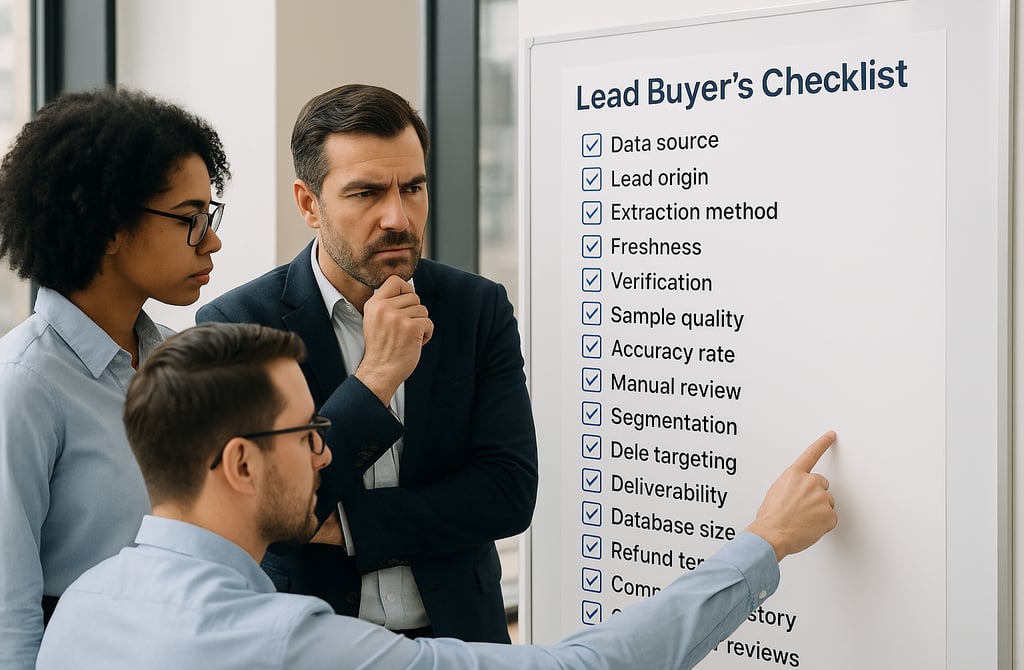
Buying B2B leads should make your outbound faster — not risk your domain, budget, or reputation. But most founders rush the purchase and skip the due-diligence process, which is where the biggest mistakes happen.
This checklist gives you 15 things you must audit before you send a single dollar to any lead vendor in 2026. Treat this as your buyer’s protection guide — the process that keeps you safe from bad data, inflated promises, and low-quality databases.
1. Data Source
Start with the foundation.
If the seller can’t explain where the data comes from (even in general terms), walk away.
2. Lead Origin
Ask if the leads were:
scraped,
extracted,
manually collected,
or purchased from someone else.
Each origin has different risk levels.
3. Extraction Method
Good extraction = consistent structure.
Bad extraction = missing fields, broken formatting, messy data.
If they can’t explain their extraction method, the list is probably sloppy.
4. Freshness
How old is the data?
When was the last update?
What’s the recency of job titles and emails?
Freshness determines deliverability.
5. Verification
If they don’t perform email verification, the bounce rate will be your problem.
Ask how they verify:
SMTP checks
spam trap avoidance
bounce prediction
Real providers always verify.
6. Sample Quality
Never buy without testing a sample.
Evaluate:
roles
relevance
accuracy
bounce rate
targeting
The sample always reveals the truth.
7. Accuracy Rate
Real vendors don’t guarantee 100%.
They give a realistic accuracy range based on verification methods.
Scammers promise perfection.
8. Manual Review
Technical verification is not enough.
Manual review removes:
wrong industries
wrong roles
catch-all traps
duplicated companies
If there’s no human layer, expect junk.
9. Segmentation
A good seller can deliver:
company size
geography
seniority
targeted roles
If they can’t segment, they didn’t do the work.
10. Relevance to Your Campaign
Does the data match your ICP?
If not, even “clean” leads will fail.
Relevance > Volume.
11. Deliverability
Ask the vendor for:
past bounce rates
common risk levels
how they handle catch-alls
Deliverability determines your domain’s health.
12. Database Size vs. Specificity
A massive “10M+ database” means nothing if 80% of it is irrelevant.
Specific > Huge.
13. Refund Terms
Real vendors have:
refund policies
partial credits
bounce-back guarantees
Scam vendors disappear after payment.
14. Company Legitimacy
Before paying, confirm:
website
support channels
business history
online presence
If everything feels temporary, it’s a red flag.
15. Customer Testimonials & Reviews
Look for:
real screenshots
named clients
repeat buyers
consistent patterns
Fake vendors have fake reviews — or none at all.
Final Thought
Buying B2B leads becomes much safer when every vendor goes through a strict audit process. Take your time, evaluate each factor carefully, and you’ll avoid bad data — while protecting your budget and your domain reputation.
A disciplined buying process prevents wasted spend and unreliable lists.
Skipping these checks guarantees low accuracy, weak targeting, and campaigns that fail before they start.
Related Posts
How Verified Leads Turn Cold Email Into a Predictable Sales Machine
Manual vs Automated Validation: Why Human-Verified Data Wins
How Verified Data Helps Startups Reduce Marketing Waste
Best B2B Lead Sources in 2026: What Founders Should Know
How to Buy B2B Leads Safely in 2026 (Founder’s Guide)
Why 98 Percent of B2B Leads Are Outdated in 2026
The ROI of Buying Leads vs Hiring SDRs in 2026
Cold Email: DIY vs Email Outreach Services — Which Gets More Replies?
What Email Outreach Services Actually Do: How They Work, What You Get & Why They Convert
How Email Outreach Services Generate Sales Conversations Faster
Email Outreach Service Pricing: What It Really Costs in 2025–2026
How Email Outreach Services Help Agencies Scale Faster
How to Tell if B2B Leads Are Actually Verified Most Aren’t
Why Data Freshness Matters More Than Lead Quantity in 2026
The Hidden Dangers of Outdated Email Lists And How to Spot Them
How Lead Validation Works: Inside a Modern Data Verification Stack
7 Ways Cheap Leads Destroy Your Domain Reputation
Why Bounce Rate Spikes Happen And How Clean Data Prevents Them
What a Verified Lead Really Means in 2026
How Bad Data Quietly Raises Your CAC by 30–60%
The Quality Checklist Every B2B Lead Must Pass Before You Buy
The Lifecycle of a High-Quality B2B Lead From Source to Inbox
How to Buy B2B Leads Without Getting Scammed in 2026
Connect
Get verified leads that drive real results for your business today.
www.capleads.org
© 2025. All rights reserved.
Serving clients worldwide.
CapLeads provides verified B2B datasets with accurate contacts and direct phone numbers. Our data helps startups and sales teams reach C-level executives in FinTech, SaaS, Consulting, and other industries.