The Lifecycle of a High Quality B2B Lead From Source to Inbox
Follow the journey of a high-quality B2B lead—from initial source, to validation, to segmentation, to final inbox delivery. Learn how clean data flows through each stage and why it determines your outbound results.
DATA QUALITY & VERIFICATIONLEAD MANAGEMENTEMAIL DELIVERABILITYB2B LEADS
CapLeads Team
11/23/20253 min read
Most founders only see the end result of a lead — the moment it lands in their CRM or inside their outreach tool. But the real ROI of your outbound comes from everything that happens before that.
A high-quality B2B lead isn’t “found.”
It’s built, step by step, through a lifecycle that determines whether your campaign succeeds… or crashes with bounces, spam issues, and wasted spend.
This guide breaks down the full journey — the exact lifecycle every lead passes through before it becomes outreach-ready.
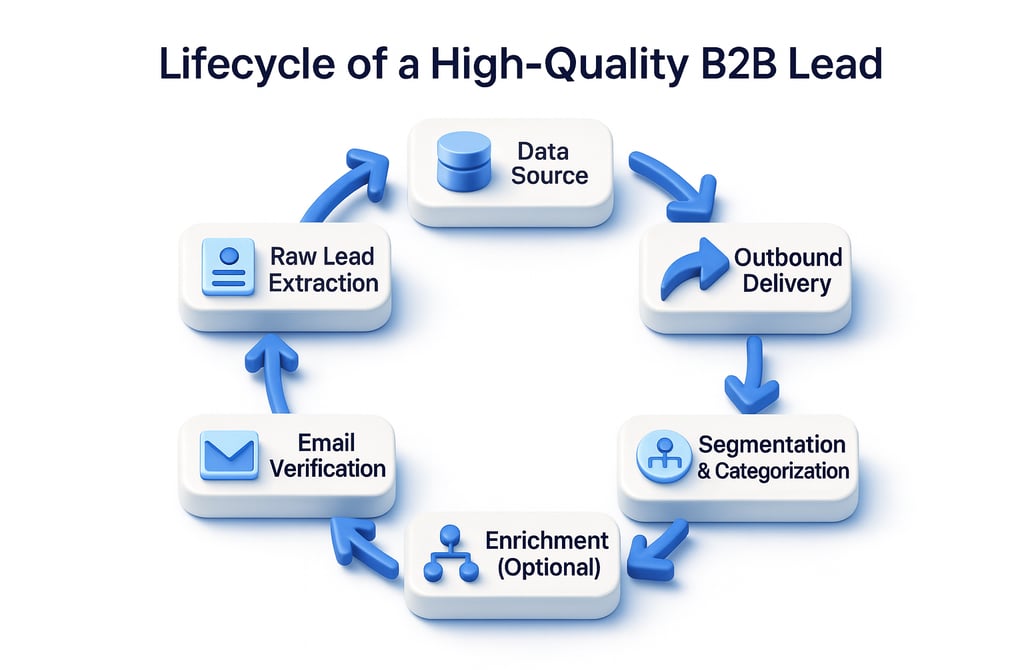
1. Data Source: Where the Lead Begins
Every lead starts with a source — but not all sources are equal.
You have:
public data
business directories
social platforms
scraped or exported databases
third-party tools like Apollo, PB, etc.
The quality of your entire campaign begins here.
A bad source creates bad data — and you can’t “fix” that later.
2. Raw Lead Extraction
This is the messy part most teams underestimate.
Raw extraction often contains:
outdated job titles
missing emails
duplicate companies
generic inboxes
inactive domains
This stage isn’t about outreach yet. It’s about pulling the clay out of the ground so you can shape it later.
3. Email Verification
This is the stage that determines whether:
your emails will bounce,
your domain reputation will drop, and
your deliverability will survive the campaign.
A proper verification pass removes:
invalid emails
spam traps
risky domains
catch-alls (depending on your tolerance)
Skipping this stage is the #1 reason founders burn their sending reputation.
4. Segmentation & Categorization
Even with clean data, sending to the wrong segment kills results.
This stage organizes leads by:
company size
role
geography
buying power
outbound angle
Segmentation makes your messaging relevant instead of generic.
And relevance is what gets replies.
5. Enrichment (Optional but Powerful)
Enrichment adds context that improves targeting.
Examples:
revenue
employee headcount
tech stack
funding
decision-maker seniority
Not every campaign needs enrichment, but when used correctly, it turns a cold email into a personalized opener that doesn’t feel cold at all.
6. Export to CRM or Outreach Tool
At this point, the lead is structurally complete.
But the final quality check happens here:
Are the fields mapped correctly?
Are there duplicates in the CRM?
Does the format match the outreach tool?
Are UTM or tracking parameters handled?
One broken field can ruin an entire sequence.
7. Outbound Delivery
This is the final stage — the moment the lead actually receives your message.
Outbound delivery depends on:
domain warmup
sending reputation
deliverability setup
content relevance
clean data from previous stages
If any earlier lifecycle stage was weak, this is where everything collapses.
But when the lifecycle is followed end-to-end, outbound becomes predictable.
Final Thought
A high-quality B2B lead isn’t an accident — it’s the result of a lifecycle built on clean data, careful validation, and precise segmentation. When every stage is done right, your outbound becomes stronger, cheaper, and far more consistent.
A strong lead lifecycle makes your outreach efficient and predictable.
A broken lifecycle guarantees wasted spend, missed replies, and unstable results — no matter how good your offer is.
Related Posts
How Verified Leads Turn Cold Email Into a Predictable Sales Machine
Manual vs Automated Validation: Why Human-Verified Data Wins
How Verified Data Helps Startups Reduce Marketing Waste
Best B2B Lead Sources in 2026: What Founders Should Know
How to Buy B2B Leads Safely in 2026 (Founder’s Guide)
Why 98 Percent of B2B Leads Are Outdated in 2026
The ROI of Buying Leads vs Hiring SDRs in 2026
Cold Email: DIY vs Email Outreach Services — Which Gets More Replies?
What Email Outreach Services Actually Do: How They Work, What You Get & Why They Convert
How Email Outreach Services Generate Sales Conversations Faster
Email Outreach Service Pricing: What It Really Costs in 2025–2026
How Email Outreach Services Help Agencies Scale Faster
How to Tell if B2B Leads Are Actually Verified Most Aren’t
Why Data Freshness Matters More Than Lead Quantity in 2026
The Hidden Dangers of Outdated Email Lists And How to Spot Them
How Lead Validation Works: Inside a Modern Data Verification Stack
7 Ways Cheap Leads Destroy Your Domain Reputation
Why Bounce Rate Spikes Happen And How Clean Data Prevents Them
What a Verified Lead Really Means in 2026
How Bad Data Quietly Raises Your CAC by 30–60%
The Quality Checklist Every B2B Lead Must Pass Before You Buy
Connect
Get verified leads that drive real results for your business today.
www.capleads.org
© 2025. All rights reserved.
Serving clients worldwide.
CapLeads provides verified B2B datasets with accurate contacts and direct phone numbers. Our data helps startups and sales teams reach C-level executives in FinTech, SaaS, Consulting, and other industries.