
The Hidden ICP Mistakes That Make Outreach Unpredictable
Most outreach unpredictability isn’t caused by copy or tools — it’s caused by flawed ICP definitions. Discover the hidden ICP mistakes that quietly distort targeting, inflate pipeline noise, and damage reply consistency.
INDUSTRY INSIGHTSLEAD QUALITY & DATA ACCURACYOUTBOUND STRATEGYB2B DATA STRATEGY
CapLeads Team
2/16/20263 min read
Unpredictable outreach rarely starts in the inbox.
It starts in the definition phase.
When reply rates swing from strong to silent, most teams assume:
The copy stopped working.
The subject lines lost power.
The domain reputation slipped.
So they optimize the visible layer.
But unpredictability usually lives in the invisible layer — the ICP.
The Stability Illusion
If you define your ICP as:
“Mid-market SaaS”
“Tech companies”
“North American B2B”
“Decision-makers”
It feels stable.
You can build lists consistently.
You can launch campaigns quickly.
You can measure industry-level performance.
But industry stability does not equal buyer stability.
An ICP that lacks behavioral depth creates a pipeline where every campaign looks technically aligned — yet produces wildly inconsistent outcomes.
Same industry.
Same offer.
Different results.
That variance isn’t random.
It’s structural.
Mistake 1: Treating Industry as a Proxy for Urgency
Industry fit only tells you where a company operates.
It doesn’t tell you:
Whether they’re expanding.
Whether they’re budget-constrained.
Whether they’re in procurement freeze.
Whether leadership is shifting priorities.
Within a single vertical, lifecycle variance can be extreme.
Campaigns targeting AI and ML B2B leads often look promising at first glance. But inside that category, early-stage experimentation companies behave completely differently from late-stage, cost-optimization enterprises. Same industry. Different urgency profiles.
When urgency isn’t built into the ICP, reply patterns become inconsistent.
Some segments respond immediately.
Others go silent.
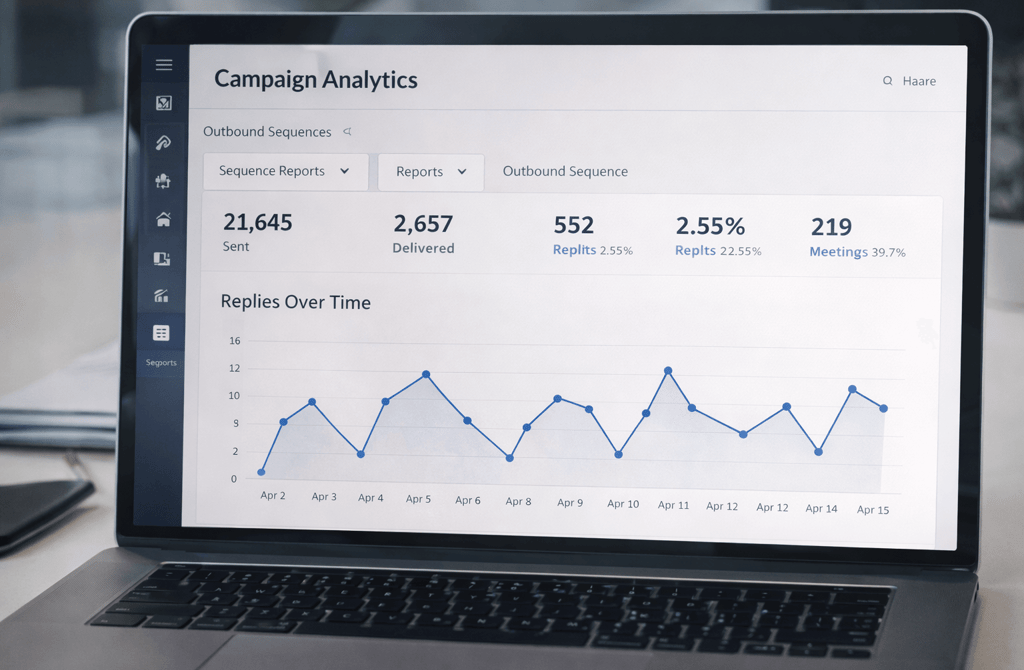
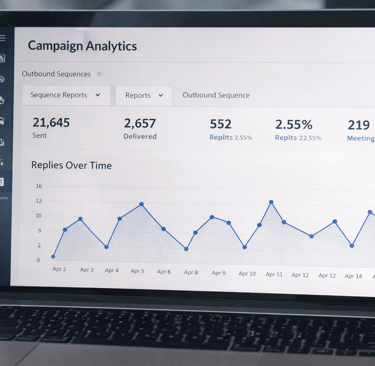
Your analytics chart looks volatile — because your targeting logic is.
Mistake 2: Ignoring Role Context
Titles are not decision maps.
“Head of Operations” could mean:
Strategic authority
Tactical implementer
Budget influencer
Execution-only manager
Without contextual filtering — seniority depth, budget scope, functional ownership — outreach hits buyers with uneven decision leverage.
The result?
One campaign produces strong booked calls.
The next produces polite but powerless responses.
From the outside, it looks like performance drift.
In reality, it's authority inconsistency.
Mistake 3: Static ICPs in Moving Markets
Markets move faster than ICP definitions.
Hiring spikes.
Layoffs.
Product pivots.
Funding changes.
Mergers.
Expansion cycles.
When ICP definitions stay static while companies evolve, targeting drifts quietly.
A segment that converted three months ago may now be in cost-protection mode.
A previously unresponsive group may now be hiring aggressively.
Unpredictability is often just outdated assumptions.
Mistake 4: Over-Broad Company Size Bands
“50–500 employees” sounds reasonable.
But that band can include:
Founder-led growth teams.
Structured mid-market operators.
Semi-enterprise procurement-heavy organizations.
Each behaves differently in outreach.
Without tighter size precision — or at least lifecycle qualifiers layered on top — conversion consistency erodes.
You’re not targeting one ICP.
You’re targeting several compressed into one label.
Why These Mistakes Create Volatile Analytics
When ICP definitions are shallow, each campaign effectively tests a different audience — even if the filters look identical.
That’s why:
Reply rates spike unpredictably.
Booked calls fluctuate.
Deal velocity varies month to month.
Forecast accuracy deteriorates.
The system appears unstable.
But it’s behaving logically — based on inconsistent buyer inputs.
Unpredictable outreach is often predictable targeting error.
The Shift: From Descriptive to Operational ICPs
Descriptive ICP:
Industry
Size
Geography
Title
Operational ICP:
Budget control proximity
Lifecycle timing
Internal pressure indicators
Problem ownership alignment
When ICP definitions include behavioral and structural variables, campaign variance narrows.
Not because messaging improved.
Not because send volume changed.
Because the input consistency improved.
And systems behave predictably when inputs are stable.
What This Means
Outreach unpredictability isn’t usually a copy failure.
It’s an ICP precision failure.
When buyer fit depth increases, analytics smooth out.
When lifecycle alignment improves, reply curves stabilize.
When authority mapping tightens, deal velocity normalizes.
Predictable outbound doesn’t start with better emails.
It starts with better definitions.
Stable inputs create stable systems.
And stable systems close faster than reactive ones ever will.
Related Post:
Why Validation Complexity Increases in Specialized Markets
How Revenue Misclassification Creates Fake ICP Matches
Why Geo Inaccuracies Lower Your Reply Rate
The Size Signals That Predict Whether an Account Is Worth Targeting
How Bad Location Data Breaks Personalization Attempts
Why Company Growth Rates Matter for Accurate Targeting
Why Testing B2B Lead Data Matters Before You Buy
How Department Shifts Impact Your Cold Email Results
Why Title Ambiguity Creates Hidden Pipeline Waste
The Hidden Problems Caused by Outdated Job Roles
How Poor Infrastructure Amplifies Minor Data Issues
Why Weak Architecture Triggers Spam Filters Faster
The Domain Reputation Mechanics Founders Should Understand
How Spam Algorithms Interpret Sudden Send Volume Changes
Why Inconsistent Targeting Raises Spam Filter Suspicion
The Inbox Sorting Logic ESPs Never Explain Publicly
How Risky Sending Patterns Trigger Domain-Level Penalties
Why Domain Reputation Is Built on Consistency, Not Volume
The Hidden Domain Factors That Influence Inbox Placement
Why Copy Tweaks Don’t Fix Underlying Data Problems
The Hidden Data Requirements Behind High-Performing Frameworks
Why Framework Experiments Fail When Lists Aren’t Fresh
How Overly Broad Segments Lower Reply Probability
Why Weak Targeting Logic Confuses Inbox Providers
The Real Cost of Using “Catch-All” Segments in Outbound
How Weak ICP Definitions Inflate Your Pipeline With Noise
Why Buyer Fit Accuracy Matters More Than Industry Fit
Connect
Get verified leads that drive real results for your business today.
www.capleads.org
© 2025. All rights reserved.
Serving clients worldwide.
CapLeads provides verified B2B datasets with accurate contacts and direct phone numbers. Our data helps startups and sales teams reach C-level executives in FinTech, SaaS, Consulting, and other industries.