
How Company Health Signals Predict Your Cold Email Success
Company health signals reveal which accounts are primed to respond. Learn how growth, hiring velocity, layoffs, and funding patterns shape cold email success rates.
INDUSTRY INSIGHTSLEAD QUALITY & DATA ACCURACYOUTBOUND STRATEGYB2B DATA STRATEGY
CapLeads Team
12/11/20252 min read
Most cold email strategies focus on messaging, personalization, timing, and targeting.
But one factor silently determines whether your email succeeds or dies in the inbox:
Company health.
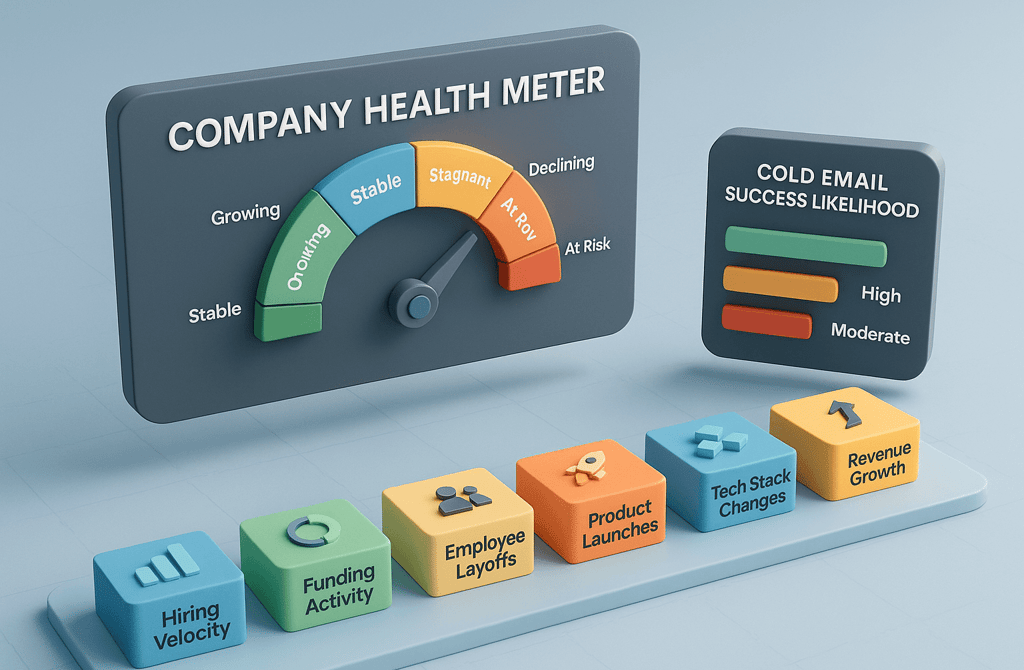
A company’s internal health — growth, hiring velocity, layoffs, funding, revenue trends, and product momentum — directly affects how likely they are to reply, convert, or even open your email.
Cold email isn’t just about who you contact.
It’s about when you contact them.
Here’s the breakdown of why company health signals should shape your outbound strategy.
1. Healthy Companies Have Higher Capacity to Respond
Companies in a growth state:
hire more
test new tools more often
have open budgets
delegate better
reply faster
When a company is scaling, leadership is actively searching for time savings, efficiency, automation, and new capabilities.
Your email lands at the perfect moment — they have the resources + urgency to reply.
“Inbound behavior” appears even in outbound when the company is healthy.
2. Struggling Companies Ignore Everything Not Related to Survival
Companies facing:
layoffs
hiring freezes
revenue decline
funding issues
leadership turnover
…don’t reply even if your offer is perfect.
Why?
Because their internal priority stack collapses into one goal: survive.
These companies:
freeze tools
stop replying
delay decisions
avoid adopting anything new
Your email is not competing with other vendors.
Your email is competing with internal chaos — and chaos always wins.
3. Health Signals Predict Budget Availability
Healthy companies show outward signs of having budget:
hiring velocity
new roles opening
recent fundraising
expansions
product launches
These signals tell you:
“They can afford to buy something right now.”
On the flip side:
layoffs
sudden job closures
shrinking departments
leaders exiting
halted projects
…signal:
“No budget. No replies. No point sending now.”
Outbound becomes predictable when you stop guessing and start reading signals.
4. Tech Stack Changes Indicate Openness to New Solutions
When a company is updating:
CRM
marketing stack
sales automation tools
engineering tools
internal platforms
…it means leadership is already in “improvement mode.”
This is the perfect time to enter the conversation.
Outbound wins when your timing aligns with internal momentum.
5. Revenue Growth Creates Pressure That Favors Your Offer
A growing company has growing problems:
bigger teams
bigger customer base
bigger workloads
more complexity
more inefficiency
This means they’re actively searching for:
automation
optimization
better data
new opportunities
more efficiency
Healthy companies are hungry — and hungry companies reply.
6. Company Health Data Gives You Predictable Outbound Priorities
This is how elite outbound teams operate:
Start with healthy accounts → highest reply probability
Move to stable accounts → consistent pipeline
Avoid declining accounts → wasted sends
Blacklist at-risk companies → reputation protection
Cold email becomes scientific.
Not emotional.
Not random.
Not “spray and pray.”
Signals tell you exactly where to spend your sending power.
Final Thought
Cold email success isn’t just about messaging — it’s about timing and company readiness.
When you contact a healthy company, the reply rate lifts across every metric.
Clean company signals make outbound predictable.
Ignoring those signals makes every campaign unpredictable.
Related Post
Why Good Copy Fails When the Lead Data Isn't Prepared
The Data Filters Your Emails Pass Through Before Reaching Inboxes
Why Data Cleaning Should Happen Before Warming Up Domains
How Lead Quality Shapes Your Open Rate More Than Subject Lines
What Inbox Providers Infer About Your Lead List
Why Reply Rates Improve When Your Data Is Pre-Qualified
The Hidden Data Rules Behind Modern Spam Filters
Why Cold Email Isn't Working (And Why Data Is Usually the Reason)
How Data Enrichment Changes Your Cold Email Targeting
Why Bounce Rate Drops When You Source Better Data
The Data Layer Founders Forget When Running Outreach
Why Email Volume Doesn't Fix Data Problems
How Data Scoring Boosts Deliverability
Why Domain Reputation Depends on Your Lead Data Quality
The Data-Driven Way to Increase Cold Email ROI
Why Your Inbox Placement Is Linked to Lead Validation
How Data Recency Improves Reply Intent
Why Clean Lists Outperform Personalization Tricks
Why Lead Segmentation Matters More Than List Size
The Real Science Behind Targeting the Right Decision-Maker
Connect
Get verified leads that drive real results for your business today.
www.capleads.org
© 2025. All rights reserved.
Serving clients worldwide.
CapLeads provides verified B2B datasets with accurate contacts and direct phone numbers. Our data helps startups and sales teams reach C-level executives in FinTech, SaaS, Consulting, and other industries.