
Why Fully Automated Outreach Creates Hidden Risk
Fully automated outreach scales fast, but it also hides compounding risk. Here’s why problems stay invisible until damage is done.
INDUSTRY INSIGHTSLEAD QUALITY & DATA ACCURACYOUTBOUND STRATEGYB2B DATA STRATEGY
CapLeads Team
1/17/20263 min read
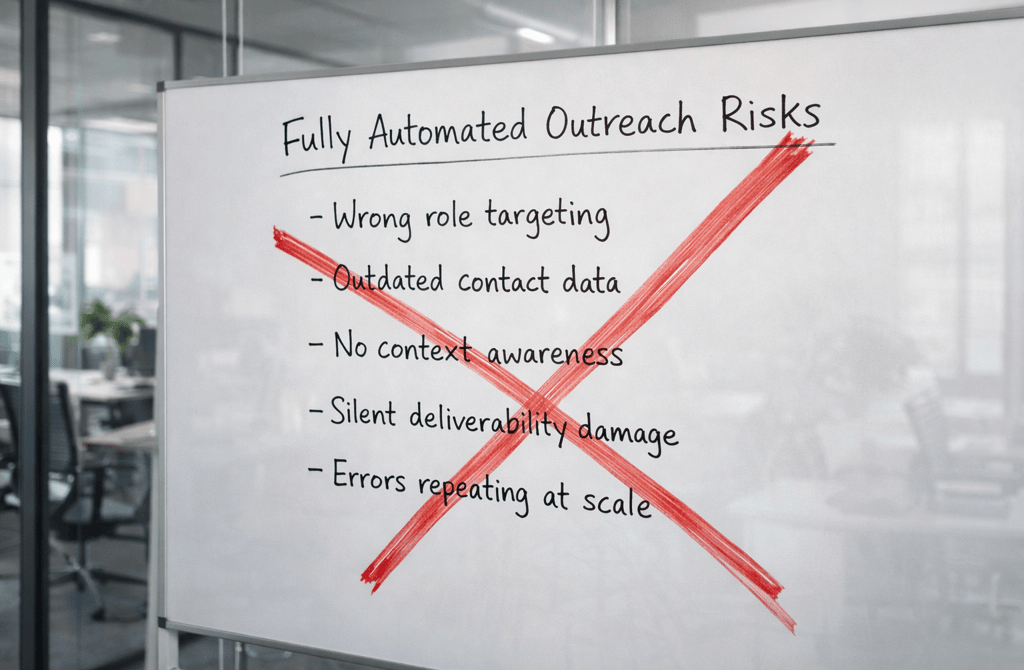
The most dangerous outbound systems aren’t the ones that break loudly.
They’re the ones that keep running smoothly while getting worse.
Fully automated outreach doesn’t usually fail because something stops working. It fails because nothing forces anyone to stop and question what’s happening. When friction is removed entirely, risk doesn’t disappear—it just becomes harder to see.
Automation Removes the Natural “Pause Points”
In human-led outbound, friction exists by default:
someone notices replies don’t match expectations
someone hesitates before scaling volume
Those pauses are inconvenient, but they’re protective. They surface doubts early.
Fully automated systems eliminate those pauses. Once a campaign is launched, the system’s job is to continue. Every successful send reinforces the assumption that everything is fine.
This is where hidden risk begins—not with errors, but with unchecked momentum.
Clean Dashboards Create False Confidence
Automation platforms are built to reassure.
Statuses show as “active.” Delivery looks stable. Sequences complete on schedule.
None of that answers the most important question:
Is this still the right outreach to be sending?
Dashboards report activity, not judgment. They confirm execution, not relevance. As long as emails are being sent and technical thresholds aren’t breached, the system signals success—even if outcomes quietly deteriorate.
This creates a dangerous mismatch between what the system reports and what the market is actually experiencing.
Risk Compounds When Feedback Is Delayed
Outbound risk rarely shows up immediately.
Wrong role targeting doesn’t always bounce.
Outdated data doesn’t always hard-fail.
Context mismatch doesn’t always get a reply.
Instead, these issues accumulate:
slight drops in engagement
subtle shifts in reply tone
gradual inbox placement erosion
By the time metrics clearly reflect a problem, the system has already trained inbox providers and prospects to distrust the sender.
Automation didn’t cause the risk.
It allowed the delay between cause and effect to grow wide enough that no one noticed.
Scale Turns Small Assumptions Into Big Problems
Every automated outreach system is built on assumptions:
job titles mean the same thing across companies
data freshness is “good enough”
relevance is consistent across a segment
At small volume, bad assumptions are survivable.
At scale, they become structural.
Automation doesn’t question assumptions—it multiplies them. A single flawed rule doesn’t affect one prospect; it affects thousands. And because everything still “works,” there’s no natural alarm.
Hidden risk thrives in systems that scale certainty without verification.
The Absence of Judgment Is the Real Risk
The problem isn’t that automation makes mistakes.
The problem is that it removes judgment from the system entirely.
Judgment is what asks:
does this still make sense?
has something changed?
are we optimizing the right signal?
Fully automated outreach answers none of those questions. It assumes the past is still valid and the present will behave the same way.
That assumption holds—until it doesn’t.
Why Teams Discover the Risk Too Late
Most teams only realize how risky full automation was after they turn it off.
They notice:
reputation takes time to recover
lists need deeper cleaning than expected
segments that “performed” were never aligned
The system didn’t warn them because it wasn’t designed to. It did exactly what it was told to do—efficiently, consistently, and without reflection.
Hidden risk isn’t accidental. It’s a byproduct of removing human judgment from places where uncertainty still exists.
What This Means
Automation is powerful when it executes decisions that are already sound.
It becomes risky when it replaces the process of questioning those decisions.
Outbound systems stay healthy when friction exists in the right places—before scale, not after damage.
Bottom Line
Fully automated outreach doesn’t fail because it’s fast.
It fails because it makes flawed assumptions feel safe at scale.
Outbound stays predictable when data is current and decisions are continuously validated.
When outdated data is automated without judgment, risk doesn’t disappear—it compounds quietly until results collapse.
Related Post:
Why Company Lifecycle Stage Dictates Cold Email Outcomes
The Lifecycle Signals That Reveal Real Buying Readiness
How Early-Stage Companies Respond Differently to Outbound
Why Growth-Stage Accounts Require More Precise Targeting
The Hidden Data Problems Inside Mature Companies
Why Multi-Source Data Blending Beats Single-Source Lists
The Conflicts That Arise When You Merge Multiple Lead Sources
How Cross-Source Validation Improves Data Reliability
Why Data Blending Fails When Metadata Isn’t Aligned
The Hidden Errors Inside Aggregated Lead Lists
Why Bad Data Creates Massive Hidden Operational Waste
The Outbound Tasks That Multiply When Data Is Wrong
How Weak Lead Quality Increases SDR Workload
Why Founders Waste Hours Fixing Data Problems
The Operational Drag Caused by Inconsistent Metadata
Why RevOps Fails Without Strong Data Foundations
The RevOps Data Flows That Predict Outbound Success
How Weak Data Breaks RevOps Alignment Across Teams
Why Revenue Models Collapse When Metadata Is Inaccurate
The Hidden RevOps Data Dependencies Embedded in Lead Quality
Why Automation Alone Can’t Run a Reliable Outbound System
The Decisions Automation Gets Wrong in Cold Email
How Human Judgment Fixes What Automated Tools Misread
Connect
Get verified leads that drive real results for your business today.
www.capleads.org
© 2025. All rights reserved.
Serving clients worldwide.
CapLeads provides verified B2B datasets with accurate contacts and direct phone numbers. Our data helps startups and sales teams reach C-level executives in FinTech, SaaS, Consulting, and other industries.