
Why Automation Alone Can’t Run a Reliable Outbound System
Automation scales outbound, but without human judgment it introduces risk. Learn why hybrid systems outperform fully automated outreach setups.
INDUSTRY INSIGHTSLEAD QUALITY & DATA ACCURACYOUTBOUND STRATEGYB2B DATA STRATEGY
CapLeads Team
1/17/20263 min read
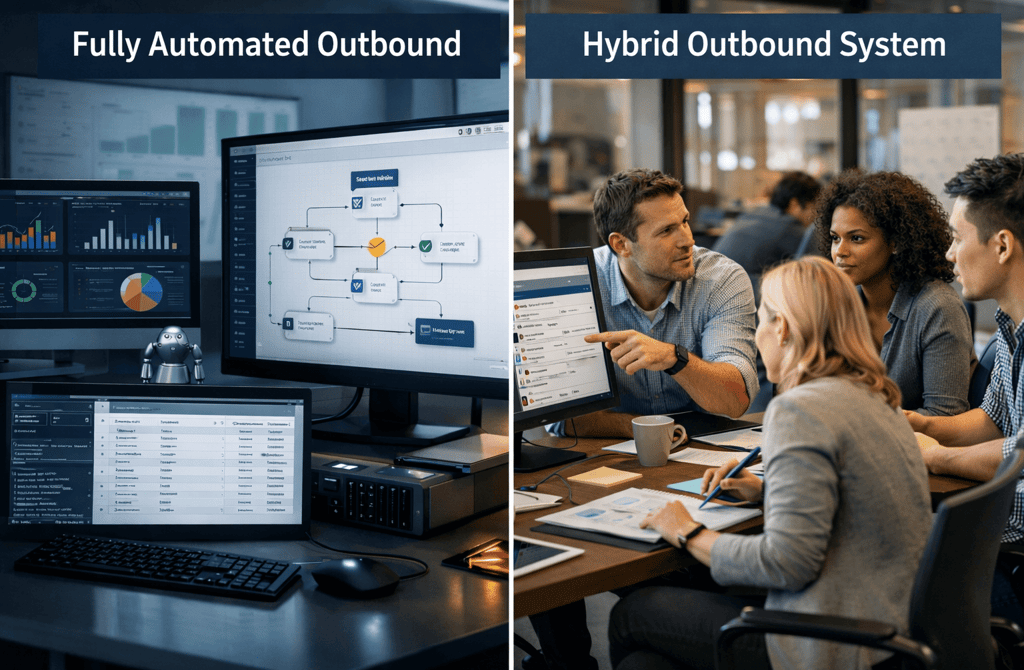
Outbound didn’t break because teams lacked tools.
It broke because decisions were handed to systems that don’t understand context.
Automation promised scale, speed, and consistency. And it delivered those—partially. What it never solved was judgment. When outbound becomes fully automated, small data errors stop being small. They compound silently, at scale, until performance collapses and teams blame copy, cadence, or channels instead of the real issue.
The problem isn’t automation itself. It’s the absence of human decision-making where it still matters most.
Automation Is Excellent at Execution — Not Evaluation
Automation shines when rules are stable and inputs are clean. Sending sequences, rotating inboxes, throttling volume, and managing schedules are mechanical problems. Software is built for that.
But outbound is not purely mechanical.
Every outbound system relies on assumptions:
This contact still holds this role
This company still fits the ICP
This domain is still safe to email
Automation accepts these assumptions as truth. It does not challenge them. It cannot ask “does this still make sense?” It simply executes.
When those assumptions drift—and they always do—automation accelerates the damage. What should have been caught early gets amplified across thousands of sends.
Fully Automated Systems Create Invisible Risk
One of the most dangerous aspects of automation-first outbound is how clean the dashboards look while performance degrades underneath.
Bounce rates might stay “acceptable” while inbox placement quietly worsens. Reply rates might flatten gradually, not suddenly enough to trigger alarms. Engagement metrics still exist, but they’re increasingly detached from revenue outcomes.
Because automation keeps things moving, teams mistake activity for health.
Without human review, no one stops to ask:
Are we still targeting the right roles?
Has this industry shifted hiring patterns?
Are these leads decaying faster than expected?
Are we scaling volume on weakening data?
Automation doesn’t notice patterns. Humans do.
Human Judgment Is What Interprets Signals
Outbound generates signals long before results show up in revenue:
Slight increases in soft bounces
Replies that indicate role mismatch
Prospects forwarding emails internally instead of replying
More “not relevant anymore” responses
These are not failures. They’re early warnings.
A human operator recognizes them as signals to slow down, re-segment, re-validate, or adjust targeting logic. An automated system treats them as noise unless explicitly programmed otherwise—and most teams never program for nuance.
This is where hybrid systems outperform.
Hybrid Outbound Systems Reduce Compounding Errors
A hybrid outbound system doesn’t replace automation. It governs it.
Automation handles:
Volume control
Sequencing
Scheduling
Infrastructure consistency
Humans handle:
Lead sanity checks
Segment health reviews
Decision-maker relevance
Go/no-go judgments before scaling
This separation prevents small data issues from becoming systemic failures. It also keeps outbound adaptable when markets, roles, or industries change faster than software rules can be updated.
Hybrid systems don’t move slower. They move with intent.
Reliability Comes from Intervention Points
Reliable outbound systems are not “set and forget.” They are designed with intentional checkpoints:
Before a list is activated
Before volume is increased
When response patterns shift
When bounce behavior changes
At each checkpoint, a human decision prevents automation from running blindly. This is how outbound remains predictable instead of fragile.
The irony is that teams chasing maximum automation often end up doing more manual cleanup later—fixing domains, rebuilding reputation, scrubbing CRMs, and revalidating entire pipelines. Hybrid systems avoid that rework by intervening earlier.
The Real Tradeoff Isn’t Speed vs Scale
It’s control vs chaos.
Automation without judgment scales mistakes.
Human-only systems don’t scale at all.
Hybrid systems scale decisions, not just emails.
Outbound becomes reliable when automation executes and humans decide.
Bottom Line
Automation is a force multiplier—but it multiplies whatever you feed it.
When judgment is missing, small data flaws grow into system-wide failures.
Outbound becomes predictable when automation is guided by human checkpoints.
When it isn’t, scale doesn’t create leverage—it creates risk.
Related Post:
Why Company Lifecycle Stage Dictates Cold Email Outcomes
The Lifecycle Signals That Reveal Real Buying Readiness
How Early-Stage Companies Respond Differently to Outbound
Why Growth-Stage Accounts Require More Precise Targeting
The Hidden Data Problems Inside Mature Companies
Why Multi-Source Data Blending Beats Single-Source Lists
The Conflicts That Arise When You Merge Multiple Lead Sources
How Cross-Source Validation Improves Data Reliability
Why Data Blending Fails When Metadata Isn’t Aligned
The Hidden Errors Inside Aggregated Lead Lists
Why Bad Data Creates Massive Hidden Operational Waste
The Outbound Tasks That Multiply When Data Is Wrong
How Weak Lead Quality Increases SDR Workload
Why Founders Waste Hours Fixing Data Problems
The Operational Drag Caused by Inconsistent Metadata
Why RevOps Fails Without Strong Data Foundations
The RevOps Data Flows That Predict Outbound Success
How Weak Data Breaks RevOps Alignment Across Teams
Why Revenue Models Collapse When Metadata Is Inaccurate
The Hidden RevOps Data Dependencies Embedded in Lead Quality
Connect
Get verified leads that drive real results for your business today.
www.capleads.org
© 2025. All rights reserved.
Serving clients worldwide.
CapLeads provides verified B2B datasets with accurate contacts and direct phone numbers. Our data helps startups and sales teams reach C-level executives in FinTech, SaaS, Consulting, and other industries.