
Why Company Lifecycle Stage Dictates Cold Email Outcomes
Company lifecycle stage shapes how prospects read, trust, and respond to cold email. Learn how early, growth, and mature stages create very different outreach outcomes.
INDUSTRY INSIGHTSLEAD QUALITY & DATA ACCURACYOUTBOUND STRATEGYB2B DATA STRATEGY
CapLeads Team
1/13/20263 min read
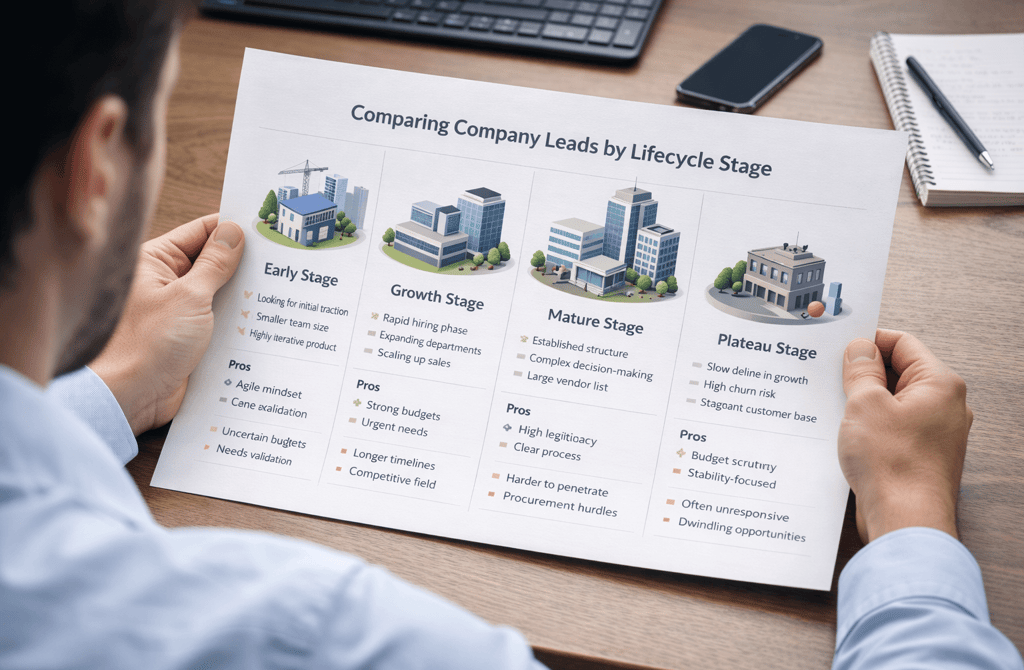
Most cold email advice treats companies as if they all behave the same. Same copy frameworks. Same cadence. Same follow-ups. Same expectations.
In reality, two companies in the same industry can react very differently to the same email—simply because they’re at different stages of their lifecycle. Not because one has better taste in messaging, but because their internal priorities, constraints, and decision logic are fundamentally different.
Company lifecycle stage quietly shapes how cold email is received, evaluated, delayed, or ignored.
Lifecycle stage changes how emails are interpreted
When an email lands in an inbox, the recipient doesn’t just read the words. They subconsciously filter it through the context of where the company is right now.
A company trying to survive behaves differently from one trying to scale. A company optimizing operations behaves differently from one fighting decline. These differences affect response behavior long before copy or personalization has a chance to work.
Ignoring lifecycle stage creates false conclusions about what’s “working” or “not working” in outbound.
Early-stage companies: receptive but fragile
Early-stage companies tend to respond faster, but not always for the reasons people assume.
They’re often exploring options, validating ideas, or searching for leverage. Decision-makers are closer to execution, inboxes are lighter, and curiosity is higher. But budgets are uncertain, priorities shift weekly, and buying power may not match intent.
Cold emails to early-stage companies often get replies—but many stall after the first conversation. The mistake is assuming early responsiveness equals readiness to buy.
Lifecycle reality:
Fast replies
High curiosity
Low process maturity
Unstable follow-through
Growth-stage companies: active but selective
Growth-stage companies behave very differently. They’re hiring, expanding teams, and formalizing processes. Outreach competes with real operational pressure.
They respond when messages align with immediate scaling pain—but ignore anything that feels abstract, experimental, or mis-timed. Decision-making is faster than mature companies, but slower than startups. More stakeholders get involved. More scrutiny appears.
Cold email outcomes here are highly sensitive to relevance and timing.
Lifecycle reality:
Selective engagement
Clear problems, limited attention
Budget exists but is guarded
Internal alignment matters
Mature companies: structured and slow
Mature organizations don’t ignore cold email because it’s bad. They ignore it because they operate inside rigid structures.
Procurement rules, approval chains, vendor reviews, and internal politics all shape response behavior. Even interested buyers may not reply immediately because responding itself creates work.
These companies often reply late—or only after internal discussion has already happened. Outreach success depends less on clever copy and more on matching role, timing, and organizational context.
Lifecycle reality:
Slower replies
Formal evaluation paths
High credibility requirements
Decision friction is normal
Plateau or declining companies: unpredictable signals
Companies in plateau or decline stages are the hardest to interpret. Some are cost-cutting aggressively. Others are quietly looking for fixes. Some are disengaged entirely.
Cold email here produces noisy signals: sudden interest followed by silence, skepticism mixed with urgency, or defensive responses. Outreach can work—but outcomes vary wildly depending on internal pressure that isn’t visible from the outside.
Lifecycle reality:
Inconsistent behavior
Heightened risk sensitivity
Budget scrutiny
Unclear ownership of decisions
Why lifecycle mismatch creates bad conclusions
When lifecycle stage isn’t accounted for, teams misread results.
They assume:
“Replies mean interest”
“No reply means bad messaging”
“High opens should convert”
“Same framework should scale”
In reality, lifecycle mismatch creates false negatives and false positives. Good emails fail. Weak emails sometimes succeed. Pipelines inflate or stall for reasons unrelated to copy quality.
Lifecycle stage doesn’t replace ICP, role accuracy, or targeting—but it quietly influences how all of those factors play out.
Lifecycle-aware outbound is more predictable
Outbound becomes more predictable when lifecycle stage is treated as context, not an afterthought.
This doesn’t require complex modeling. It requires recognizing that company behavior changes as organizations grow, stabilize, or slow down—and adjusting expectations accordingly.
When lifecycle stage is ignored, teams chase surface-level fixes. When it’s understood, results start making sense.
Bottom line
Cold email doesn’t succeed or fail in a vacuum. It succeeds or fails inside a company’s current reality.
When outreach aligns with lifecycle stage, responses feel logical and consistent.
When it ignores lifecycle context, even great messages struggle to land.
Related Post:
Why Data Problems Create Invisible Pipeline Leaks
The Silent Funnel Drop-Offs Caused by Weak Lead Quality
How Bad Data Corrupts Every Stage of Your Pipeline
Why Pipeline Inflation Happens With Outdated Leads
The Hidden Pipeline Leaks Most Founders Never Detect
Why CRM Cleanliness Determines Whether Outbound Scales
The Hidden CRM Errors That Break Your Entire Funnel
How Dirty CRM Records Create Pipeline Confusion
Why CRM Drift Happens Faster Than Teams Expect
The CRM Hygiene Rules That Protect Your Outbound System
Why Lead Scoring Fails Without Clean Data
The Scoring Indicators That Predict Real Pipeline Movement
How Bad Data Corrupts Lead Prioritization Models
Why Fit Score and Intent Score Must Be Aligned
The Hidden Scoring Errors Most Teams Don’t Notice
Why Metadata Quality Predicts Outbound Success
The Hidden Contact Signals Most Founders Overlook
How Metadata Gaps Create Unpredictable Campaign Behavior
Why Subtle Lead Signals Influence Reply Probability
The Micro-Patterns in Metadata That Reveal Buyer Intent
Connect
Get verified leads that drive real results for your business today.
www.capleads.org
© 2025. All rights reserved.
Serving clients worldwide.
CapLeads provides verified B2B datasets with accurate contacts and direct phone numbers. Our data helps startups and sales teams reach C-level executives in FinTech, SaaS, Consulting, and other industries.