
The Industry-Level Reply Patterns Most Teams Miss
Different industries reply to outbound in predictable ways most teams overlook. Learn how reply patterns vary by sector and what the data is really saying.
INDUSTRY INSIGHTSLEAD QUALITY & DATA ACCURACYOUTBOUND STRATEGYB2B DATA STRATEGY
CapLeads Team
1/21/20263 min read
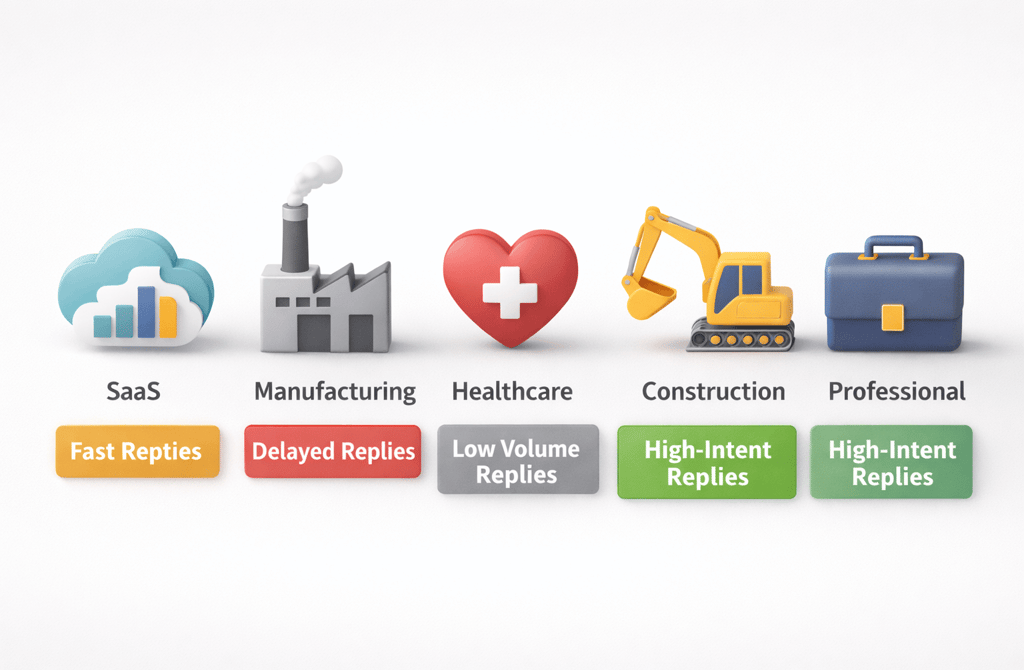
Most outbound teams don’t misread replies — they misread absence.
Silence gets treated as rejection.
Delayed responses get treated as low intent.
Uneven reply volume gets blamed on copy or timing.
In reality, many of these signals are industry-level reply patterns doing exactly what they always do. The problem isn’t performance — it’s interpretation.
Reply Volume Isn’t the Same as Interest
Some industries respond frequently but shallowly.
Others respond rarely but decisively.
High reply volume often shows up in sectors where:
Roles are exposed to frequent vendor outreach
Gatekeeping is light
Saying “no” is culturally normal
Low reply volume is common in industries where:
Decisions move slowly
External communication is filtered
Engagement happens only when there’s real relevance
Teams that chase reply quantity end up optimizing toward the wrong verticals and mislabeling high-quality segments as “cold.”
Timing Patterns Are Industry-Bound, Not Random
Reply timing clusters by industry far more than most dashboards reveal.
Some sectors reply:
Quickly after the first or second touch
Almost never after long delays
Others reply:
Days later
After internal review
After a trigger unrelated to your sequence step
When teams enforce a universal “reply window,” they quietly discard entire verticals that simply operate on a different clock.
The Shape of Replies Matters More Than the Count
Industry reply patterns aren’t just about how many replies — they’re about what those replies look like.
Some industries produce:
One-line responses
Redirects to another contact
Minimal context
Others produce:
Clarifying questions
Internal forwarding
Multi-paragraph replies
Judging reply quality without industry context causes teams to overweight verbose responses and undervalue concise but meaningful engagement.
Why Benchmarks Break Across Verticals
Benchmarks assume uniform behavior.
Industries don’t behave uniformly.
When teams compare:
SaaS reply rates to construction
Professional services to logistics
Healthcare to manufacturing
They’re comparing behaviors that were never meant to look the same. The result is false negatives, unnecessary optimization loops, and broken confidence in otherwise healthy outbound systems.
Hidden Pattern: Who Replies First Isn’t Accidental
In some industries, decision-makers reply directly.
In others, intermediaries always reply first.
That’s not a targeting error — it’s an industry communication structure.
Teams that treat first responders as the wrong contact miss the internal routing pattern happening behind the scenes. In many verticals, who replies first is part of the buying process.
What Teams Usually Fix Instead (and Why It Fails)
When reply patterns don’t match expectations, teams often:
Rewrite copy
Change subject lines
Increase volume
Shorten sequences
These fixes don’t address the real issue: the expectation itself is wrong.
Outbound doesn’t fail because industries reply differently. It fails because teams don’t adjust how they read the signals those industries naturally produce.
What This Means
Reply behavior isn’t a universal metric — it’s a vertical-specific signal.
When you understand industry reply patterns, silence becomes informative instead of discouraging.
When you ignore them, good data looks bad and bad conclusions pile up fast.
Clean data reveals how each industry actually responds.
Misaligned expectations turn those signals into confusion instead of clarity.
Outbound becomes predictable when reply patterns are interpreted in context — not forced into averages they were never meant to match.
Related Post:
The RevOps Data Flows That Predict Outbound Success
How Weak Data Breaks RevOps Alignment Across Teams
Why Revenue Models Collapse When Metadata Is Inaccurate
The Hidden RevOps Data Dependencies Embedded in Lead Quality
Why Automation Alone Can’t Run a Reliable Outbound System
The Decisions Automation Gets Wrong in Cold Email
How Human Judgment Fixes What Automated Tools Misread
Why Fully Automated Outreach Creates Hidden Risk
The Outbound Decisions That Still Require Human Logic
Why Outbound Systems Fail When Data Dependencies Break
The Chain Reactions Triggered by Weak Data Inputs
How One Bad Field Corrupts an Entire Outbound System
Why Data Dependencies Matter More Than Individual Signals
The Upstream Errors That Create Downstream Pipeline Damage
Why Some Industries Naturally Produce Higher Bounce Rates
The Vertical Patterns Behind High-Bounce Lead Lists
How Industry Type Predicts Email Bounce Probability
Why Low-Bounce Verticals Offer More Stable Outreach
The Structural Reasons Certain Verticals Bounce More
Why Outbound Behavior Differs Wildly Across Verticals
Connect
Get verified leads that drive real results for your business today.
www.capleads.org
© 2025. All rights reserved.
Serving clients worldwide.
CapLeads provides verified B2B datasets with accurate contacts and direct phone numbers. Our data helps startups and sales teams reach C-level executives in FinTech, SaaS, Consulting, and other industries.