
Why Some Industries Naturally Produce Higher Bounce Rates
Why do some industries see higher email bounce rates than others? Learn how industry structure, role churn, and data volatility drive bounce risk.
INDUSTRY INSIGHTSLEAD QUALITY & DATA ACCURACYOUTBOUND STRATEGYB2B DATA STRATEGY
CapLeads Team
1/19/20263 min read
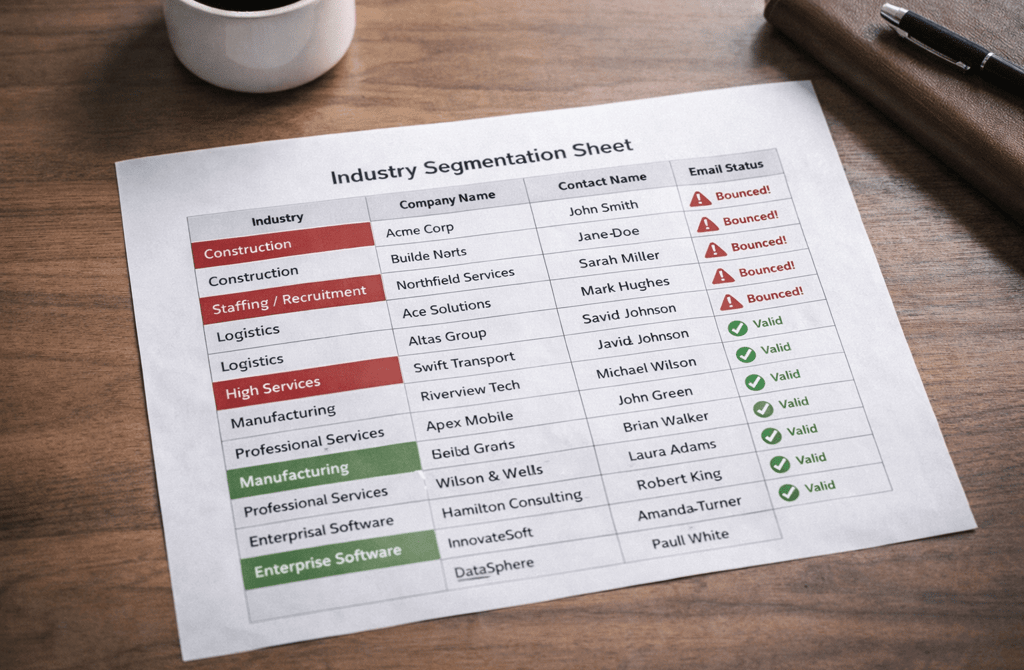
Email bounce rates aren’t random.
They’re not just the result of poor tools, lazy list building, or bad execution.
In many cases, bounce rates are structural — shaped by how an industry operates, hires, and changes over time. Two teams can follow the same outbound playbook, use similar validation steps, and still see wildly different bounce outcomes simply because they’re targeting different industries.
Understanding this distinction is the difference between blaming your process and fixing the real problem.
Bounce Rate Is an Industry Behavior, Not Just a Data Problem
Most outbound teams treat bounce rate as a hygiene issue.
Clean the list. Re-verify emails. Swap tools. Try again.
That works — but only up to a point.
Every industry has:
different role stability
different company lifecycles
different email ownership norms
different levels of digital discipline
These factors quietly determine how long an email address stays valid before you ever touch the data.
That’s why bounce rate patterns tend to repeat at the industry level, even across different data sources.
Why High-Bounce Industries Behave the Way They Do
Industries like construction, staffing, logistics, and field services consistently produce higher bounce rates — and not because they “don’t care” about email.
They bounce more because:
1. Roles Change Faster Than Email Records
Supervisors, recruiters, site managers, and coordinators move roles frequently. Promotions, site changes, contract endings, and turnover all happen faster than email databases can keep up.
An address can be valid today and dead in 30 days.
2. Email Is Not the Primary Work Tool
In many high-bounce industries, email is secondary to:
phone
SMS
WhatsApp
in-person coordination
That leads to:
inbox neglect
unmaintained mailboxes
faster deactivations
3. Companies Are Smaller and More Fragmented
Smaller operators:
don’t maintain strict IT policies
recycle domains
shut down and reopen under new names
That volatility shows up as bounced emails, even when the contact name itself is real.
None of this is a data provider failure.
It’s how the industry functions.
What Low-Bounce Industries Do Differently (Without Trying)
On the other end, industries like manufacturing, professional services, and enterprise software naturally produce lower bounce rates.
Not because the data is “better” — but because the structure is.
1. Roles Are Stable
Titles change slowly.
Email addresses persist across years, not months.
When someone leaves, forwarding or reassignment is common — meaning fewer hard bounces.
2. Email Is Business-Critical
Email is the system of record:
contracts
vendor communication
internal workflows
Shutting down inboxes casually isn’t an option.
3. IT Hygiene Is Non-Negotiable
Larger organizations maintain:
standardized domain rules
consistent email formats
controlled provisioning and deprovisioning
That discipline dramatically extends email lifespan.
Medium-Bounce Industries Sit in the Middle for a Reason
B2B services, regional SaaS, and consulting firms often fall into a mixed zone.
They combine:
growing teams
moderate turnover
partial IT structure
The result is predictable variability:
some inboxes stay valid long-term
others decay quickly during growth spurts
These industries reward tighter timing and fresher data more than heavy validation alone.
Why Treating All Industries the Same Breaks Outbound
When teams apply one bounce-rate expectation across all industries, three things happen:
Good industries get over-validated
Time and cost are wasted where risk is already low.High-risk industries get misdiagnosed
Teams blame tools instead of adjusting strategy.Send volume gets distorted
Bounce-heavy industries inflate sending without improving results.
The smarter approach isn’t avoiding high-bounce industries — it’s accounting for their behavior.
What This Means for Outbound Strategy
Bounce rate should influence:
industry prioritization
refresh frequency
batch sizing
expectations around decay
Not every industry deserves the same outbound cadence.
When you understand which verticals naturally shed emails faster, you stop fighting reality — and start building campaigns that match it.
Bottom Line
High bounce rates don’t automatically signal bad data.
They often signal fast-moving industries where email stability is structurally limited.
Low bounce rates don’t mean perfect targeting either — just more predictable inbox behavior.
Outbound works best when it respects how industries actually operate, not how we wish they did.
Data that aligns with industry dynamics stays usable longer — while data that ignores them breaks faster.
Related Post:
The Outbound Tasks That Multiply When Data Is Wrong
How Weak Lead Quality Increases SDR Workload
Why Founders Waste Hours Fixing Data Problems
The Operational Drag Caused by Inconsistent Metadata
Why RevOps Fails Without Strong Data Foundations
The RevOps Data Flows That Predict Outbound Success
How Weak Data Breaks RevOps Alignment Across Teams
Why Revenue Models Collapse When Metadata Is Inaccurate
The Hidden RevOps Data Dependencies Embedded in Lead Quality
Why Automation Alone Can’t Run a Reliable Outbound System
The Decisions Automation Gets Wrong in Cold Email
How Human Judgment Fixes What Automated Tools Misread
Why Fully Automated Outreach Creates Hidden Risk
The Outbound Decisions That Still Require Human Logic
Why Outbound Systems Fail When Data Dependencies Break
The Chain Reactions Triggered by Weak Data Inputs
How One Bad Field Corrupts an Entire Outbound System
Why Data Dependencies Matter More Than Individual Signals
The Upstream Errors That Create Downstream Pipeline Damage
Connect
Get verified leads that drive real results for your business today.
www.capleads.org
© 2025. All rights reserved.
Serving clients worldwide.
CapLeads provides verified B2B datasets with accurate contacts and direct phone numbers. Our data helps startups and sales teams reach C-level executives in FinTech, SaaS, Consulting, and other industries.