
The Hidden Data Requirements Behind High-Performing Frameworks
High-performing cold email frameworks depend on clean data, precise targeting, and accurate validation. Here’s the data layer most teams ignore when optimizing copy and sequences.
INDUSTRY INSIGHTSLEAD QUALITY & DATA ACCURACYOUTBOUND STRATEGYB2B DATA STRATEGY
CapLeads Team
2/13/20264 min read
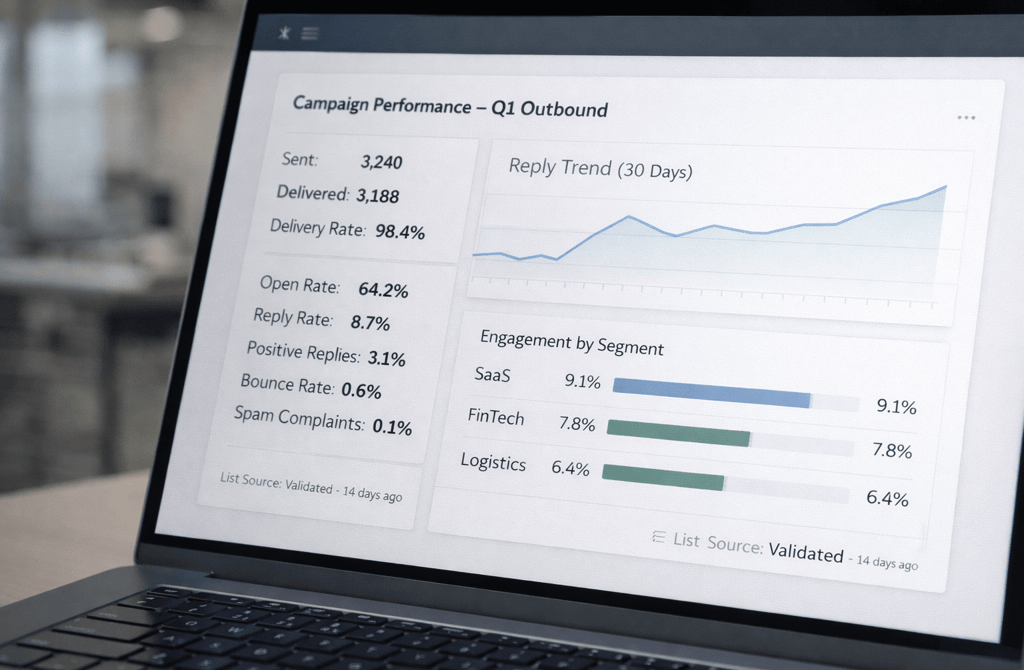
There’s a version of this story that gets told at every outbound meetup.
“We changed the framework. Replies doubled.”
What rarely gets mentioned is what happened before that framework started working.
Because high-performing cold email frameworks don’t operate in isolation. They sit on top of invisible conditions. And when those conditions aren’t met, the same “proven” sequence that wins in one account completely flattens in another.
The difference isn’t creativity. It’s data readiness.
Frameworks Don’t Create Alignment — They Amplify It
A strong outbound framework does three things well:
Establish relevance
Reduce friction
Create forward motion
But none of those matter if the underlying targeting is off by even a small margin.
When the ICP definition is tight, role accuracy is precise, and contact recency is controlled, frameworks feel sharp. They generate predictable reply behavior. Engagement looks stable.
When those layers drift, the same framework suddenly feels “burned.”
Not because prospects got smarter.
Because the alignment signal weakened.
Frameworks don’t manufacture fit. They amplify whatever fit already exists in the data.
The Stability Threshold Most Teams Ignore
There’s a hidden threshold where frameworks start working consistently.
It usually includes:
Validation cycles within a tight recency window
Role and department precision with minimal ambiguity
Company size segmentation that reflects actual buying power
Bounce stability under 1%
Once those thresholds are met, performance smooths out. Metrics stop swinging wildly between batches. Reply curves become more consistent.
Below that threshold, framework performance becomes volatile.
You can test ten variations and see ten different outcomes — not because the copy is dramatically different, but because the data underneath is inconsistent.
Framework iteration without data stability is noise.
Why Frameworks “Suddenly Stop Working”
This is one of the most common complaints in outbound:
“This framework used to work. Now it doesn’t.”
What changed?
Often, nothing about the message.
What changed is:
Job role movement inside the target segment
ICP creep from broadening filters
Aged contact data slipping into exports
Multi-source blending introducing small conflicts
Those shifts are subtle. But they compound.
A framework that once matched the buyer’s pain precisely now hits adjacent roles. Or reaches contacts who no longer own the decision.
The drop in reply rate gets attributed to fatigue.
But fatigue is rarely the real cause.
Misalignment is.
High-Performing Frameworks Depend on Controlled Variables
Framework testing assumes that everything else is stable.
But if:
List segments aren’t normalized
Recency windows vary between sends
Different enrichment depths are mixed together
Role hierarchies are inconsistently mapped
Then you aren’t testing framework quality.
You’re testing unstable data conditions.
This is why some teams think they’re optimizing copy when they’re actually chasing data inconsistencies.
The more unstable the input, the more misleading the learning.
Data Completeness Shapes Message Depth
High-performing frameworks often rely on:
Clear seniority mapping
Department-specific language
Industry nuance
Accurate company growth signals
Without complete metadata, frameworks become generic by necessity.
You can’t write role-aware messaging if title precision is weak.
You can’t tailor outreach by lifecycle stage if revenue data is misclassified.
You can’t reference operational pain if industry tagging is broad.
When data completeness increases, frameworks naturally become sharper.
When it decreases, frameworks flatten.
Copy didn’t lose power.
Context disappeared.
Deliverability Is the Silent Requirement
There’s another hidden dependency: inbox stability.
High-performing frameworks assume:
Healthy domain reputation
Stable bounce rates
Positive engagement clusters
Consistent sending cadence
If data quality declines, engagement signals weaken. That affects placement. Lower placement affects visibility. Lower visibility affects replies.
And once again, the framework gets blamed.
But no sequence performs well when inbox placement erodes quietly behind the scenes.
Data hygiene protects not only targeting accuracy — it protects the conditions required for frameworks to be evaluated fairly.
The Illusion of Copy-Led Success
When a framework produces strong results, it’s tempting to attribute success entirely to structure.
But structure is only the visible layer.
Underneath it are:
Validation discipline
Segmentation precision
ICP clarity
Role accuracy
Recency control
Infrastructure stability
Remove those supports, and the framework collapses.
Maintain them, and even modest copy can perform reliably.
Frameworks feel powerful because they’re visible.
Data foundations feel boring because they’re quiet.
But performance lives in the quiet layer.
What This Means
If you’re testing framework after framework without consistent improvement, don’t assume creativity is the bottleneck.
Audit the hidden requirements:
Is the segment stable week to week?
Are roles clean and mapped correctly?
Is recency tightly controlled?
Are bounce levels stable?
Is enrichment complete enough to support personalization depth?
High-performing frameworks aren’t magic formulas. They’re structures that only work when the data beneath them is stable.
Strong frameworks accelerate results when the inputs are disciplined.
Weak data turns even the best framework into a guessing game.
Related Post:
How Risky Email Patterns Reveal Broken Data Providers
How Industry Structure Influences Email Risk Levels
Why Certain Sectors Experience Faster Data Decay Cycles
The Hidden Validation Gaps Inside Niche Industry Lists
How Industry Turnover Impacts Lead Freshness
Why Validation Complexity Increases in Specialized Markets
How Revenue Misclassification Creates Fake ICP Matches
Why Geo Inaccuracies Lower Your Reply Rate
The Size Signals That Predict Whether an Account Is Worth Targeting
How Bad Location Data Breaks Personalization Attempts
Why Company Growth Rates Matter for Accurate Targeting
Why Testing B2B Lead Data Matters Before You Buy
How Department Shifts Impact Your Cold Email Results
Why Title Ambiguity Creates Hidden Pipeline Waste
The Hidden Problems Caused by Outdated Job Roles
How Poor Infrastructure Amplifies Minor Data Issues
Why Weak Architecture Triggers Spam Filters Faster
The Domain Reputation Mechanics Founders Should Understand
How Spam Algorithms Interpret Sudden Send Volume Changes
Why Inconsistent Targeting Raises Spam Filter Suspicion
The Inbox Sorting Logic ESPs Never Explain Publicly
How Risky Sending Patterns Trigger Domain-Level Penalties
Why Domain Reputation Is Built on Consistency, Not Volume
The Hidden Domain Factors That Influence Inbox Placement
Why Copy Tweaks Don’t Fix Underlying Data Problems
Connect
Get verified leads that drive real results for your business today.
www.capleads.org
© 2025. All rights reserved.
Serving clients worldwide.
CapLeads provides verified B2B datasets with accurate contacts and direct phone numbers. Our data helps startups and sales teams reach C-level executives in FinTech, SaaS, Consulting, and other industries.