
Why Industry Complexity Drives Lead Cost Variation
Industry complexity directly impacts B2B lead pricing. Learn how regulation, role structure, and data difficulty drive cost differences across industries.
INDUSTRY INSIGHTSLEAD QUALITY & DATA ACCURACYOUTBOUND STRATEGYB2B DATA STRATEGY
CapLeads Team
1/28/20263 min read
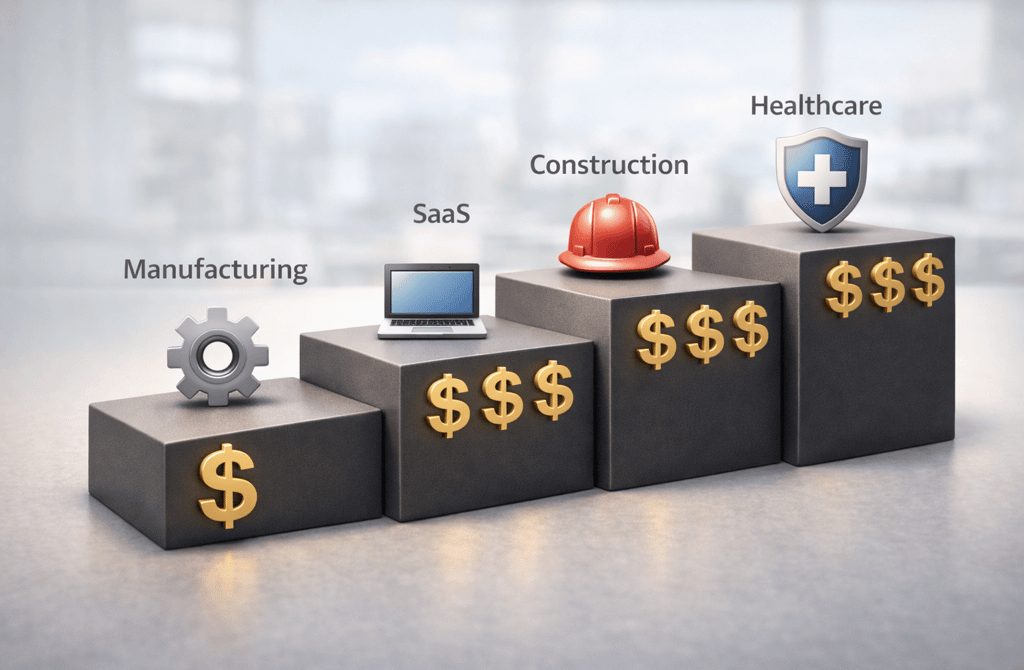
Two companies can look identical on paper—same size, same revenue band, same headcount—and yet their leads can cost wildly different amounts. The difference rarely comes down to greed, hype, or brand positioning. It comes from how complicated the industry is beneath the surface.
Lead pricing isn’t arbitrary. It reflects the friction involved in identifying, verifying, and maintaining accurate contact data inside a specific market. Some industries are structurally simple. Others are layered, fragmented, and constantly shifting. That complexity shows up directly in lead cost.
Complexity Isn’t About “Prestige”
A common misconception is that expensive leads are expensive because the industry is “premium.” In reality, pricing has far more to do with how hard it is to answer basic questions reliably:
Who actually makes the decision?
How often do roles change?
How standardized are job titles?
How visible are companies and contacts publicly?
Industries with clear answers to these questions tend to produce cheaper, more stable lead data. Industries where these answers are murky, inconsistent, or constantly changing drive costs upward.
Organizational Layers Multiply Validation Work
In straightforward industries, roles are flat and responsibilities are obvious. A “Head of Operations” usually means the same thing across companies. In complex industries, titles can be misleading, duplicated, or context-dependent.
Think of sectors with:
Matrixed reporting structures
Regional leadership overlays
Shared services across subsidiaries
Each layer increases the chance that a contact looks correct on the surface but is functionally irrelevant. Verifying these contacts requires deeper checks, cross-referencing, and often manual judgment—each step adding time and cost.
Fragmentation Increases Noise
Industries with thousands of small operators behave very differently from consolidated markets dominated by a few large players. Fragmented sectors often suffer from:
Inconsistent naming conventions
Poor digital footprints
Outdated public records
Informal or hybrid job roles
This creates noisy data environments where automated enrichment struggles and manual review becomes necessary. The more fragmented the industry, the harder it is to scale accuracy cheaply.
Regulation Changes Data Behavior
Regulated industries don’t just limit access to data—they change how companies present themselves. Titles become deliberately vague. Departments are split for compliance reasons. Contact information is often shielded behind generic inboxes.
This doesn’t make leads impossible to source, but it does increase the effort required to confirm whether a contact is usable for outreach. More checks, more exclusions, more edge cases—all of which push costs higher.
Role Volatility Accelerates Decay
Some industries experience constant internal movement. Mergers, project-based staffing, and rapid growth cycles mean that today’s accurate contact can be tomorrow’s mismatch.
High role volatility forces providers to:
Validate closer to delivery
Shorten refresh cycles
Accept higher discard rates during QA
When more records fail validation late in the process, the usable output becomes more expensive—even if the raw data volume looks the same.
Why “Same Lead Count” Doesn’t Mean Same Effort
This is where buyers often get tripped up. A list of 1,000 leads from one industry might require half the validation effort of 1,000 leads from another. Pricing reflects that asymmetry.
Lower-cost industries benefit from:
Stable org structures
Predictable titles
Strong public signals
Higher-cost industries demand:
Deeper role interpretation
Multi-source confirmation
Higher rejection thresholds
The output may look similar, but the work behind it is not.
Cost Is a Signal, Not a Penalty
When viewed correctly, lead pricing becomes informative. It tells you where complexity exists, where risk concentrates, and where shortcuts are most likely to fail.
Cheap leads in a complex industry aren’t a bargain—they’re a warning. Expensive leads in a stable industry, on the other hand, often signal unnecessary layers or poor sourcing discipline.
What This Means for Buyers
Instead of asking why one industry costs more than another, the better question is: what complexity am I paying to avoid?
Lead cost variation reflects the hidden work required to turn raw contact data into something usable. Industries don’t price evenly because their structures aren’t evenly navigable.
Bottom Line
Industry complexity quietly dictates how much effort it takes to produce reliable lead data. Markets with layered organizations, volatile roles, regulatory friction, and fragmented company structures demand deeper validation—and that reality shows up in pricing.
When lead costs rise, it’s rarely inflation. It’s complexity asserting itself.
Accurate outreach depends on respecting how difficult certain industries are to map.
Ignoring that difficulty is how cheap lists become expensive mistakes.
Related Post:
Why High-Pace Markets Produce Faster-Expiring Lead Data
The Decay-Speed Differences Between Tech and Traditional Verticals
The AI Signal Patterns That Predict Lead Reliability
How Machine Learning Improves Multi-Field Enrichment
Why AI-Assisted Verification Outperforms Manual Checks Alone
The Hidden Biases AI Introduces When Data Is Weak
How AI Detects Drift Patterns Before Humans Notice
How Data Reliability Varies Across Industry Segments
Why Some Verticals Produce Cleaner Metadata Than Others
The Industry-Level Factors Behind Lead Consistency
How Vertical Dynamics Shape Data Stability Over Time
Why Certain Industries Generate More Role Ambiguity
How LinkedIn Data Stays “Fresh” Longer Than Email Data
Why Phone Numbers Age Faster in Certain Industries
The Channel Fit Signals That Predict Reply Probability
How Email Bounce Risk Doesn’t Translate to LinkedIn
Why LinkedIn Titles Matter More Than Email Metadata
How Regulatory Environments Influence Data Quality
Why Global Lead Lists Require Region-Specific Handling
The International Data Signals That Predict Reliability
How Country-Level Mobility Impacts Role Accuracy
Why Global Data Drifts Faster in Emerging Markets
How Market Competition Influences Lead Pricing
Connect
Get verified leads that drive real results for your business today.
www.capleads.org
© 2025. All rights reserved.
Serving clients worldwide.
CapLeads provides verified B2B datasets with accurate contacts and direct phone numbers. Our data helps startups and sales teams reach C-level executives in FinTech, SaaS, Consulting, and other industries.