
The Hidden Costs of Emailing Contacts Who Haven’t Been Validated Recently
Emailing unvalidated contacts creates hidden costs across deliverability, infrastructure, and pipeline quality. Here’s what happens when recency checks are skipped.
INDUSTRY INSIGHTSLEAD QUALITY & DATA ACCURACYOUTBOUND STRATEGYB2B DATA STRATEGY
CapLeads Team
1/29/20263 min read
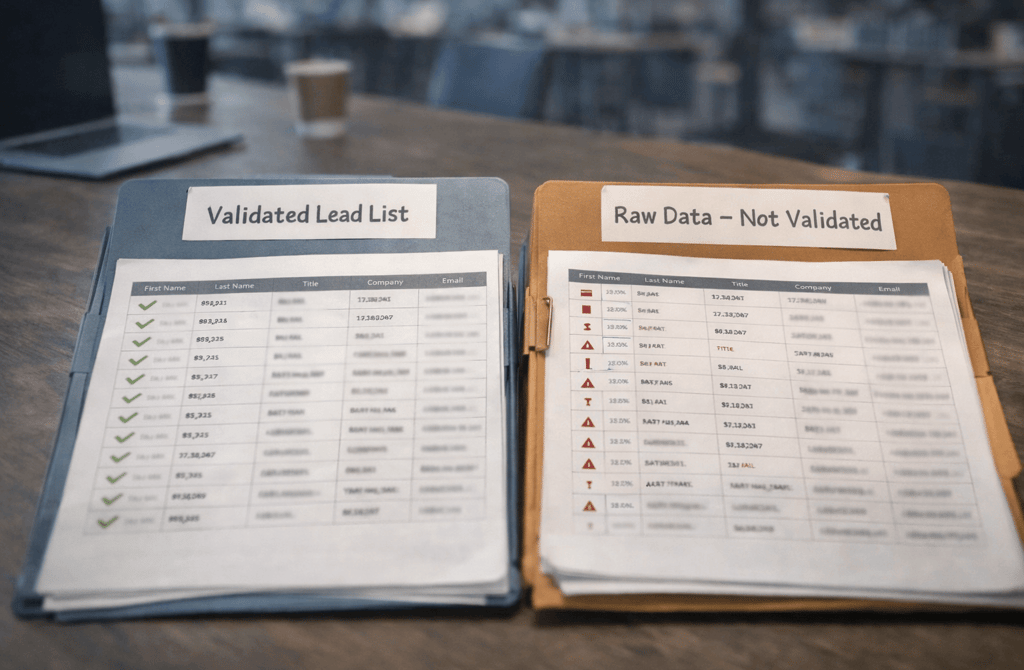
Unvalidated contacts don’t usually break campaigns on day one.
They slowly make everything more expensive.
Not in obvious line items, but in friction, wasted effort, and system drag that compounds quietly over time. Teams feel it, but rarely trace it back to the same root cause: sending to contacts that haven’t been checked recently enough to still reflect reality.
The first cost is wasted certainty
When contacts aren’t recently validated, outbound teams operate with false confidence.
Lists look complete. Counts look healthy. Segments appear ready. But under the surface, role changes, inactive inboxes, and silent errors have already crept in.
That false certainty forces teams to treat every signal with suspicion. Is the low reply rate real? Is the bounce spike meaningful? Is the segment weak—or just outdated?
Every decision now costs more because nothing can be trusted at face value.
Infrastructure absorbs damage before results do
One of the most hidden costs of unvalidated contacts is where the damage shows up first.
It’s not replies.
It’s not pipeline.
It’s infrastructure.
Sending to stale contacts increases soft bounces, intermittent hard bounces, and engagement inconsistency. Inbox providers don’t care why it happened—they only see patterns.
By the time campaign results clearly decline, reputation damage has often already accumulated. Recovery costs more time and effort than prevention ever would have.
Operations slow down to compensate
As data validation slips, teams add process to compensate.
Extra QA checks.
Manual spot reviews.
Longer warmups.
More cautious send limits.
None of these feel catastrophic individually. But together, they slow execution and drain focus. What should be a straightforward campaign launch becomes a checklist-heavy process designed to avoid surprises rather than drive results.
Unvalidated contacts don’t just hurt performance—they change how teams work.
Time cost hides inside follow-ups and cleanup
Another overlooked cost is how much time unvalidated data creates after emails are sent.
More follow-ups are required to get the same response volume. More internal discussion happens around “what went wrong.” More list cleanup happens mid-campaign instead of before launch.
That time doesn’t show up in reports. But it accumulates in calendars, Slack threads, and delayed launches.
Outbound feels busier without becoming more productive.
Pipeline quality degrades unevenly
One of the most dangerous effects of skipping recent validation is that pipeline degradation isn’t uniform.
Some segments still perform. Others quietly rot. This uneven decay creates misleading signals—teams double down on what looks like “working” without realizing other segments failed for data reasons, not market reasons.
Over time, pipeline quality narrows instead of scaling. Opportunities feel harder to replicate, and wins become harder to explain.
Validation isn’t a safety step — it’s a cost control
Recent validation isn’t just about avoiding mistakes. It’s about preventing unnecessary spend—of time, attention, reputation, and confidence.
When contacts are validated close to send time, outbound systems stay lean. Fewer compensations are needed. Fewer assumptions break mid-flight. Teams move faster because less cleanup is required.
The absence of validation doesn’t create one big failure.
It creates hundreds of small costs that quietly add up.
What This Means
Emailing contacts that haven’t been validated recently doesn’t just reduce effectiveness—it increases operational cost across the entire outbound system.
Clean, recent data keeps effort proportional to results.
Outdated data forces teams to spend more just to stand still.
Outbound becomes predictable when data reflects the present.
When it doesn’t, the real cost isn’t a failed campaign—it’s everything you spend compensating for accuracy you no longer have.
Related Post:
The Hidden Biases AI Introduces When Data Is Weak
How AI Detects Drift Patterns Before Humans Notice
How Data Reliability Varies Across Industry Segments
Why Some Verticals Produce Cleaner Metadata Than Others
The Industry-Level Factors Behind Lead Consistency
How Vertical Dynamics Shape Data Stability Over Time
Why Certain Industries Generate More Role Ambiguity
How LinkedIn Data Stays “Fresh” Longer Than Email Data
Why Phone Numbers Age Faster in Certain Industries
The Channel Fit Signals That Predict Reply Probability
How Email Bounce Risk Doesn’t Translate to LinkedIn
Why LinkedIn Titles Matter More Than Email Metadata
How Regulatory Environments Influence Data Quality
Why Global Lead Lists Require Region-Specific Handling
The International Data Signals That Predict Reliability
How Country-Level Mobility Impacts Role Accuracy
Why Global Data Drifts Faster in Emerging Markets
How Market Competition Influences Lead Pricing
Why Industry Complexity Drives Lead Cost Variation
The Cross-Industry Factors That Predict Lead Price
How Data Difficulty Impacts Lead Cost Across Verticals
Why Some Sectors Offer Better Lead Value Than Others
Why Outbound Falls Apart When Lead Lists Age Faster Than Your Campaigns
The Real Reason Fresh Data Makes Your Outreach Feel Easier
How a 90-Day Recency Window Changes Your Entire Cold Email Strategy
Connect
Get verified leads that drive real results for your business today.
www.capleads.org
© 2025. All rights reserved.
Serving clients worldwide.
CapLeads provides verified B2B datasets with accurate contacts and direct phone numbers. Our data helps startups and sales teams reach C-level executives in FinTech, SaaS, Consulting, and other industries.