
How AI Detects Drift Patterns Before Humans Notice
AI spots subtle data drift long before metrics break. Learn how pattern shifts reveal lead quality decay before humans can see it.
INDUSTRY INSIGHTSLEAD QUALITY & DATA ACCURACYOUTBOUND STRATEGYB2B DATA STRATEGY
CapLeads Team
1/24/20263 min read
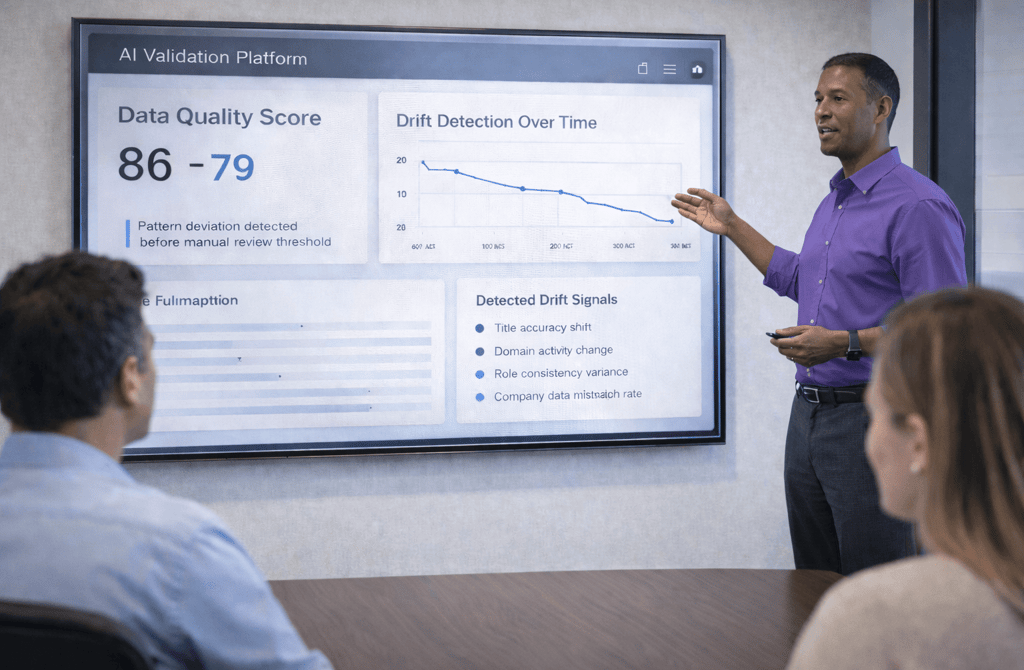
Drift doesn’t arrive as a break.
It arrives as a shift.
Nothing looks wrong at first. Campaigns still send. Replies still come in. Metrics hover inside acceptable ranges. The problem is that by the time humans agree something feels off, the underlying change has already settled in.
AI detects drift earlier because it doesn’t wait for failure. It watches movement.
Why humans notice drift late by default
Human review is anchored to thresholds.
Teams react when:
reply rates fall below expectations
bounce rates cross a visible line
segments stop converting the way they used to
This works for catching breakdowns. It’s not built for spotting directional change.
Humans are good at recognizing states (“working” vs “not working”).
Drift happens in transitions — where nothing is broken yet.
Drift is not decay — it’s misalignment in motion
Data decay implies age.
Drift implies change.
Examples:
job titles evolving faster than enrichment updates
domains shifting usage patterns
role seniority flattening across company sizes
Each change is small. Together, they alter how data behaves — even though individual fields still look acceptable.
AI models are designed to track these relationships continuously.
What AI sees that dashboards don’t
Traditional dashboards show snapshots:
averages
totals
deltas
AI looks at shape.
It detects:
slope changes instead of drops
variance expansion instead of outright errors
timing shifts instead of volume loss
A reply rate that stays flat but takes longer to arrive is a signal.
A title distribution that widens slightly over time is a signal.
A domain that responds differently at the same volume is a signal.
None of these trip alarms on their own. Together, they indicate drift.
Pattern comparison beats absolute measurement
Humans often ask: Is this number good or bad?
AI asks: Is this number behaving the way it used to?
By comparing:
current patterns vs historical baselines
segment behavior vs peer groups
recent distributions vs long-term norms
AI flags divergence before performance degrades.
This isn’t foresight. It’s pattern memory at scale.
Why early drift rarely feels urgent
Drift doesn’t hurt immediately.
Early symptoms tend to be:
slightly lower relevance
longer sales cycles
more follow-ups required
marginal engagement decay
These are easy to rationalize:
“Market’s quieter.”
“Messaging needs a tweak.”
By the time those explanations stop working, the drift has already compounded.
AI doesn’t rationalize. It compares.
The role of confidence bands in drift detection
One of the biggest differences between human and AI detection is tolerance.
Humans accept variance until it becomes uncomfortable.
AI defines acceptable movement ranges and watches for boundary pressure.
When behavior repeatedly touches the edge of those ranges — even without crossing them — AI treats it as a warning.
That’s why drift alerts often feel early or conservative. They’re based on trajectory, not outcome.
Why drift matters before campaigns fail
Drift changes the meaning of data before it breaks the system.
If titles drift, personalization loses relevance.
If domains drift, deliverability assumptions weaken.
If role behavior drifts, ICP definitions blur.
None of these cause instant failure. They quietly reduce signal clarity — which makes every downstream decision noisier.
AI detects drift early because noise shows up in patterns long before it shows up in results.
Humans still matter — just not at detection time
AI is not better at deciding what to do.
It’s better at deciding when attention is required.
Humans are needed to:
interpret why drift is happening
decide whether it’s temporary or structural
adjust targeting, messaging, or sourcing accordingly
The advantage comes from letting AI surface the change while options are still open.
What this changes operationally
Teams that rely on human detection tend to respond after impact.
Teams that monitor drift respond while behavior is still flexible.
Early drift visibility allows:
targeted refresh instead of full replacement
segmentation adjustments instead of volume increases
messaging refinement instead of system overhaul
The difference isn’t speed.
It’s intervention timing.
Data doesn’t fail all at once. It slides.
Systems that watch for movement — not just breakage — see it first.
Related Post:
The Chain Reactions Triggered by Weak Data Inputs
How One Bad Field Corrupts an Entire Outbound System
Why Data Dependencies Matter More Than Individual Signals
The Upstream Errors That Create Downstream Pipeline Damage
Why Some Industries Naturally Produce Higher Bounce Rates
The Vertical Patterns Behind High-Bounce Lead Lists
How Industry Type Predicts Email Bounce Probability
Why Low-Bounce Verticals Offer More Stable Outreach
The Structural Reasons Certain Verticals Bounce More
Why Outbound Behavior Differs Wildly Across Verticals
The Industry-Level Reply Patterns Most Teams Miss
How Vertical Dynamics Shape Cold Email Engagement
Why Some Industries Respond Faster Than Others
The Vertical Factors Behind High-Intent Replies
Why Some Industries Experience Lightning-Fast Data Decay
The Vertical Decay Speed Patterns Most Teams Never Measure
How Industry Turnover Dictates Data Decay Velocity
Why High-Pace Markets Produce Faster-Expiring Lead Data
The Decay-Speed Differences Between Tech and Traditional Verticals
The AI Signal Patterns That Predict Lead Reliability
How Machine Learning Improves Multi-Field Enrichment
Why AI-Assisted Verification Outperforms Manual Checks Alone
The Hidden Biases AI Introduces When Data Is Weak
Connect
Get verified leads that drive real results for your business today.
www.capleads.org
© 2025. All rights reserved.
Serving clients worldwide.
CapLeads provides verified B2B datasets with accurate contacts and direct phone numbers. Our data helps startups and sales teams reach C-level executives in FinTech, SaaS, Consulting, and other industries.