
Why AI-Assisted Verification Outperforms Manual Checks Alone
Manual checks catch obvious errors. AI-assisted verification detects hidden inconsistencies across data fields—making lead quality more reliable at scale.
INDUSTRY INSIGHTSLEAD QUALITY & DATA ACCURACYOUTBOUND STRATEGYB2B DATA STRATEGY
CapLeads Team
1/24/20263 min read
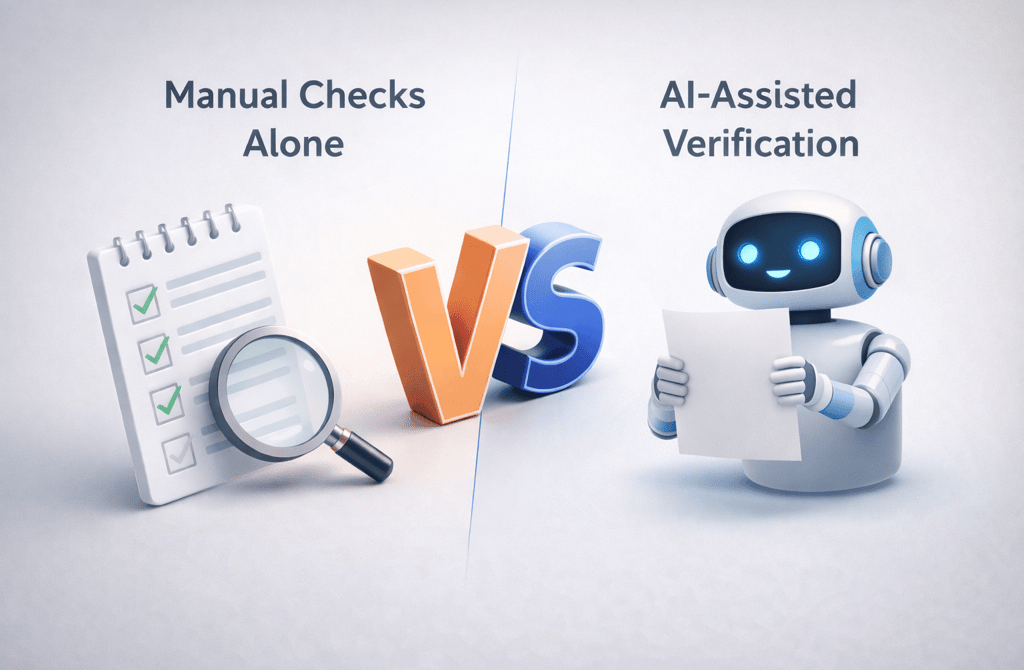
Verification usually breaks at the exact moment teams think they’ve “done enough.”
A list gets reviewed. A sample looks clean. A few emails pass basic checks. Someone signs off — not because the data is perfect, but because the process feels complete. That’s the quiet gap where most verification systems fail.
Manual checks are good at answering one question: Does this record look reasonable in isolation?
Modern outbound needs answers to a harder one: Does this record still make sense when every field is evaluated together?
That difference is where AI-assisted verification changes the outcome.
Where manual checks actually shine — and where they stop
Human review is excellent at spotting obvious problems:
clearly wrong job titles
malformed email patterns
records that “feel off” at a glance
For small lists or one-off campaigns, that’s often enough. The issue isn’t that manual checks are bad — it’s that they are linear.
A human reviewer typically evaluates one field at a time:
email → looks valid
title → seems plausible
company → exists
What’s rarely tested is whether those fields still make sense together.
That’s not a skill problem. It’s a bandwidth problem.
Verification failures are rarely single-field errors
Most bad leads don’t fail loudly. They fail subtly.
Examples:
a valid email tied to a recently changed role
a correct title attached to a legacy department structure
a real company with a contact no longer aligned to buying authority
Each field passes inspection on its own.
The relationship between fields is what’s broken.
Manual review struggles here because humans don’t naturally compute multi-variable consistency at scale — especially across thousands of records.
What AI-assisted verification actually adds
AI-assisted verification doesn’t replace human judgment. It changes what gets tested.
Instead of validating fields independently, AI evaluates:
cross-field consistency (role ↔ company ↔ domain)
probability conflicts (seniority vs company size)
pattern deviation (records that technically pass but statistically drift)
This matters because lead reliability is rarely binary. It’s probabilistic.
AI excels at identifying:
edge cases humans would approve due to familiarity bias
inconsistencies that only appear when multiple fields are scored together
That’s not something a checklist catches.
Scale is where the gap becomes visible
Manual verification degrades as volume increases — not because reviewers get worse, but because attention becomes selective.
AI-assisted systems don’t get tired, don’t skip edge cases, and don’t rely on gut feel. They apply the same cross-field logic to the first record and the ten-thousandth.
At scale, this leads to:
fewer “technically valid but wrong” contacts
lower downstream correction work
more stable campaign behavior over time
The benefit isn’t speed. It’s consistency under pressure.
Why “AI-only” is still a mistake
AI-assisted verification works best when it flags what needs judgment, not when it replaces judgment entirely.
Humans still matter for:
interpreting context-heavy roles
understanding industry-specific anomalies
making final calls on borderline records
The advantage comes from letting AI narrow the surface area of risk — so humans focus where judgment actually changes outcomes.
That’s the difference between automation and assistance.
The real reason AI-assisted verification wins
This isn’t about intelligence. It’s about coverage.
Manual checks cover what’s visible.
AI-assisted verification covers what’s relational.
As outbound systems become more complex — multi-contact, multi-sequence, multi-channel — reliability depends less on whether a single field is “correct” and more on whether the entire record holds together.
That’s a problem built for systems, not spot checks.
What this means operationally
Teams relying only on manual checks tend to:
discover issues after campaigns launch
misdiagnose reply drops as copy problems
accept “good enough” data until volume exposes the cracks
Teams using AI-assisted verification catch those issues before sending, when fixes are cheap and reputation risk is low.
Clean data doesn’t make outreach magical.
But when verification evaluates how fields interact — not just whether they exist — outbound stops breaking in quiet, expensive ways.
Related Post:
The Chain Reactions Triggered by Weak Data Inputs
How One Bad Field Corrupts an Entire Outbound System
Why Data Dependencies Matter More Than Individual Signals
The Upstream Errors That Create Downstream Pipeline Damage
Why Some Industries Naturally Produce Higher Bounce Rates
The Vertical Patterns Behind High-Bounce Lead Lists
How Industry Type Predicts Email Bounce Probability
Why Low-Bounce Verticals Offer More Stable Outreach
The Structural Reasons Certain Verticals Bounce More
Why Outbound Behavior Differs Wildly Across Verticals
The Industry-Level Reply Patterns Most Teams Miss
How Vertical Dynamics Shape Cold Email Engagement
Why Some Industries Respond Faster Than Others
The Vertical Factors Behind High-Intent Replies
Why Some Industries Experience Lightning-Fast Data Decay
The Vertical Decay Speed Patterns Most Teams Never Measure
How Industry Turnover Dictates Data Decay Velocity
Why High-Pace Markets Produce Faster-Expiring Lead Data
The Decay-Speed Differences Between Tech and Traditional Verticals
The AI Signal Patterns That Predict Lead Reliability
How Machine Learning Improves Multi-Field Enrichment
Connect
Get verified leads that drive real results for your business today.
www.capleads.org
© 2025. All rights reserved.
Serving clients worldwide.
CapLeads provides verified B2B datasets with accurate contacts and direct phone numbers. Our data helps startups and sales teams reach C-level executives in FinTech, SaaS, Consulting, and other industries.