
How Data Reliability Varies Across Industry Segments
Data reliability isn’t consistent across industries. Learn why some sectors produce cleaner, more stable B2B data than others—and how that impacts outreach results.
INDUSTRY INSIGHTSLEAD QUALITY & DATA ACCURACYOUTBOUND STRATEGYB2B DATA STRATEGY
CapLeads Team
1/25/20263 min read
Most outbound teams assume data reliability is a tooling problem.
It isn’t.
Two companies can buy leads from the same provider, run the same campaigns, and see completely different outcomes—simply because the industries they target behave differently at the data level.
Industry structure quietly dictates how stable, accurate, and usable contact data really is. Ignoring that reality leads to misdiagnosis: teams blame copy, cadence, or deliverability when the real issue is that not all industries produce reliable data at the same rate.
Why industry structure shapes data reliability
Every industry creates data through real-world behavior: hiring patterns, role clarity, company stability, regulation, and how often people change jobs. These forces shape how quickly records go stale and how accurate they are at any given moment.
Industries with:
High employee mobility
Fluid job titles
Frequent company restructuring
naturally produce less reliable contact data.
Meanwhile, industries with slower operational cycles and clearer role definitions tend to maintain usable data for longer periods—even without constant refreshes.
This isn’t about quality of providers. It’s about how the underlying market behaves.
High-variance industries: fast change, fragile data
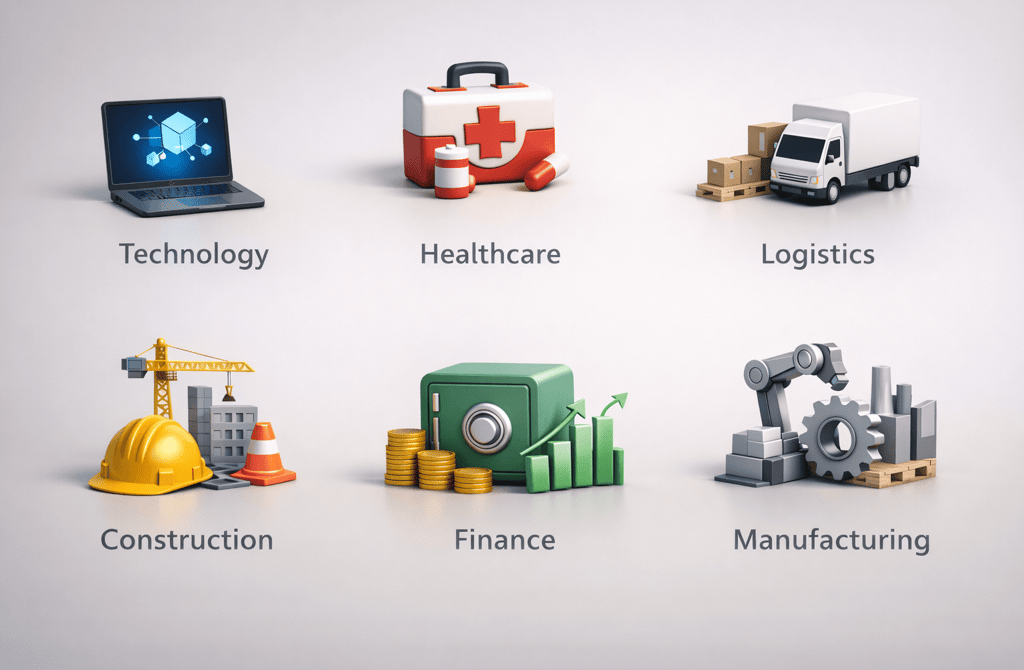
Technology, startups, and high-growth SaaS sectors are classic examples of low data stability.
Titles evolve quickly. Responsibilities blur. Teams reorganize mid-quarter. A “Head of Growth” today may be a consultant tomorrow—or gone entirely.
In these industries:
Job changes happen frequently
Titles are inconsistent across companies
As a result, even recently validated data degrades quickly. Reliability windows are shorter, and outreach systems must compensate with stricter recency controls and more frequent revalidation.
Moderate-stability industries: usable with constraints
Professional services, agencies, finance-adjacent firms, and B2B services often sit in the middle.
Roles are more standardized, but companies themselves move at different speeds. Mergers, rebrands, and internal restructuring introduce gradual data drift rather than sudden collapse.
Here, data reliability depends heavily on:
Role seniority accuracy
Company size consistency
Clear department mapping
When those fields are correct, lists perform predictably. When they’re wrong, campaigns still “send” but fail to convert meaningfully—creating the illusion of engagement without pipeline.
High-stability industries: slower change, stronger data
Construction, manufacturing, logistics, and regulated sectors tend to produce more durable contact data.
These industries share common traits:
Slower hiring cycles
Clear functional roles
Less title experimentation
A procurement manager or operations lead often remains in place longer, and job scopes change less dramatically. As a result, data holds its value for longer periods—if it’s sourced correctly.
However, stability doesn’t mean zero risk. Field-based roles, regional branches, and legacy systems introduce their own challenges, especially with phone numbers and location accuracy.
Why “one-size-fits-all” data strategies fail
When teams treat all industries the same, they misalign their expectations.
A bounce rate that’s acceptable in one sector may be disastrous in another. A validation cycle that works for logistics may fail entirely for SaaS. Outreach volume that’s safe in one vertical can trigger negative signals elsewhere.
Industry-aware data handling isn’t optimization—it’s baseline hygiene.
The strongest outbound systems don’t ask, “Is this data verified?”
They ask, “Is this data behaving normally for this industry?”
Adjusting expectations, not just filters
Understanding industry-level reliability helps teams:
Set realistic validation windows
Choose appropriate outreach cadence
Interpret engagement signals correctly
More importantly, it prevents wasted iteration. When reply rates drop, teams can distinguish between messaging issues and structural data limits—saving time, budget, and infrastructure health.
What This Means Going Forward
Data reliability is not evenly distributed across markets. It’s shaped by how industries hire, organize, and evolve—and outbound performance follows those patterns whether teams acknowledge them or not.
Outbound becomes easier to manage when data behavior is predictable for the sector you’re targeting.
It becomes fragile when list quality ignores how quickly that industry’s information actually changes.
When teams align their outreach systems with industry-level data reality, campaigns stabilize.
When they don’t, even “clean-looking” lists quietly undermine results long before anyone notices.
Related Post:
How Industry Type Predicts Email Bounce Probability
Why Low-Bounce Verticals Offer More Stable Outreach
The Structural Reasons Certain Verticals Bounce More
Why Outbound Behavior Differs Wildly Across Verticals
The Industry-Level Reply Patterns Most Teams Miss
How Vertical Dynamics Shape Cold Email Engagement
Why Some Industries Respond Faster Than Others
The Vertical Factors Behind High-Intent Replies
Why Some Industries Experience Lightning-Fast Data Decay
The Vertical Decay Speed Patterns Most Teams Never Measure
How Industry Turnover Dictates Data Decay Velocity
Why High-Pace Markets Produce Faster-Expiring Lead Data
The Decay-Speed Differences Between Tech and Traditional Verticals
The AI Signal Patterns That Predict Lead Reliability
How Machine Learning Improves Multi-Field Enrichment
Why AI-Assisted Verification Outperforms Manual Checks Alone
The Hidden Biases AI Introduces When Data Is Weak
How AI Detects Drift Patterns Before Humans Notice
Connect
Get verified leads that drive real results for your business today.
www.capleads.org
© 2025. All rights reserved.
Serving clients worldwide.
CapLeads provides verified B2B datasets with accurate contacts and direct phone numbers. Our data helps startups and sales teams reach C-level executives in FinTech, SaaS, Consulting, and other industries.