
How Email Bounce Risk Doesn’t Translate to LinkedIn
Email bounce risk impacts deliverability and reputation, but those risks don’t exist on LinkedIn. Learn why channel risk behaves differently across platforms.
INDUSTRY INSIGHTSLEAD QUALITY & DATA ACCURACYOUTBOUND STRATEGYB2B DATA STRATEGY
CapLeads Team
1/26/20263 min read
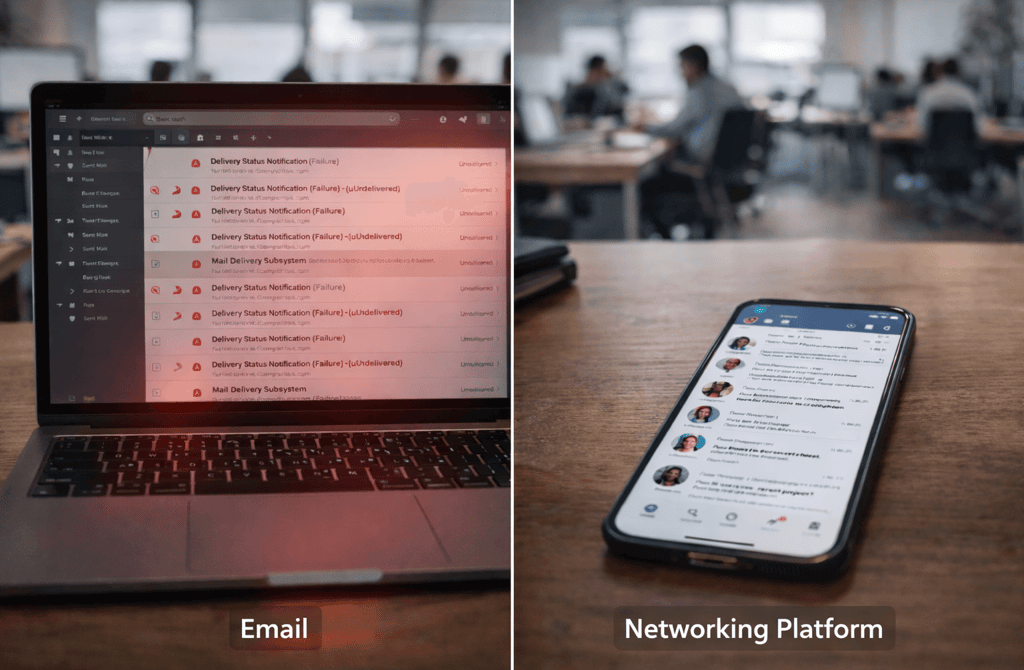
Email and LinkedIn failures look similar on the surface—no response, no progress—but they behave very differently underneath. Treating them as equivalent mistakes is how teams end up fixing the wrong problems.
The key difference isn’t engagement. It’s risk exposure.
Email failure carries systemic consequences. LinkedIn failure does not. Once you separate outcome from risk, the contrast between the two channels becomes obvious.
Email Bounce Risk Is Structural, Not Situational
An email bounce isn’t just a missed message. It’s a signal that propagates outward.
Inbox providers interpret bounces as indicators of sender quality. Enough of them—especially hard bounces—and the sender’s reputation deteriorates. That deterioration affects future sends, even to valid contacts. Deliverability drops before teams notice anything is wrong.
What makes this dangerous is that bounce risk compounds. One bad list doesn’t just fail quietly; it makes the next list harder to deliver. Email systems are designed to remember mistakes.
LinkedIn doesn’t work this way. A message that goes unanswered doesn’t degrade your ability to message the next person. There is no cumulative penalty attached to non-response.
Failure Visibility Works in Opposite Directions
Email failures are mostly invisible at the moment they occur. A bounce may be logged somewhere, but the real impact shows up later as lower inbox placement, suppressed volume, or inconsistent performance.
LinkedIn failures are immediate and contained. A message sits unread. A connection request is ignored. The outcome is visible, but it doesn’t poison future attempts.
This difference changes how risk should be managed. Email requires preventive controls because damage is delayed. LinkedIn allows experimentation because failure is localized.
Email Risk Is Tied to Infrastructure Trust
Email operates on a trust-based system shared across senders, domains, and providers. When trust erodes, it affects everything downstream.
That’s why email bounce risk isn’t just about list quality—it’s about infrastructure health. Poor data introduces instability into the entire system, regardless of message relevance.
LinkedIn messaging doesn’t rely on sender infrastructure reputation in the same way. Messages are evaluated at the interaction level, not through a shared trust ledger. One bad message doesn’t reduce the visibility of the next one.
Bounce Risk Alters Measurement Accuracy
Another overlooked consequence of email bounce risk is distorted metrics.
When bounces increase, open rates and reply rates become unreliable. Suppressed delivery can make performance look worse—or better—than reality. Teams end up optimizing based on corrupted signals.
LinkedIn metrics don’t suffer from this distortion. Non-response remains non-response. There’s no hidden filtering layer quietly altering visibility behind the scenes.
This makes LinkedIn failures easier to diagnose. Email failures often mislead.
Why Channel Mistakes Feel the Same—but Aren’t
From a human perspective, silence feels identical across channels. No reply is no reply.
From a system perspective, email silence may be the result of damage already done. LinkedIn silence is usually just a lack of interest, timing, or relevance.
Conflating the two leads teams to treat email like a low-risk sandbox when it isn’t—and to overcorrect LinkedIn behavior as if it were harming something long-term.
How to Think About Risk Correctly
Email should be treated as a risk-sensitive channel. Data quality, validation timing, and list hygiene matter because mistakes persist.
LinkedIn should be treated as a signal-testing channel. Messages can fail without consequence, which makes it suitable for learning, probing, and adjusting without structural fallout.
The channels serve different purposes not because of reach or engagement—but because of how failure behaves inside each system.
What This Means
Email bounce risk doesn’t translate to LinkedIn because the channels punish failure differently. Email remembers mistakes and applies them forward. LinkedIn contains mistakes at the point of interaction.
Outbound strategies become more stable when risk is assigned where it actually exists. Email demands discipline because errors compound. LinkedIn allows iteration because errors end cleanly.
Understanding that distinction prevents teams from fixing the wrong problems—and from turning manageable issues into long-term damage.
Related Post:
How Vertical Dynamics Shape Cold Email Engagement
Why Some Industries Respond Faster Than Others
The Vertical Factors Behind High-Intent Replies
Why Some Industries Experience Lightning-Fast Data Decay
The Vertical Decay Speed Patterns Most Teams Never Measure
How Industry Turnover Dictates Data Decay Velocity
Why High-Pace Markets Produce Faster-Expiring Lead Data
The Decay-Speed Differences Between Tech and Traditional Verticals
The AI Signal Patterns That Predict Lead Reliability
How Machine Learning Improves Multi-Field Enrichment
Why AI-Assisted Verification Outperforms Manual Checks Alone
The Hidden Biases AI Introduces When Data Is Weak
How AI Detects Drift Patterns Before Humans Notice
How Data Reliability Varies Across Industry Segments
Why Some Verticals Produce Cleaner Metadata Than Others
The Industry-Level Factors Behind Lead Consistency
How Vertical Dynamics Shape Data Stability Over Time
Why Certain Industries Generate More Role Ambiguity
How LinkedIn Data Stays “Fresh” Longer Than Email Data
Why Phone Numbers Age Faster in Certain Industries
The Channel Fit Signals That Predict Reply Probability
Connect
Get verified leads that drive real results for your business today.
www.capleads.org
© 2025. All rights reserved.
Serving clients worldwide.
CapLeads provides verified B2B datasets with accurate contacts and direct phone numbers. Our data helps startups and sales teams reach C-level executives in FinTech, SaaS, Consulting, and other industries.