
Why Spam Filters Care More About Data Signals Than Copy
Spam filters don’t judge emails by copy alone. Learn how data signals like list quality, engagement history, and sending behavior determine inbox placement.
INDUSTRY INSIGHTSLEAD QUALITY & DATA ACCURACYOUTBOUND STRATEGYB2B DATA STRATEGY
CapLeads Team
1/1/20263 min read

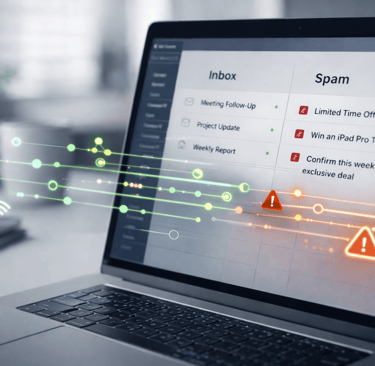
Most founders assume spam filters behave like readers.
They believe inbox placement comes down to wording, tone, subject lines, or whether the email “sounds salesy.” When campaigns fail, the instinct is to rewrite copy, tweak personalization, or swap templates.
But spam filters don’t read emails the way humans do.
They score systems, not sentences.
Modern inbox providers decide placement almost entirely through data signals — long before copy quality ever matters.
Spam Filters Don’t Judge Content First
Inbox providers like Google and Microsoft process emails through layered decision systems. By the time content is evaluated, the email has already passed (or failed) multiple upstream checks.
Those checks are not subjective. They are statistical.
Spam filters ask questions like:
Does this sender usually target the right people?
Do recipients historically engage with this sender?
Does this domain generate bounces, complaints, or ignored sends?
Does sending behavior look consistent and intentional?
None of those questions involve copy quality.
An email with excellent writing can still go to spam if the data signals say the sender is risky.
Inbox Placement Is a Pattern Recognition Problem
Spam filtering is fundamentally about pattern recognition.
Inbox providers analyze millions of sends to identify which patterns correlate with positive user behavior — and which correlate with annoyance, irrelevance, or abuse.
They don’t need to “read” your email to know if it’s unwanted.
They infer intent based on:
Who you send to
How often you send
How recipients react over time
If a sender repeatedly emails people who never reply, never open, or mark messages as spam, filters learn quickly — regardless of how polite or well-written the message is.
Why Clean Targeting Beats Clever Copy
One of the strongest inbox signals is recipient fit.
When emails consistently land with people who recognize the sender, expect the message, or see immediate relevance, engagement naturally follows. Replies happen. Deletions slow down. Spam complaints stay low.
That behavior trains inbox providers to trust the sender.
On the other hand, when messages go to the wrong roles, outdated contacts, or mismatched industries, negative signals accumulate quietly:
No opens
No replies
Fast deletes
Silent ignoring
Over time, filters treat the sender as low-value — even if the copy itself is perfectly fine.
This is why two senders using the same email template can see wildly different results.
The difference isn’t copy.
It’s data alignment.
Engagement History Matters More Than Any Single Send
Spam filters don’t judge emails in isolation.
They evaluate sender history.
A sender with a long track record of clean targeting and stable engagement earns leeway. Minor mistakes don’t immediately trigger penalties.
A sender with weak history gets no benefit of the doubt.
This means:
Short-term wins don’t override long-term patterns
Fixing copy won’t undo historical data problems
Inbox providers remember behavior longer than most founders expect.
Why “Spammy Words” Are a Distraction
Founders often obsess over avoiding certain phrases, punctuation, or formatting choices.
While extreme patterns can still trigger filters, most modern spam decisions happen before content scanning.
If your data signals are strong:
Direct language is tolerated
CTAs are acceptable
Sales framing isn’t punished
If your data signals are weak:
Even neutral copy struggles
Safe wording doesn’t save placement
Small mistakes are amplified
Spam filters don’t need keywords when behavior already predicts risk.
The Quiet Feedback Loop Founders Miss
Inbox providers watch how recipients behave after delivery.
They measure:
Replies vs non-responses
Deletes without opening
Time spent before engagement
Complaint rates across segments
These behaviors feed back into future placement decisions.
This creates a loop:
Bad data → poor engagement → worse placement → even poorer engagement
Many founders try to break this loop by rewriting emails, when the real issue is that the loop started before sending ever began.
Copy Still Matters — Just Later
None of this means copy is irrelevant.
Copy matters once an email:
Reaches the inbox
Reaches the right person
Arrives at the right time
But copy cannot compensate for weak data signals.
Spam filters don’t reward creativity.
They reward predictability, relevance, and restraint.
Final Thought
Inbox placement is not won with clever phrasing — it’s earned through consistent, data-aligned behavior.
When your targeting is accurate and your engagement patterns are healthy, inbox providers treat your emails as expected communication, not interruptions.
But when your lists are misaligned or outdated, even the best-written message becomes invisible.
Strong outbound doesn’t start with words.
It starts with signals — and those signals come from the quality of the data behind every send.
Related Post:
How Industry Dynamics Affect Lead Verification Accuracy
Why Some Verticals Require Deeper Validation Than Others
The Validation Rules That Change Based on Industry Type
Why Company Size Errors Break Your Targeting Strategy
The Revenue Accuracy Problems Hidden Inside Most Lead Lists
How Incorrect Company Location Data Distorts Segmentation
Why HQ vs Branch Confusion Derails Cold Email Targeting
The Real Cost of Running Outbound on Mis-Sized Companies
Why Role Accuracy Matters More Than Personalization
The Title Errors That Break Your Buyer Targeting
How Incorrect Department Data Skews Segmentation
Why Job Seniority Precision Predicts Reply Probability
The Role Drift That Makes Outreach Hit the Wrong Person
Why Deliverability Architecture Decides Whether Your Emails Land
The Infrastructure Mistakes That Break Inbox Placement
How Domain Setup Shapes Your Entire Outbound Performance
Why Technical Architecture Matters More Than Copy Quality
The DNS Configuration Gaps That Hurt Cold Email Reach
Connect
Get verified leads that drive real results for your business today.
www.capleads.org
© 2025. All rights reserved.
Serving clients worldwide.
CapLeads provides verified B2B datasets with accurate contacts and direct phone numbers. Our data helps startups and sales teams reach C-level executives in FinTech, SaaS, Consulting, and other industries.