
Why Enriched Leads Outperform Basic Lists Every Time
Enriched leads consistently outperform basic lists because they reduce mis-targeting, operational drag, and outbound risk. Learn why completeness changes results.
INDUSTRY INSIGHTSLEAD QUALITY & DATA ACCURACYOUTBOUND STRATEGYB2B DATA STRATEGY
CapLeads Team
12/25/20253 min read
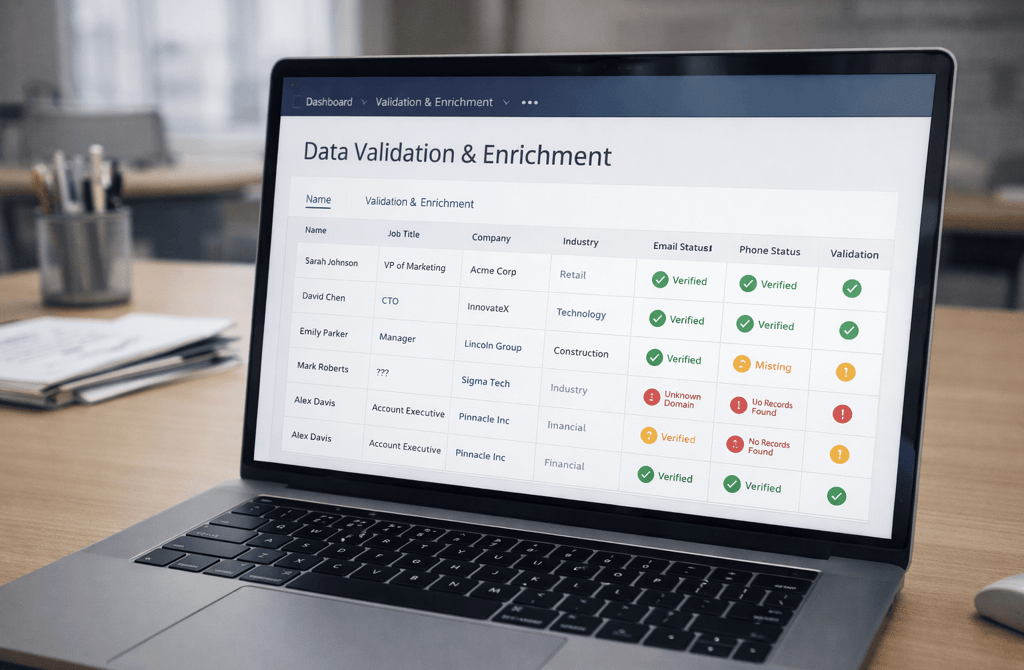
Most teams think enriched leads outperform basic lists because they’re “more accurate.”
That’s true — but it’s not the real reason.
The real advantage of enriched leads isn’t just better data quality. It’s how enrichment changes decision-making, execution speed, and behavior across the entire outbound motion.
Basic lists don’t just perform worse. They subtly push teams into inefficient habits that compound over time.
1. Enriched Leads Remove Hesitation at the Point of Action
One of the biggest hidden costs in outbound is hesitation.
When SDRs or founders look at a basic list, they pause:
“Is this the right role?”
“Is this company even a fit?”
“Is this contact still valid?”
That hesitation slows execution and reduces confidence.
Enriched leads remove that friction. When roles, company context, and contactability are already clear, teams don’t second-guess. They act.
Speed here isn’t about volume — it’s about decisiveness.
2. Basic Lists Create Defensive Workflows
Basic lists force teams to protect themselves from bad outcomes.
This shows up as:
Extra enrichment steps before sending
Manual spot checks
Conservative segmentation rules
Over-filtering to avoid mistakes
These defensive workflows feel responsible, but they are overhead created solely because the data isn’t trusted.
Enriched leads eliminate the need for defense. The workflow becomes simpler because the risk has already been handled upstream.
3. Enriched Data Improves Internal Alignment
Basic lists don’t just hurt outreach — they create internal disagreement.
Teams argue about:
Whether performance issues are caused by data or copy
Whether a campaign should be paused or pushed
Enriched leads reduce these debates.
When the data is clearly structured and complete, teams align faster on decisions. Less energy is spent diagnosing inputs, and more energy goes into execution and learning.
That alignment is a performance advantage most teams never measure.
4. Enriched Leads Produce Cleaner Feedback Loops
Outbound performance depends on feedback loops.
Basic lists distort them.
When results are weak, teams don’t know whether the issue is:
Targeting
Role mismatch
Company fit
Deliverability
Messaging
Enriched leads narrow the variables.
When the data is reliable, performance signals are easier to interpret. Teams can adjust copy, timing, or strategy with confidence — instead of guessing which layer is broken.
This makes iteration faster and smarter.
5. Enriched Leads Change How Teams Scale
Scaling outbound with basic lists forces tradeoffs.
Teams either:
Increase volume and accept more waste
Slow down and lose momentum
Enriched leads change that equation.
Because enriched data reduces mis-targeting and cleanup work, teams can scale without expanding process complexity. Volume increases don’t require proportional increases in manual effort.
That’s why enriched leads outperform over time — not because they’re perfect, but because they scale cleanly.
6. Basic Lists Hide Their Cost Until It’s Too Late
The most dangerous thing about basic lists is that they often “work” at small scale.
A few replies come in.
A few meetings get booked.
The problems feel manageable.
But as volume increases:
Manual fixes stop working
Errors multiply
Small inefficiencies become systemic
By the time teams recognize the cost, it’s already embedded in their workflows.
Enriched leads prevent that slow degradation.
7. Enrichment Is a Strategic Choice, Not a Tactical Upgrade
Many teams treat enrichment as a feature add-on.
In reality, it’s a strategic decision about how much uncertainty you’re willing to tolerate in your outbound system.
Basic lists require teams to absorb uncertainty downstream.
Enriched leads absorb it upstream.
That difference determines how predictable outbound becomes as teams grow.
Final Thought
Enriched leads don’t outperform basic lists because they’re “better.”
They outperform because they change how teams think, move, and decide.
When data is complete and structured, outbound becomes decisive, aligned, and repeatable.
When lists are basic or under-enriched, uncertainty spreads — and performance quietly erodes long before results make the problem obvious.
Related Post
The Age Signals That Predict Whether a Lead Will Ever Respond
How Data Staleness Creates Invisible Pipeline Delays
Why Old Contacts Tank Your Reply Rate Long Before You Noticest
The Simple Recency Rule That Separates High-Intent Prospects from Dead Leads
The Verification Gaps That Create Hidden Bounce Risk
Why “Validated” Isn’t Always Valid: The Pitfalls in Modern Data Checks
The Role True Verification Plays in Protecting Domain Reputation
How Weak Validation Layers Inflate Your Deliverability Metrics
Why You Should Never Trust Email Lists Without Proof-of-Validation
The Bounce Patterns That Reveal Weak Data Hygiene
Why Bounce Rate Spikes Usually Point to Data, Not Domains
The Silent Infrastructure Issues Behind Rising Bounce Rates
How Poor Lead Quality Damages Your Domain at Scale
Why Bounce Reduction Begins Long Before You Hit Send
The Slow Data Drift That Quietly Breaks Your Targeting
Why Aging Data Distorts Your ICP More Than You Realize
The Decay Patterns That Predict When a List Stops Performing
How Data Drift Creates Hidden Misalignment in Outbound
Why Old Company Records Lead to Wrong-Person Outreach
The Missing Data Points That Break Your Targeting Strategy
Why Incomplete Lead Fields Create Hidden Outbound Waste
The Role Field Enrichment Plays in High-Precision Outreach
How Incomplete Company Data Skews Your Segmentation Logic
Connect
Get verified leads that drive real results for your business today.
www.capleads.org
© 2025. All rights reserved.
Serving clients worldwide.
CapLeads provides verified B2B datasets with accurate contacts and direct phone numbers. Our data helps startups and sales teams reach C-level executives in FinTech, SaaS, Consulting, and other industries.