
The Verification Gaps That Create Hidden Bounce Risk
Bounce spikes often start long before sending — inside verification gaps teams don’t notice. This article breaks down where validation fails and how those blind spots quietly increase bounce risk.
INDUSTRY INSIGHTSLEAD QUALITY & DATA ACCURACYOUTBOUND STRATEGYB2B DATA STRATEGY
CapLeads Team
12/21/20253 min read
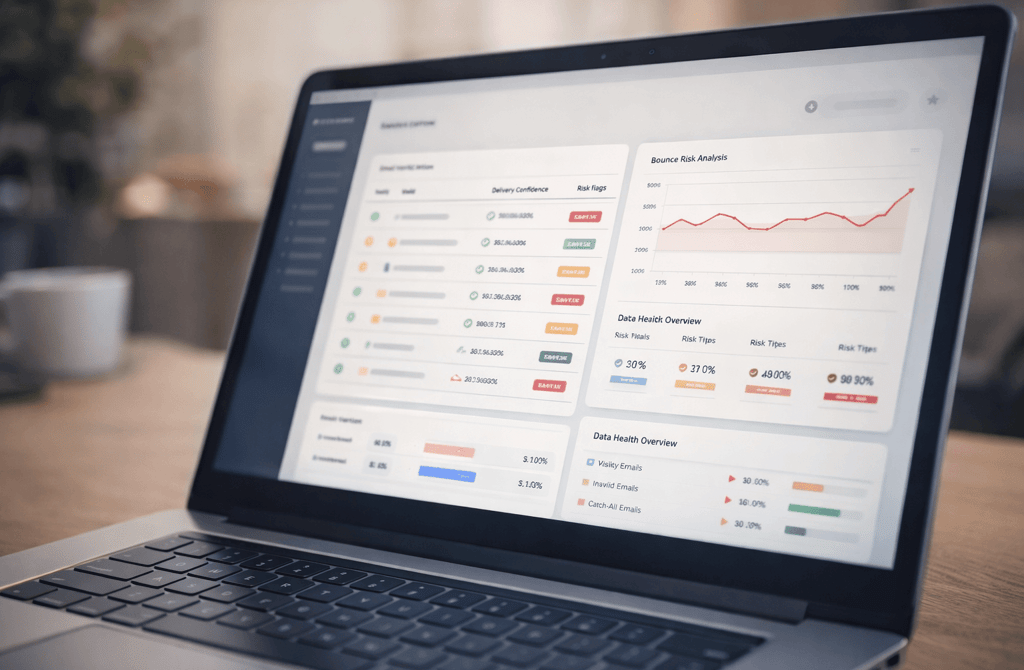
Most bounce problems don’t start when you press send.
They start much earlier — inside verification decisions that look “good enough” on the surface but quietly introduce risk into your list. This is why teams often feel blindsided by bounce spikes. The infrastructure looks fine. The copy hasn’t changed. Volume is stable. Yet bounce rates creep up anyway.
The cause is almost always verification gaps.
Not obvious failures. Subtle ones.
Verification Is Not a Single Event
One of the most common mistakes teams make is treating verification as a one-time checkbox. A list gets verified, marked “clean,” and then reused across campaigns, sequences, or even months.
But verification isn’t a static state. It’s a moment-in-time judgment.
An email that was technically valid two weeks ago may now be:
inactive
abandoned
reassigned
temporarily rejecting mail
flagged by the receiving domain
When verification is treated as a fixed outcome instead of a decaying signal, bounce risk builds invisibly.
Syntax Checks Hide Real Risk
Many verification layers stop at syntax and basic mailbox existence checks. These catch obvious errors — malformed domains, misspellings, missing MX records — but they don’t surface deeper risk.
What slips through:
inboxes that technically exist but no longer accept mail
domains with aggressive filtering rules
addresses that intermittently reject new senders
role-based emails that pass checks but bounce under volume
From the sender’s perspective, everything looks validated. From the inbox provider’s perspective, the list contains uncertainty.
That gap is where bounce risk lives.
Catch-All Domains Are a Blind Spot
Catch-all domains are often mislabeled as “safe” or “valid.” In reality, they’re unknown, not verified.
A catch-all domain accepts mail during verification but can reject messages later based on:
sender reputation
sending pattern
content signals
historical engagement
When lists contain a high percentage of catch-all emails without additional risk scoring, bounce rates become unpredictable. The problem isn’t volume — it’s uncertainty at send time.
Verification Timing Matters More Than Teams Realize
Even strong verification loses value when the timing is wrong.
Common timing gaps include:
reusing “recently verified” lists across multiple campaigns
verifying in batches instead of close to send windows
mixing freshly verified contacts with older segments
Bounce risk isn’t evenly distributed. It clusters around time-lagged verification.
The longer the gap between verification and sending, the less predictive the result becomes.
Automated Validation Misses Context
Automation is fast and scalable, but it struggles with nuance.
Automated systems often miss:
job changes that keep inboxes active but irrelevant
departmental role shifts
internal forwarding rules
dormant inboxes that still pass checks
domains that accept mail but silently drop it
These aren’t “invalid” emails. They’re fragile ones.
Without contextual review — even lightweight — lists accumulate contacts that look valid individually but behave poorly in aggregate.
Small Gaps Compound at Scale
One risky email doesn’t hurt much.
But when:
5–8% of a list sits in a gray zone
those emails are sent repeatedly
volume increases gradually
Inbox providers start to see patterns.
Bounce risk compounds quietly until one send pushes the list over tolerance thresholds. That’s why bounce spikes often feel sudden — the damage was incremental, not immediate.
Closing the Gaps
Reducing hidden bounce risk doesn’t require extreme measures. It requires discipline.
That means:
treating verification as ongoing, not final
separating “valid” from “safe to send”
scoring risk instead of relying on pass/fail labels
aligning verification timing tightly with send windows
isolating uncertain segments instead of blending lists
Bounce prevention is less about chasing perfect data and more about eliminating blind spots.
Final Thought
Bounce rates don’t spike randomly. They surface problems that were already present but unseen.
When verification is shallow, mistimed, or overly automated, risk accumulates silently inside your list. Tightening those gaps doesn’t just lower bounces — it stabilizes your entire outbound system.
When verification reflects how inboxes actually behave, sending becomes predictable.
When verification relies on surface-level checks, bounce risk builds long before you notice it.
Related Post
The Channel-Specific Decay Patterns Hidden in Lead Lists
Why Data Accuracy Varies Dramatically Across Regions
The Global Data Gaps Most Outbound Teams Don’t See
How Geographic Differences Shape Lead Reliability
Why Some Countries Produce Cleaner Metadata Than Others
The Cross-Border Factors Behind Data Accuracy Shifts
Why Lead Prices Differ Dramatically Across Industries
The Industry Pricing Patterns Most Buyers Don’t Notice
How Sector Dynamics Shape Lead Cost Structures
Why Some Verticals Produce Higher Cost-Per-Lead Rates
The Price Mechanics Behind Expensive B2B Verticals
The Recency Gaps That Quietly Kill Cold Email Performance
The Age Signals That Predict Whether a Lead Will Ever Respond
How Data Staleness Creates Invisible Pipeline Delays
Why Old Contacts Tank Your Reply Rate Long Before You Noticest
The Simple Recency Rule That Separates High-Intent Prospects from Dead Leads
Connect
Get verified leads that drive real results for your business today.
www.capleads.org
© 2025. All rights reserved.
Serving clients worldwide.
CapLeads provides verified B2B datasets with accurate contacts and direct phone numbers. Our data helps startups and sales teams reach C-level executives in FinTech, SaaS, Consulting, and other industries.