
Why You Should Never Trust Email Lists Without Proof-of-Validation
Many email lists claim to be validated without showing proof. This article explains why verification evidence matters and how trusting blind labels exposes outbound teams to hidden risk.
INDUSTRY INSIGHTSLEAD QUALITY & DATA ACCURACYOUTBOUND STRATEGYB2B DATA STRATEGY
CapLeads Team
12/21/20253 min read
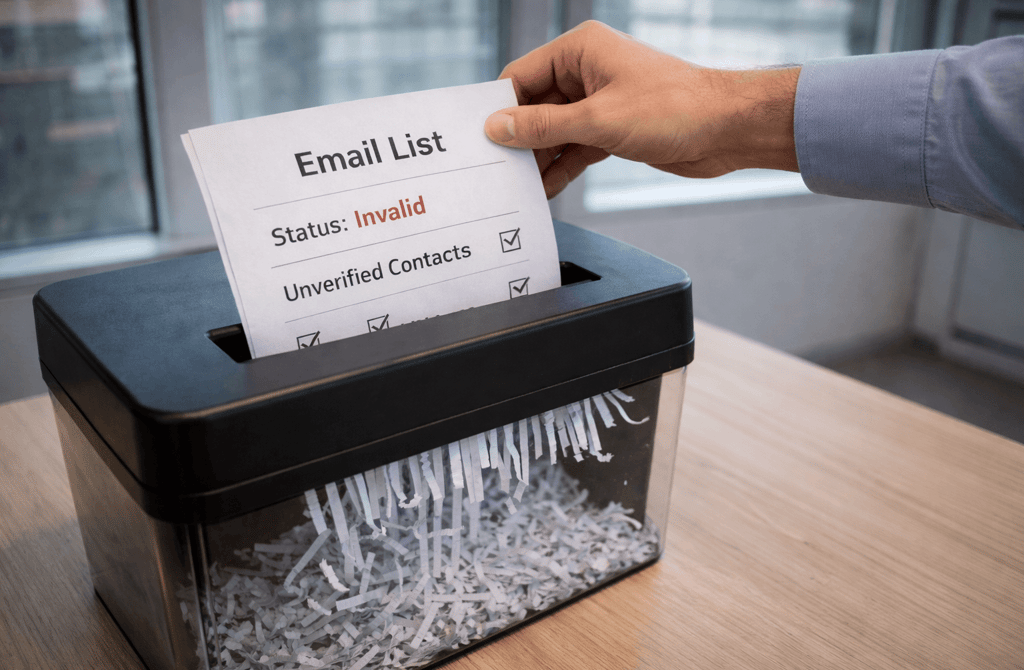
In B2B, email lists are often purchased under pressure.
A campaign needs to launch. A pipeline gap needs filling. A vendor promises “validated data” and shows a sample file that looks clean enough. The list gets approved, uploaded, and sent.
What rarely happens is verification of the verification itself.
That missing step — proof — is where most B2B buyers expose themselves to risk they don’t see until after damage is done.
“Validated” Is a Claim, Not Evidence
In the B2B data market, validation is frequently presented as a label rather than a process.
Buyers hear:
“fully validated”
“cleaned and verified”
“safe to send”
But without proof, these are marketing claims, not operational guarantees.
Real validation leaves artifacts.
It produces logs, timestamps, methodologies, and decision rules. When none of that is visible, buyers are trusting words instead of evidence.
B2B Risk Is Structural, Not Tactical
For B2B teams, bad data doesn’t just waste a campaign.
It creates:
domain-level deliverability exposure
CRM contamination
inaccurate performance attribution
wasted SDR cycles
distorted pipeline reporting
Unlike B2C blasts, B2B outbound operates on lower volume and higher consequence. Each contact carries more weight. Each bounce or misfire has outsized impact.
Proof-of-validation is not a “nice to have” — it’s a control mechanism.
What Proof-of-Validation Actually Looks Like
Legitimate validation processes can be explained and demonstrated.
Proof typically includes:
when validation occurred
how close validation was to send time
which checks were applied (syntax, domain, mailbox, risk flags)
how edge cases were handled
what was excluded and why
When a provider cannot explain these clearly, it usually means validation was shallow, outdated, or outsourced blindly.
Why B2B Buyers Rarely Ask for Proof
Most buyers don’t skip proof intentionally. They skip it because:
validation sounds technical
vendors normalize opacity
urgency overrides diligence
previous sends “worked fine”
But outbound failures are cumulative. The cost of one bad list often shows up later — in declining engagement, inbox placement issues, or inconsistent results across campaigns.
By the time teams question the data, the trail is cold.
Lists Without Proof Shift Risk to the Buyer
When validation isn’t documented, accountability disappears.
If bounces spike or campaigns fail:
the provider blames infrastructure
the buyer blames copy
the SDR team blames targeting
Without proof-of-validation, no one can trace the root cause. Risk gets silently transferred to the buyer, who absorbs the downstream damage.
This is especially dangerous in B2B environments where lists are reused, enriched, and synced across systems.
Proof Enables Decision-Making, Not Just Safety
Proof-of-validation isn’t only about avoiding bad outcomes.
It enables better ones.
When buyers can see:
validation depth
exclusion logic
freshness windows
They can decide:
which segments to send first
which roles to test cautiously
which accounts need re-verification
which lists should never be reused
Without proof, all lists look equal — and that’s rarely true.
Why Mature B2B Teams Treat Proof as a Requirement
Experienced B2B teams don’t ask if a list is validated.
They ask how and when.
They treat validation proof the same way they treat:
compliance documentation
security attestations
data processing disclosures
Not because they’re risk-averse — but because they understand how fragile outbound systems are when inputs are unverified.
Final Thought
In B2B outbound, trust should be earned through transparency, not assumed through labels.
Email lists without proof-of-validation don’t just carry technical risk — they create decision blind spots that compound over time. When buyers demand evidence, they regain control over performance, accountability, and outcomes.
Predictable outbound starts with knowing what went into the list.
When validation can’t be proven, the safest action is not to send at all.
Related Post
The Channel-Specific Decay Patterns Hidden in Lead Lists
Why Data Accuracy Varies Dramatically Across Regions
The Global Data Gaps Most Outbound Teams Don’t See
How Geographic Differences Shape Lead Reliability
Why Some Countries Produce Cleaner Metadata Than Others
The Cross-Border Factors Behind Data Accuracy Shifts
Why Lead Prices Differ Dramatically Across Industries
The Industry Pricing Patterns Most Buyers Don’t Notice
How Sector Dynamics Shape Lead Cost Structures
Why Some Verticals Produce Higher Cost-Per-Lead Rates
The Price Mechanics Behind Expensive B2B Verticals
The Recency Gaps That Quietly Kill Cold Email Performance
The Age Signals That Predict Whether a Lead Will Ever Respond
How Data Staleness Creates Invisible Pipeline Delays
Why Old Contacts Tank Your Reply Rate Long Before You Noticest
The Simple Recency Rule That Separates High-Intent Prospects from Dead Leads
The Verification Gaps That Create Hidden Bounce Risk
Why “Validated” Isn’t Always Valid: The Pitfalls in Modern Data Checks
The Role True Verification Plays in Protecting Domain Reputation
How Weak Validation Layers Inflate Your Deliverability Metrics
Connect
Get verified leads that drive real results for your business today.
www.capleads.org
© 2025. All rights reserved.
Serving clients worldwide.
CapLeads provides verified B2B datasets with accurate contacts and direct phone numbers. Our data helps startups and sales teams reach C-level executives in FinTech, SaaS, Consulting, and other industries.