
The Economics of B2B Lead Buying (Explained Simply)
Understand the real economics behind B2B lead buying. Learn why prices vary, what you're actually paying for, and how to buy leads more intelligently.
LEAD BUYINGLEAD PRICINGOUTBOUND STRATEGYB2B DATA QUALITY
CapLeads Team
11/26/20253 min read
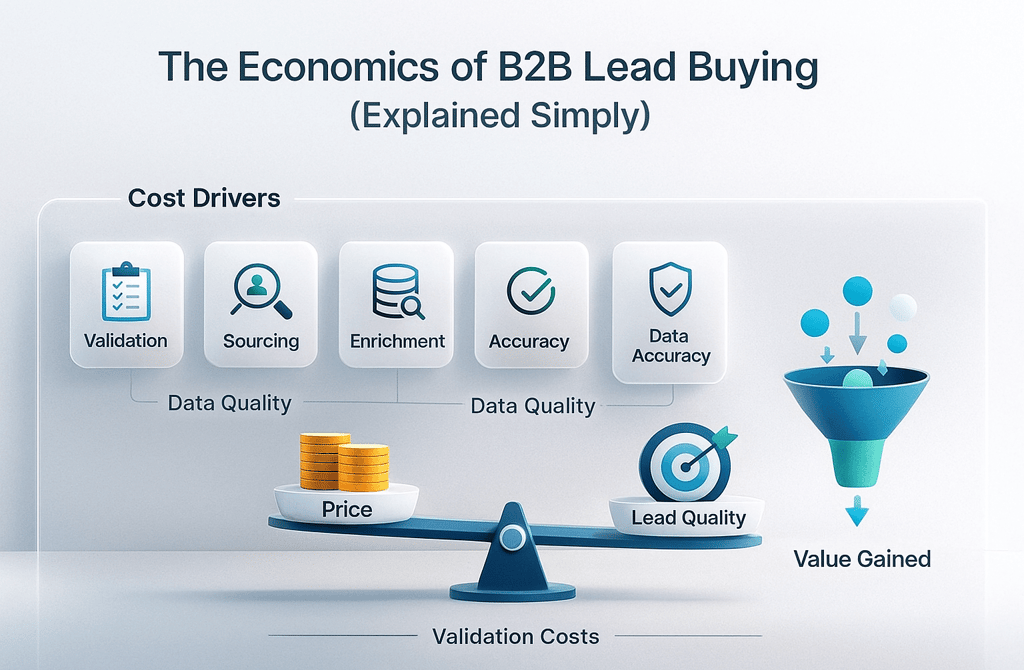
Most founders think buying B2B leads is just about paying X amount for Y contacts.
But behind every price tag is a full economic system — sourcing, validation, enrichment, data freshness, operational overhead, and risk management.
When you understand how these parts work together, you stop guessing whether a provider is cheap or expensive — and you start seeing what you’re actually paying for.
This is the simple breakdown most providers never explain.
Why Lead Prices Aren’t Random
Lead pricing isn’t based on vibes.
It’s based on how much work goes into reducing your risk.
The cheapest providers scrape, export, and sell.
Higher-quality providers clean, validate, enrich, revalidate, organise, score, and monitor.
The more steps involved, the more the seller protects you — and the more stable your outbound becomes.
That’s the real economics behind lead pricing: the buyer pays for the seller’s effort to reduce uncertainty.
Cheap lists look like a bargain until they quietly wreck deliverability, burn domains, and waste weeks of work.
Sourcing Cost = The Foundation of Price
The first economic driver is how the data is sourced.
Scraped data costs almost nothing.
But it’s noisy, outdated, and risky — which is why it sells cheap.
Manually curated or multi-source datasets cost more because they require:
multiple data streams
smarter filters
human verification or QA
more storage and processing
Better sourcing increases accuracy, and accuracy increases your chances of getting replies.
When sourcing is cheap, the buyer ends up paying the hidden price later.
Validation Cost: The Most Expensive Part
Proper validation is where most of the real cost sits.
Every email ping, domain check, SMTP test, and cleanup pass costs money.
And validators charge per record.
Anyone validating hundreds of thousands of contacts every month is paying real infrastructure fees.
Cheap providers skip steps because they must.
They can’t afford to validate properly while still selling the list at a low price.
That’s why low-cost providers always claim “verified” — but they can’t show the process behind it.
Economically, the buyer always pays for validation.
Either upfront in the price…
Or later when campaigns bounce.
Freshness Has an Ongoing Cost
Data ages fast.
People change jobs, domains expire, inboxes die, companies restructure.
Keeping a dataset fresh requires constant revalidation — which costs real money and real time.
Most providers avoid this because it cuts into margin.
They revalidate once, then keep selling the same stale batch for months.
The economics here is simple:
Fresh data costs more because it requires ongoing operational work.
If freshness isn’t part of the price, it isn’t happening.
Enrichment Raises Lead Value — But Also Cost
Every added field has an economic cost:
phone numbers
LinkedIn profiles
company details
revenue and headcount
geography
tech stack
Enrichment takes time, tools, and scoring systems.
And when done right, it makes targeting sharper — which means more replies, fewer wasted sends, and better campaigns.
You’re not paying for data.
You’re paying for context that makes your outreach effective.
Why Providers Price Leads Differently
Every provider has a different cost structure.
Some spend almost nothing on validation.
Some spend heavily on QA.
Some buy from marketplaces.
Some maintain their own databases.
Some use a single tool; others use full validation stacks.
So prices vary because effort varies.
The economics is simple:
Low effort → low cost → low accuracy.
High effort → higher cost → higher outcomes.
That’s the difference between a list that produces replies… and one that gets your domain blacklisted.
What Smart Buyers Actually Look For
Buyers who understand the economics of data aren’t looking for the lowest price per lead.
They look for the best value per outcome.
A cheap list that burns your domain is expensive.
A clean list that keeps your inbox warm is cheap.
Founders who win at outbound don’t optimize for price — they optimize for ROI.
They know the most expensive thing in cold outreach isn’t the list.
It’s the time wasted fixing problems caused by a bad one.
Final Thought
The economics of B2B lead buying isn’t mysterious — you’re paying for the provider’s ability to protect your outbound from risk.
Clean, validated, fresh data keeps your campaigns profitable.
Outdated or low-effort data destroys your outreach before it even starts.
Related Posts
How Buyers Can Protect Themselves From Fake or Recycled Data
Why Your Lead Provider Should Show Validation Proof — Not Promises
The Smartest Way to Evaluate a B2B Contact List Before Using It
What Buyers Overlook When Choosing a Lead Provider (But Shouldn’t)
How to Audit a B2B Lead List for Accuracy Before Sending Email
Why You Shouldn’t Buy “Unlimited Leads” Packages
The Truth About “Niche Email Lists” Sold Online — Are They Safe?
Why Industry-Specific B2B Leads Convert Better Than Generic Lists
The Most Requested B2B Industries for Lead Buying in 2026
High-Value Industries That Respond Best to Cold Email
Why Healthcare & Medical Leads Require More Validation
The Fastest-Growing B2B Markets for 2026 (Based on Lead Demand)
Why Construction Leads Are Hard to Validate — And How CapLeads Does It
Global Tech Leads: What Makes Them Expensive but Worth It
Professional Services Leads: Why They Deliver Better Conversations
Manufacturing & Industrial Leads: What Smart Buyers Look For
Why Global BPO Leads Are Exploding in Demand
Why Lead Prices Are Rising in 2026 (And How to Buy Smart)
Cost-Per-Lead vs Cost-Per-Reply: Which Metric Should You Track?
Why Some Industries Have More Expensive Leads Than Others
The Real Cost of Data Validation: What Providers Don’t Tell You
Connect
Get verified leads that drive real results for your business today.
www.capleads.org
© 2025. All rights reserved.
Serving clients worldwide.
CapLeads provides verified B2B datasets with accurate contacts and direct phone numbers. Our data helps startups and sales teams reach C-level executives in FinTech, SaaS, Consulting, and other industries.