
The Early Warning Signs Your Domain Reputation Is Slipping
Domain reputation issues rarely start with spam folders. Learn the early warning signs that signal trust erosion before deliverability visibly drops.
INDUSTRY INSIGHTSLEAD QUALITY & DATA ACCURACYOUTBOUND STRATEGYB2B DATA STRATEGY
CapLeads Team
1/2/20263 min read

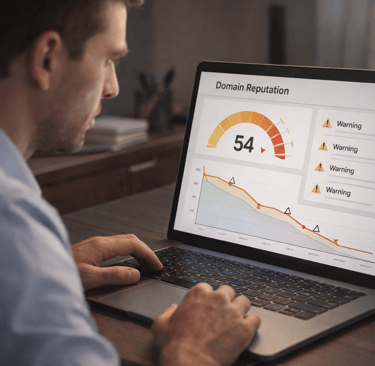
Most teams wait for obvious failure before worrying about domain reputation.
Spam folder complaints.
Inbox placement drops.
Campaigns suddenly “stop working.”
But by the time those show up, reputation damage is already done.
The real warning signs appear much earlier — not in deliverability tools, but in the day-to-day behavior of your outbound system. These signals don’t scream. They whisper. And they’re easy to miss if you don’t know where to look.
1. Your Campaigns Become Increasingly Fragile
One of the earliest indicators of reputation slippage is reduced tolerance for change.
Campaigns that once handled:
small list expansions
slightly higher daily volume
new segments
…suddenly become sensitive.
A minor adjustment now causes:
bounce spikes
reply volatility
inbox placement inconsistencies
This fragility is a sign that inbox providers are already limiting trust. When reputation is strong, systems allow flexibility. When it weakens, they enforce stricter controls.
Stable domains bend. Slipping ones crack.
2. Performance Variance Increases Between Identical Sends
Another quiet signal: inconsistency.
You run similar campaigns with similar targeting, similar copy, and similar volume — but results swing wildly:
One day performs normally
The next drops off with no clear reason
Different inbox providers behave unevenly
This isn’t randomness. It’s selective trust.
Inbox systems start making recipient-level decisions instead of granting domain-level confidence. That fragmentation happens before broad deliverability collapse.
Consistency disappears before performance does.
3. Inbox Placement Becomes Role-Dependent
When reputation is healthy, inbox placement is fairly uniform across roles and companies.
As trust weakens, a pattern emerges:
Senior roles still see emails
Operational or edge roles stop engaging
Certain departments go silent entirely
Inbox providers increasingly filter based on predicted relevance. When reputation slips, emails are only allowed through where risk appears lowest.
This selective delivery is an early defense mechanism — and a warning sign most teams misinterpret as ICP noise.
4. Replies Shift Toward Polite Negatives or Confusion
Another overlooked indicator is reply quality, not reply count.
Early reputation decay often shows up as:
“Not the right person” replies
Polite deflections
Confused responses that miss the point of the message
These replies signal a targeting mismatch that inbox providers also observe.
While humans see “a reply is a reply,” ESPs see misaligned engagement — and weight it negatively over time.
Positive engagement isn’t just replies. It’s relevant replies.
5. Warm Domains Stop Feeling “Warm”
Domains that are slipping often feel like they need constant babysitting.
Signs include:
You hesitate to increase volume
You space sends more cautiously
You rotate domains sooner than expected
You rely on workarounds to maintain performance
This behavior isn’t superstition — it’s intuition responding to declining trust.
When teams start managing fear instead of systems, reputation problems are already underway.
6. Small Data Issues Create Outsized Impact
Early-stage reputation decay amplifies data weaknesses.
Things that used to be harmless now cause issues:
Slightly aged lists
Minor role ambiguity
Inbox providers become less forgiving as trust drops. What once passed quietly now triggers suppression.
This is why teams often think their data “suddenly got worse” — when in reality, their margin for error shrank.
7. Your Troubleshooting Focus Shifts Downstream
One of the clearest warning signs is where teams look for fixes.
When reputation is healthy, issues are rare and isolated.
When it slips, teams start focusing on:
copy tweaks
subject line experiments
cadence changes
tooling adjustments
Meanwhile, the upstream causes — data freshness, targeting accuracy, list behavior — go untouched.
This inversion happens because early reputation damage feels like a messaging problem before it becomes a delivery problem.
Final Thought
Domain reputation rarely fails loudly at first.
It tightens quietly.
Campaigns lose flexibility.
Systems grow brittle.
Performance becomes uneven.
These early warning signs aren’t visible in dashboards — they show up in how your outbound behaves under normal conditions.
Teams that catch these signals early don’t scramble to recover trust later. They correct inputs before inbox providers finish recalibrating.
Because once reputation damage becomes obvious, it’s no longer a warning — it’s a consequence.
Related Post:
How Incorrect Company Location Data Distorts Segmentation
Why HQ vs Branch Confusion Derails Cold Email Targeting
The Real Cost of Running Outbound on Mis-Sized Companies
Why Role Accuracy Matters More Than Personalization
The Title Errors That Break Your Buyer Targeting
How Incorrect Department Data Skews Segmentation
Why Job Seniority Precision Predicts Reply Probability
The Role Drift That Makes Outreach Hit the Wrong Person
Why Deliverability Architecture Decides Whether Your Emails Land
The Infrastructure Mistakes That Break Inbox Placement
How Domain Setup Shapes Your Entire Outbound Performance
Why Technical Architecture Matters More Than Copy Quality
The DNS Configuration Gaps That Hurt Cold Email Reach
Why Spam Filters Care More About Data Signals Than Copy
The Inbox Behavior Patterns Most Founders Misunderstand
How Spam Filters Score Your Sending Patterns in Real Time
Why Engagement History Shapes Inbox Placement More Than Content
The Hidden Signals That Push Your Emails Into Promotions
Why Domain Reputation Is the Real Gatekeeper of Cold Email
The Risk Signals ESPs Use to Judge Your Domain Instantly
How Domain Reputation Declines Long Before You Notice
Why Poor Data Quality Damages Your Domain’s Trust Profile
Connect
Get verified leads that drive real results for your business today.
www.capleads.org
© 2025. All rights reserved.
Serving clients worldwide.
CapLeads provides verified B2B datasets with accurate contacts and direct phone numbers. Our data helps startups and sales teams reach C-level executives in FinTech, SaaS, Consulting, and other industries.