
Why Fit Score and Intent Score Must Be Aligned
Fit score without intent wastes effort, and intent without fit stalls deals. Learn why aligning both scores is critical for predictable pipeline prioritization.
INDUSTRY INSIGHTSLEAD QUALITY & DATA ACCURACYOUTBOUND STRATEGYB2B DATA STRATEGY
CapLeads Team
1/11/20263 min read
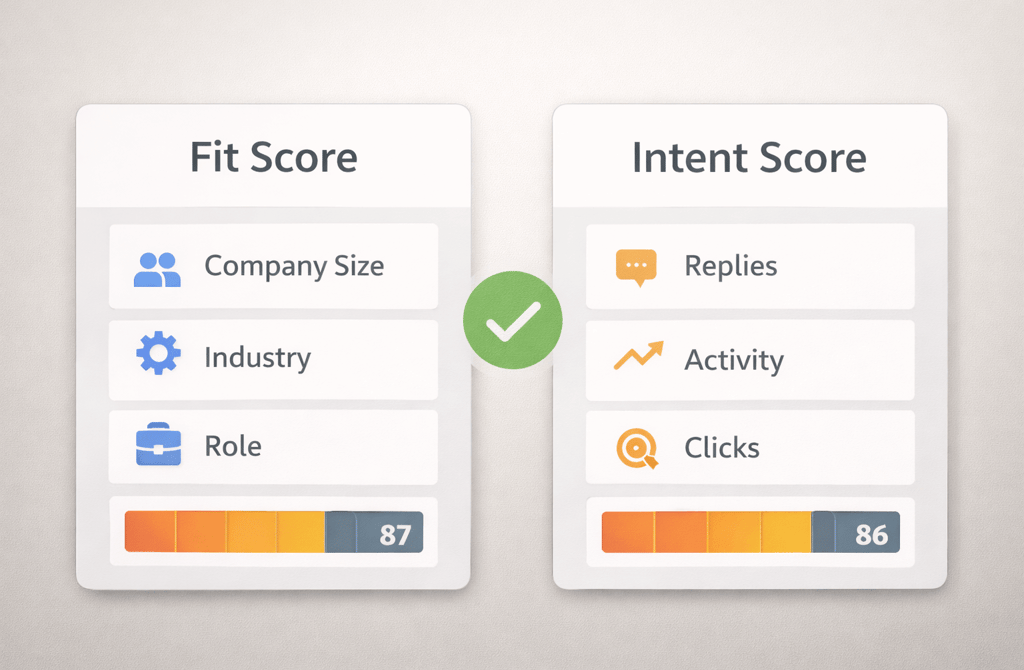
Most teams don’t struggle with a lack of signals. They struggle with conflicting signals.
Fit score says one thing. Intent score says another. SDRs are left choosing between a perfectly matched account that shows no activity and a highly active lead that doesn’t belong in the ICP. When these scores aren’t aligned, prioritization turns into guesswork—and pipeline performance becomes inconsistent.
Alignment between fit and intent isn’t a technical detail. It’s what separates busy outreach from revenue-producing outreach.
Fit without intent creates stalled conversations
Fit score answers a structural question: Should this account ever buy from us?
It looks at company size, industry, role relevance, and organizational shape.
When fit is high but intent is absent, outreach often feels polite but unproductive. Emails get opened but not replied to. Conversations start and then fade. Meetings get postponed indefinitely.
Nothing is “wrong” with the account. It’s simply not in a buying window.
Prioritizing fit alone leads teams to overinvest in accounts that make sense on paper but aren’t ready to move. Pipeline fills with opportunities that look solid yet never progress.
Intent without fit creates false momentum
Intent score answers a different question: Is someone engaging right now?
Replies, clicks, site visits, and activity spikes can all push intent upward.
The danger appears when intent is strong but fit is weak.
These leads often respond quickly, creating a sense of momentum. SDRs book calls. Activity looks healthy. But deals stall once qualification begins. Budgets don’t align. Authority is missing. The use case doesn’t hold up.
Intent without fit produces short-term excitement and long-term disappointment. It inflates early pipeline stages while quietly harming close rates.
Misalignment forces SDRs to override the system
When fit and intent disagree, SDRs stop trusting scores altogether.
Some reps chase intent because replies feel productive. Others chase fit because leadership says it matters more. Over time, scoring becomes advisory instead of directional.
Overrides increase. Personal judgment replaces prioritization. Results vary by rep rather than by system.
This is one of the clearest signs that fit and intent are being treated as separate metrics instead of two halves of the same decision.
Alignment changes how scores behave
When fit and intent are aligned, scoring becomes predictive instead of descriptive.
High-fit accounts with rising intent naturally float to the top.
Low-fit accounts with high intent are filtered earlier.
High-fit accounts with no intent remain visible but deprioritized.
This alignment reduces noise. SDRs don’t have to debate which score matters more—the list makes sense on its own.
More importantly, pipeline stages begin to correlate with reality. High-priority leads reply more consistently. Conversations progress faster. Qualification friction drops.
Timing is the bridge between fit and intent
Fit tends to be stable. Intent is volatile.
Alignment depends on timing—knowing when a good-fit account becomes an active opportunity. That’s why recency and data freshness matter so much in this equation.
Outdated fit data causes teams to pursue accounts that no longer qualify.
Outdated intent data causes teams to miss windows of genuine buying interest.
Without fresh inputs, alignment decays even if the scoring logic stays the same.
Alignment improves forecasting, not just outreach
Most discussions about fit and intent focus on SDR efficiency. But the real payoff shows up in forecasting.
When both scores move together:
Pipeline stages stabilize
Stage conversion rates become more consistent
Forecasts miss less often
That’s because aligned scores reflect buying conditions, not just activity or profile data in isolation.
Leadership stops asking why “hot” leads didn’t convert. The system explains itself.
What misalignment usually signals upstream
When fit and intent refuse to align, the issue is rarely the math. It’s usually upstream:
Incomplete firmographic data
Misclassified roles
Stale engagement signals
Duplicate or fragmented records
These issues distort one score or the other, creating artificial disagreement. Fixing alignment often starts with fixing the inputs—not redesigning the scoring model.
Final thought
Fit score and intent score are not competing priorities. They are complementary signals that only work when evaluated together.
When both are accurate and current, prioritization becomes obvious and pipeline movement becomes repeatable.
When either score is distorted by outdated or incomplete data, alignment breaks—and decisions drift away from reality instead of toward it.
Related Post:
Why Intent Signals Predict Replies Better Than Copy
The Behavioral Clues That Reveal High-Intent Prospects
How Hidden Intent Patterns Shape Cold Email Outcomes
Why High-Intent Leads Respond Faster and More Consistently
The Intent Signals Most Outbound Teams Never Track
Why Reply Rates Depend More on Data Than Messaging
The Hidden Predictors of High Reply Probability
How Lead Quality Shapes Your Reply Rate Curve
Why Clean Lists Produce More Consistent Replies
The Timing Factors That Influence Reply Behavior
Why Data Problems Create Invisible Pipeline Leaks
The Silent Funnel Drop-Offs Caused by Weak Lead Quality
How Bad Data Corrupts Every Stage of Your Pipeline
Why Pipeline Inflation Happens With Outdated Leads
The Hidden Pipeline Leaks Most Founders Never Detect
Why CRM Cleanliness Determines Whether Outbound Scales
The Hidden CRM Errors That Break Your Entire Funnel
How Dirty CRM Records Create Pipeline Confusion
Why CRM Drift Happens Faster Than Teams Expect
The CRM Hygiene Rules That Protect Your Outbound System
Why Lead Scoring Fails Without Clean Data
The Scoring Indicators That Predict Real Pipeline Movement
How Bad Data Corrupts Lead Prioritization Models
Connect
Get verified leads that drive real results for your business today.
www.capleads.org
© 2025. All rights reserved.
Serving clients worldwide.
CapLeads provides verified B2B datasets with accurate contacts and direct phone numbers. Our data helps startups and sales teams reach C-level executives in FinTech, SaaS, Consulting, and other industries.