
How Lead Quality Shapes Your Reply Rate Curve
Reply rates don’t rise evenly. See how lead quality shapes your reply rate curve over time—and why clean data creates consistent responses while bad data flattens results.
INDUSTRY INSIGHTSLEAD QUALITY & DATA ACCURACYOUTBOUND STRATEGYB2B DATA STRATEGY
CapLeads Team
1/8/20263 min read
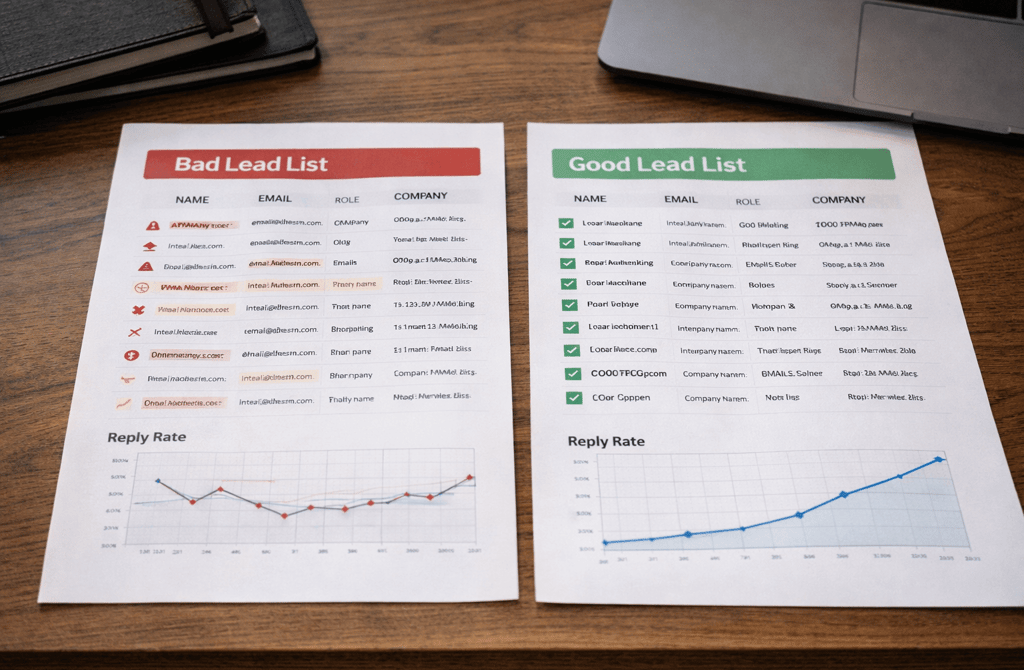
Most teams think of reply rate as a single number.
A percentage at the top of a dashboard.
A metric to compare campaigns.
A result to improve.
But reply rate isn’t static. It has shape.
And that shape is almost entirely determined by lead quality.
Reply Rates Don’t Move Linearly
When lead quality is poor, reply rates tend to follow a familiar pattern:
A brief spike from a handful of responsive contacts
A quick plateau as misaligned leads accumulate
A slow decline as sending continues
The curve flattens early because the list runs out of people who should reply.
In contrast, high-quality lead lists produce a very different curve:
Slower initial movement
Gradual, steady improvement
Sustained response levels over time
This difference isn’t about copy optimization.
It’s about how much usable relevance exists inside the list.
Why Bad Leads Create Early Illusions
Low-quality lists often produce deceptive early results.
A few contacts reply, usually because:
They happen to sit in the right role
The timing coincidentally aligns
They’re unusually responsive
Those replies create confidence. Teams assume the campaign is “working.”
But as volume increases, the curve tells the truth.
Reply probability drops because most of the remaining contacts:
Don’t own the problem
Don’t recognize the message as relevant
Aren’t in a position to engage
The curve collapses not from fatigue—but from exhausted relevance.
Lead Quality Determines Curve Stability
High-quality data changes how reply rates behave over time.
When leads are accurate, current, and role-aligned:
Each send has similar probability of response
Reply behavior remains consistent across batches
Small improvements compound instead of disappearing
The curve doesn’t spike dramatically—but it doesn’t crash either.
That stability is what scalable outbound depends on.
The Compounding Effect Most Teams Miss
Lead quality compounds quietly.
Clean data:
Reduces wasted sends
Preserves domain reputation
Prevents negative engagement signals
Keeps inbox placement stable
All of those factors reinforce reply behavior over time.
Bad data does the opposite:
Bounce risk increases
Negative signals accumulate
Send limits tighten
Engagement decays
The reply rate curve flattens not because prospects are tired—but because the system is being penalized.
Why Averages Hide Curve Damage
Average reply rate hides the story.
Two campaigns can report the same average:
One from consistent responses
One from early spikes followed by long silence
Only one of those is repeatable.
Teams that chase averages miss curve behavior:
How fast replies decay
When relevance runs out
Where lists break down
Understanding the curve reveals whether lead quality is sustainable—or temporarily lucky.
How Quality Resets the Curve
When teams upgrade lead quality, something predictable happens:
Early reply rates may look unchanged
Mid-campaign decay slows dramatically
Long-tail responses increase
Variance decreases
The curve smooths.
That’s the signal that relevance has been restored.
It’s also why teams that fix data often see “sudden” performance improvements without touching copy.
Why Reply Rate Curves Matter More Than Benchmarks
Benchmarks compare you to others.
Curves tell you the truth about your system.
A healthy reply rate curve means:
Your targeting is correct
Your audience is stable
Your sending behavior is sustainable
A collapsing curve means relevance is leaking—often invisibly.
And once the curve breaks, copy changes rarely fix it.
Final Thought
Reply rates aren’t just numbers to improve.
They’re patterns that reveal how much relevance your lead list actually contains.
When lead quality is high, reply curves stay alive.
When it’s low, curves flatten fast—no matter how good the message looks.
Clean data doesn’t just raise reply rates.
It reshapes them into something you can rely on.
Related Post:
How Domain Reputation Declines Long Before You Notice
Why Poor Data Quality Damages Your Domain’s Trust Profile
The Early Warning Signs Your Domain Reputation Is Slipping
Why Cold Email Frameworks Fail Without Clean Data
The Data Foundations Every “Winning” Framework Depends On
How Bad Data Makes Great Frameworks Look Broken
Why Segmentation Quality Determines Outbound Success
The Targeting Logic Mistakes That Break Cold Email Results
Why Accurate Targeting Beats Personalization Tricks
The Segmentation Rules High-Performing Teams Depend On
Why ICP Accuracy Determines Whether Outbound Scales
The Buyer Mapping Errors That Break Your Targeting
How ICP Drift Quietly Lowers Your Reply Rate
Why Outbound Teams Misdiagnose ICP Problems as Copy Issues
The ICP Signals That Predict High-Intent Prospects
Why Buying Committees Require Multi-Contact Targeting Logic
The Data Signals That Reveal a Real Buying Committee
How Missing Roles Break Multi-Contact Outreach
Why Single-Contact Outreach Fails Inside Larger Accounts
The Buying Path Patterns Hidden in Mid-Market Companies
Why Intent Signals Predict Replies Better Than Copy
The Behavioral Clues That Reveal High-Intent Prospects
How Hidden Intent Patterns Shape Cold Email Outcomes
Why High-Intent Leads Respond Faster and More Consistently
The Intent Signals Most Outbound Teams Never Track
Why Reply Rates Depend More on Data Than Messaging
The Hidden Predictors of High Reply Probability
Connect
Get verified leads that drive real results for your business today.
www.capleads.org
© 2025. All rights reserved.
Serving clients worldwide.
CapLeads provides verified B2B datasets with accurate contacts and direct phone numbers. Our data helps startups and sales teams reach C-level executives in FinTech, SaaS, Consulting, and other industries.