
The Silent Funnel Drop-Offs Caused by Weak Lead Quality
Weak lead quality doesn’t fail loudly — it quietly drains your funnel. Learn how poor data causes silent drop-offs that stall conversions and distort pipeline health.
INDUSTRY INSIGHTSLEAD QUALITY & DATA ACCURACYOUTBOUND STRATEGYB2B DATA STRATEGY
CapLeads Team
1/9/20263 min read

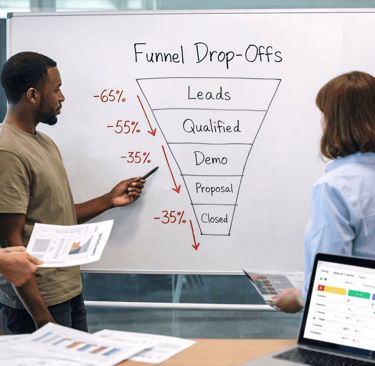
Funnel drop-offs don’t always announce themselves with obvious failures. There’s no dramatic spike in lost deals or sudden collapse in conversion rates. Instead, performance erodes quietly — stage by stage — until teams are left wondering why effort no longer translates into outcomes.
At the center of this slow decay is weak lead quality.
Not bad messaging. Not lazy follow-ups.
Weak inputs that quietly distort how buyers move through your funnel.
Drop-Offs Start at the First Handoff
Every funnel relies on clean handoffs:
From sourcing to qualification
From SDRs to sales
From early interest to serious evaluation
When lead quality is weak, these handoffs break — even if each team is doing their job correctly.
SDRs pass leads that technically meet filters but lack real buying authority. Sales accepts meetings that feel promising but stall quickly. Opportunities are created without clear ownership or urgency.
Nothing looks broken in isolation.
But momentum disappears between stages.
Weak Leads Create False Early Signals
Low-quality leads often show surface-level engagement:
Opens without replies
Clicks without intent
Polite meetings without follow-through
These signals give the illusion of progress while masking the absence of real buying intent.
Teams interpret this as a mid-funnel problem — when in reality, the issue started much earlier. By the time drop-offs become visible, the real damage has already happened upstream.
Funnel Metrics Lose Diagnostic Power
Funnels are meant to diagnose problems. But weak lead quality turns metrics into noise.
When a large percentage of leads were never qualified buyers:
Conversion rates become less meaningful
Stage-to-stage benchmarks stop predicting outcomes
Teams react by tweaking scripts, tightening stages, or increasing volume — all while the underlying issue remains untouched.
The funnel still shows activity.
It just stops telling the truth.
Sales Effort Gets Misdirected
Weak leads don’t just drop out — they pull effort in the wrong direction before they do.
Reps:
Spend time chasing follow-ups that never convert
Personalize for roles that don’t own the problem
Build proposals without internal buy-in
Over time, this creates exhaustion and skepticism. Reps lose confidence in qualification standards and start second-guessing every opportunity.
The drop-off isn’t just in the funnel.
It’s in focus and morale.
Why Drop-Offs Feel “Random”
One of the most frustrating aspects of weak lead quality is unpredictability.
Some deals move fast. Others stall immediately. Similar accounts behave differently. There’s no consistent pattern — because the inputs weren’t consistent to begin with.
Strong funnels rely on repeatable buyer behavior. Weak lead quality introduces randomness that no process can smooth out.
Fixing Drop-Offs Requires Upstream Discipline
Most teams try to fix funnel drop-offs at the point of failure:
Tighter stage definitions
More aggressive follow-ups
Better objection handling
But drop-offs caused by weak lead quality can’t be fixed downstream.
They require:
Clear definitions of buying roles
Consistent qualification standards before handoff
Leads that reflect real decision-making power
When those inputs improve, drop-offs don’t disappear — they become predictable, diagnosable, and manageable.
Final Thought
Funnels don’t collapse because teams stop executing.
They erode because weak leads quietly pass through early filters and fail later — where recovery is impossible.
When lead quality is strong, drop-offs tell a story you can act on.
When lead quality is weak, drop-offs are just noise — and the funnel stops being a guide.
Related Post:
How Bad Data Makes Great Frameworks Look Broken
Why Segmentation Quality Determines Outbound Success
The Targeting Logic Mistakes That Break Cold Email Results
Why Accurate Targeting Beats Personalization Tricks
The Segmentation Rules High-Performing Teams Depend On
Why ICP Accuracy Determines Whether Outbound Scales
The Buyer Mapping Errors That Break Your Targeting
How ICP Drift Quietly Lowers Your Reply Rate
Why Outbound Teams Misdiagnose ICP Problems as Copy Issues
The ICP Signals That Predict High-Intent Prospects
Why Buying Committees Require Multi-Contact Targeting Logic
The Data Signals That Reveal a Real Buying Committee
How Missing Roles Break Multi-Contact Outreach
Why Single-Contact Outreach Fails Inside Larger Accounts
The Buying Path Patterns Hidden in Mid-Market Companies
Why Intent Signals Predict Replies Better Than Copy
The Behavioral Clues That Reveal High-Intent Prospects
How Hidden Intent Patterns Shape Cold Email Outcomes
Why High-Intent Leads Respond Faster and More Consistently
The Intent Signals Most Outbound Teams Never Track
Why Reply Rates Depend More on Data Than Messaging
The Hidden Predictors of High Reply Probability
How Lead Quality Shapes Your Reply Rate Curve
Why Clean Lists Produce More Consistent Replies
The Timing Factors That Influence Reply Behavior
Why Data Problems Create Invisible Pipeline Leaks
Connect
Get verified leads that drive real results for your business today.
www.capleads.org
© 2025. All rights reserved.
Serving clients worldwide.
CapLeads provides verified B2B datasets with accurate contacts and direct phone numbers. Our data helps startups and sales teams reach C-level executives in FinTech, SaaS, Consulting, and other industries.