
How Dirty CRM Records Create Pipeline Confusion
Dirty CRM records distort pipeline visibility and decision-making. Learn how duplicates, stale stages, and broken records create confusion that stalls outbound and forecasting.
INDUSTRY INSIGHTSLEAD QUALITY & DATA ACCURACYOUTBOUND STRATEGYB2B DATA STRATEGY
CapLeads Team
1/10/20263 min read
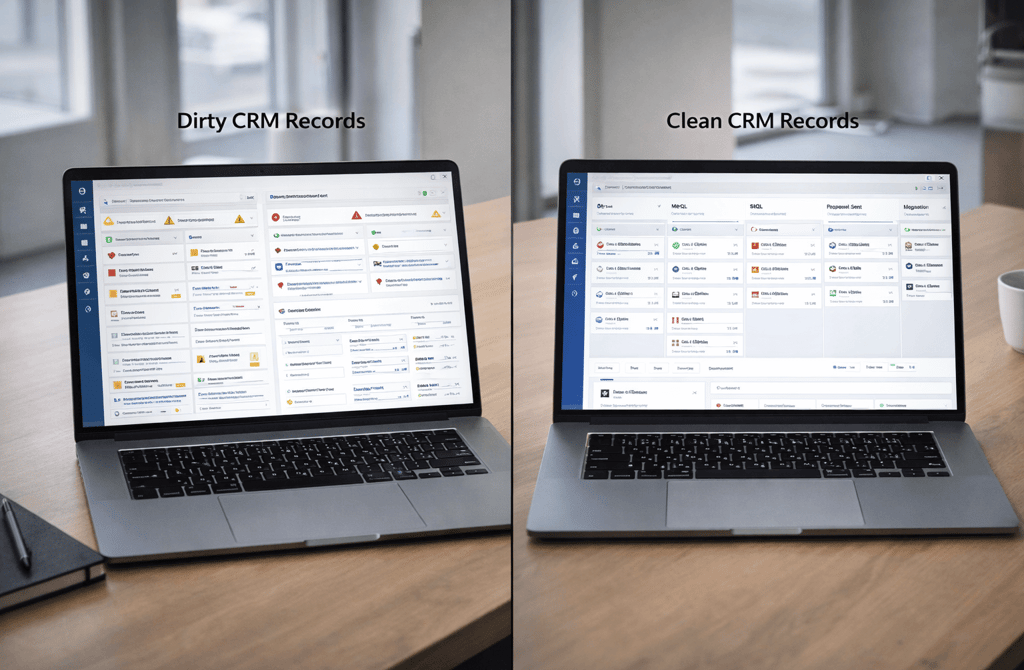
Pipeline confusion doesn’t start with bad forecasts or missed targets. It starts earlier—when the CRM stops being a source of shared truth and becomes a collection of conflicting stories.
Teams don’t argue about numbers because they disagree. They argue because the CRM is telling everyone something different.
Dirty CRM records don’t just lower performance. They fracture understanding across sales, marketing, and leadership.
Pipeline confusion is a coordination problem, not a volume problem
Most teams notice pipeline confusion when meetings get tense:
Sales claims deals are “real” but stalled
Marketing insists lead quality is fine
Leadership can’t reconcile forecasts with reality
The instinct is to add dashboards, reports, or new stages. But confusion isn’t caused by missing views—it’s caused by inconsistent records feeding those views.
When CRM data isn’t clean, every role sees a different version of the pipeline.
Inconsistent records break shared definitions
Dirty CRM records quietly destroy alignment by breaking definitions teams rely on.
Examples:
“Active opportunity” means different things to different reps
“Contacted” includes both actual conversations and unopened emails
“Qualified” reflects automation rules, not buyer intent
Once definitions drift, conversations stop being productive. Teams spend time debating what the data means instead of what to do.
Pipeline confusion isn’t about disagreement—it’s about loss of a common language.
Dirty data turns metrics into arguments
Metrics are supposed to clarify decisions. Dirty CRM records turn them into debate fuel.
When data quality is weak:
Conversion rates swing without explanation
Stage velocity looks strong but deals don’t close
Pipeline coverage appears healthy while revenue lags
Each metric can be technically “correct” and still misleading because it’s built on inconsistent inputs.
Leadership loses confidence in reporting. Sales loses trust in targets. Marketing loses credibility with attribution. The pipeline becomes something teams defend instead of rely on.
Recycled records create phantom progress
One of the most confusing effects of dirty CRM data is phantom movement.
This happens when:
Dormant accounts reappear as “revived”
Historical activity is mistaken for fresh intent
The pipeline grows, activity increases, but nothing advances meaningfully. It feels like progress without momentum.
Teams respond by working harder—more calls, more emails—because the CRM suggests opportunity still exists. In reality, the system is resurfacing noise, not signal.
Dirty CRMs create internal drag, not just external failure
Outbound performance usually gets blamed first. But internal efficiency suffers earlier.
Dirty CRM records cause:
Duplicate outreach across reps
Repeated qualification work
Conflicting handoffs between teams
Manual reconciliation after every reporting cycle
The pipeline becomes harder to manage as headcount grows. Scaling adds friction instead of leverage because every new person inherits the same confusion.
This is why some teams feel slower at 10 reps than they did at 3—coordination collapses when the CRM can’t support shared understanding.
Clean records simplify decisions, not just reports
A clean CRM doesn’t just improve accuracy—it reduces cognitive load.
When records are clean:
Everyone trusts the stage definitions
Pipeline reviews focus on decisions, not explanations
Forecasts spark action instead of debate
Teams spend less time validating data and more time acting on it
Clarity compounds. The pipeline stops being a mystery to interpret and becomes a system to operate.
Final thought
Pipeline confusion isn’t a sales problem or a reporting problem—it’s a data integrity problem. When CRM records lose consistency, teams lose alignment, and momentum fades even as activity rises.
When CRM data stays clean, pipeline decisions become simple and coordinated.
When records age, duplicate, and drift, the pipeline fills with motion—but drains of meaning.
Related Post:
Why Buying Committees Require Multi-Contact Targeting Logic
The Data Signals That Reveal a Real Buying Committee
How Missing Roles Break Multi-Contact Outreach
Why Single-Contact Outreach Fails Inside Larger Accounts
The Buying Path Patterns Hidden in Mid-Market Companies
Why Intent Signals Predict Replies Better Than Copy
The Behavioral Clues That Reveal High-Intent Prospects
How Hidden Intent Patterns Shape Cold Email Outcomes
Why High-Intent Leads Respond Faster and More Consistently
The Intent Signals Most Outbound Teams Never Track
Why Reply Rates Depend More on Data Than Messaging
The Hidden Predictors of High Reply Probability
How Lead Quality Shapes Your Reply Rate Curve
Why Clean Lists Produce More Consistent Replies
The Timing Factors That Influence Reply Behavior
Why Data Problems Create Invisible Pipeline Leaks
The Silent Funnel Drop-Offs Caused by Weak Lead Quality
How Bad Data Corrupts Every Stage of Your Pipeline
Why Pipeline Inflation Happens With Outdated Leads
The Hidden Pipeline Leaks Most Founders Never Detect
Why CRM Cleanliness Determines Whether Outbound Scales
The Hidden CRM Errors That Break Your Entire Funnel
Connect
Get verified leads that drive real results for your business today.
www.capleads.org
© 2025. All rights reserved.
Serving clients worldwide.
CapLeads provides verified B2B datasets with accurate contacts and direct phone numbers. Our data helps startups and sales teams reach C-level executives in FinTech, SaaS, Consulting, and other industries.